
 Neuroscience is a field that requires its scientists to integrate knowledge and thinking from many disciplines. Holy Cross has a long history of offering elective courses related to neuroscience, but with the establishment of a new interdisciplinary minor in the field, a team of Holy Cross professors led by Alo Basu, associate professor of psychology, sought to create a fundamental course that offered an innovative, integrative academic experience for students.
Basu’s curriculum development team included David Damiano, professor of mathematics; Andre Isaacs, assistant professor of chemistry; Michelle Mondoux, associate professor of biology; Tomohiko Narita, associate professor and chair of physics; and Constance Royden, professor of computer science and computer science coordinator. With funding from a spring 2016 Hewlett-Mellon grant, Basu and her colleagues created a rigorous course rooted in STEM concepts by using a “flipped” classroom model that challenges students to come prepared to push their thinking in class.
The course, offered during the fall semester, is mainly targeted to first-years. It is thoughtfully designed to provide an early entry point for students, many of whom may be new to the sciences, to explore neuroscience and to gain an appreciation for the complexity of the issues the field tackles and the diversity of methodologies used. For Basu, it is important that students understand how much faculty members from different departments contributed to the creation of this course because it removes a sense of “foreignness” for students when they are considering studying other disciplines.
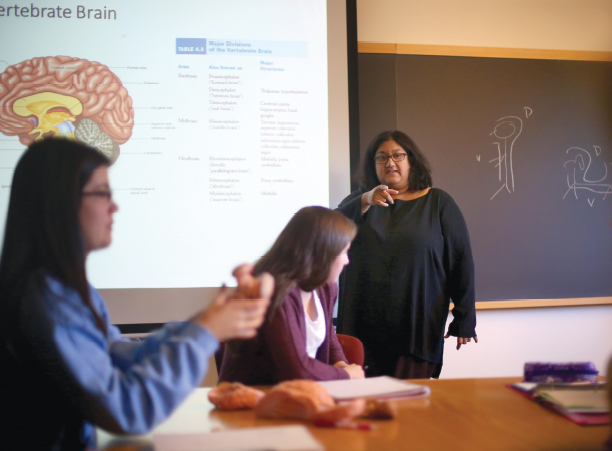
On the day HCM visited class, the power and magic of the human brain was on full display: both on the colorful slides Basu presented of neurons, but perhaps more importantly in the impressive performance from her students, who drew on previously studied material to think through complex novel problems masterfully thrown at them at lightning speed.
This particular “flipped” class asked students to show up having studied a video and animations of how DNA is transcribed to RNA and how RNA is translated to protein. After a warm-up in which Basu elicited input from students to create a chalkboard visual of the components of a chemical synapse, students were shown actual images of neurons taken by researchers.
Basu asked students to think through how these researchers would go about determining which neurons release serotonin from their presynaptic terminals. She encouraged students to brainstorm in small teams before working through ideas as a group. They followed this model to explore various complex questions.
Alumna Victoria Mousley ’17, a psychology and deaf studies double major, with a concentration in gender, sexuality, and women’s studies, who is pursuing a career in cognitive neuroscience, saw the benefit of the course’s integrative approach when auditing the class in 2016: “I never fully understood how physics, math, biology and chemistry could attack the same questions about the brain I was asking in psychology. By introducing students to STEM topics, this course allows beginners to understand neuroscience as the expansive subject it is. In doing so, students can decide what they like and don’t like about all the different levels of analysis.”
Basu’s hope is that this course will serve as that launching pad for students to determine how the sciences and the field of neuroscience may fit into their Holy Cross education. The course has already attracted diverse minds, including music and computer science majors, and Basu expects to see that trend continue — something the field of neuroscience could use.
“There are pressing social needs to do with neurological and neuropsychiatric disorders that are affecting an increasing proportion of the world’s population,” says Basu. “The study of neuroscience offers a perspective on life and human nature that seeks to integrate many different domains of human knowledge; it prompts us to ask very large questions about who we are and our relationship to the natural world. It motivates us to think and work in inventive ways that challenge traditional boundaries between disciplines, and it trains us to be integrative thinkers by virtue of the complexity of the problems.”