
 “Why are all the good ideas already taken?”
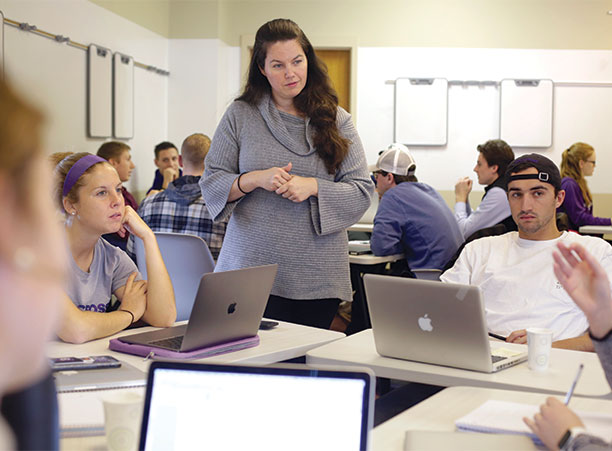
The rhetorical — and exasperated — question came from a senior during a three-minute brainstorm in which students in Holy Cross’ new Entrepreneurship course were asked to create a list of nagging everyday problems.
Broken up into smaller groups, the students dug into each other’s lists — which included everything from the difficulty of finding vegan food to the expensiveness of textbooks — doing quick Google searches to see whether another company had already run with the idea or building off each other to come up with something more unique.
“Find the connective tissue,” Ja-Naé Duane, entrepreneur-in-residence and the course’s lecturer, challenged the class. “What major themes or similar pain points do you see among your ideas?”
The collaborative exercise, a staple feature of this first-time course, aimed to parse out what larger topics students want to explore through entrepreneurial ventures that will serve as the semester’s culminating project. Exercises like these help the students connect areas that they are passionate about with the opportunity to turn it into a venture or even find a sustainable business model.
Overall, the course aims to give students a foundation to understand how and why businesses are started and the role that entrepreneurship and entrepreneurs play in today’s global economy. The course then dives deeper into the entrepreneurial mindset, challenging students to experience firsthand the steps involved in developing a successful business idea through the creation of their own.
Whether creating a product to help lacrosse players shoot more accurately or solving common issues faced while traveling, students learn to identify and anticipate the common challenges entrepreneurs experience and how to make decisions with incomplete information in environments characterized by rapid change and chronic resource scarcity.
Duane emphasizes that entrepreneurship, while complex, is a manageable process, and the lessons learned can be applied in virtually any organizational setting.
“A lot of the skills that students will learn throughout the semester are skills students will need within a larger corporation. The future of work and those skills are changing, so employees need to learn how to be flexible, to have lean thinking, and to know how to test their projects, hypotheses or campaigns so that they’re saving the company money, and they can be more efficient.”
Duane pushes students to start building these skills from day one.
“I run the class like I run a venture,” she says, giving students frequent opportunities for co-creation.
The course is also project-driven, allowing students to analyze successful and failed ventures from an academic perspective, while also participating in exercises, or “challenges,” that are more practical and application-based.
While there is no shortage of ideas in this course, Duane is more concerned with students walking away understanding entrepreneurship as a way of thinking and an attitude, dispelling the notion that entrepreneurship belongs exclusively to the business world.
“What political economist Schumpeter called ‘creative destruction’ is really the essence of entrepreneurship,” Duane says. “So, to me, to consider entrepreneurship just business is no longer valid.
“What isn’t clear to a lot of people is the connection between entrepreneurship and liberal arts,” she adds, explaining it came as no surprise that there was so much interest in the course, which drew students from a wide range of academic backgrounds.
“As someone with a fine arts background,” Duane shares, “it’s important to help students harness their creativity, the way they thoroughly think through the context of a problem and really look at all of the elements, not only just financial, but social, economic and the impact on the world. That 360-degree lens is the essence of any liberal arts education. This approach, reflected in entrepreneurship, helps students find where the connections are between their major, skills and the life that they want to lead.”