
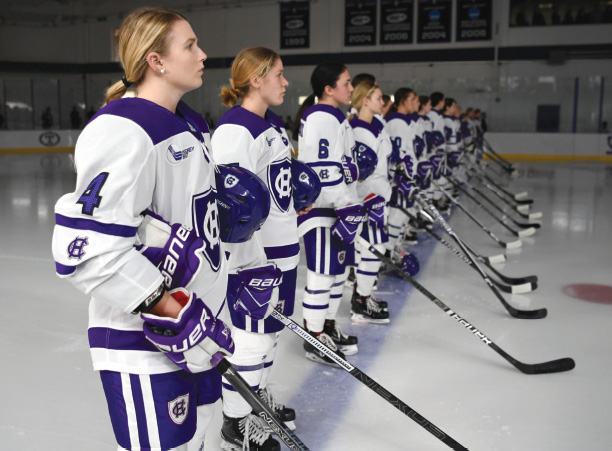
The newest members of hockey’s toughest conference prepare to take the ice at the team’s Hockey East home opener vs. Boston College in October. Photo courtesy of Holy Cross Athletics
Life is a lot different for head coach Peter Van Buskirk and the Holy Cross women’s ice hockey team this season. One day they’re facing the sixth-ranked team in the country, and the following week they’re right back at it, battling another top 10 squad filled with some of the nation’s best players.
It’s quite the change of pace for the team, one that just last year was playing in Division III. Now they’re a member of the toughest division in the sport: Hockey East.
The heralded 10-team conference is home to teams that regularly appear in the weekly national rankings. (Hockey East members include Northeastern University, Boston College, Merrimack College, Providence College, the University of Maine, the University of Connecticut, Boston University, the University of Vermont and the University of New Hampshire.) Last year, the Crusaders started the transition, playing a schedule that included a mix of Division I and non-Division I teams while increasing the number of games from its previous 27 to 32. This season, the team is slated to play a full 34-game Division I schedule.
The transition to Division I is a hallmark moment. “This move puts the team on the level of all other sports teams at Holy Cross,” Van Buskirk says. “This puts us at the top level of college hockey.”
According to Holy Cross Director of Athletics Nathan Pine, the move to Division I and Hockey East has been in the works for years. The process began with a look at the team’s options; Hockey East was an appealing choice based on the level of competition. Pine knew that having an association with the elite league would have numerous benefits for the program. “We wanted to elevate the women’s program and this was the first step,” he says.
The move was announced in 2016, and in order to become a member of the conference, the College had to meet a number of requirements, including increasing its scholarship limits, Van Buskirk says. Though the transition has been a lot of work, he notes it will pay off in a variety of ways, such as increased exposure, which will help with recruiting.