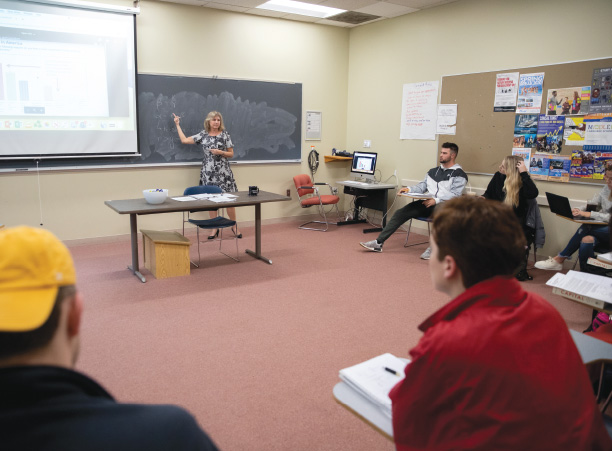
 “What is your opportunity cost of buying an iPhone?” Kolleen Rask, professor of economics, asks her class. “You wouldn’t be able to buy other products, right?”
In the case of this conversation, the term “opportunity cost” denotes the loss of potential gain from other alternatives when one option is chosen.
“What is the opportunity cost of a mother in Malawi buying diarrhea medicine for one of her children?” Murmurs make their way around the classroom. “Her other children won’t eat.”
That rhetorical question is just one of the many ways Rask is asking her students to think outside the box in her course, Economics of Inequality. The course, run for the first time last fall with 48 students in two sections, was Rask’s brainchild.
“I was looking for issues that I thought would be really interesting to students and we’ve been hearing a lot about inequality,” Rask says. “It’s been on my mind for a while, but I didn’t have a structured understanding of the issue. So, I’ve spent a lot of time over the past year looking into the research in inequality. I finally decided I could put together a course and try to make it work.”
Once word about the course spread around campus, other majors and concentrations felt it could suit their needs, as well. Now, with some expansion, the course also incorporates materials that are relevant to the international studies major and the peace and conflict studies concentration.
With a heavier-than-usual load of reading, Rask runs the course differently than many others at Holy Cross — she treats it like a graduate-level class. In addition to weekly readings, each student is responsible for writing a summary of two readings per semester. That way, Rask says, students have help reviewing readings.
The students, in turn, have taken the course and run with it.
“You don’t typically get this much opportunity for discussion in an economics course,” Rask says. “So for me, this has been really fun.”
For Darwin Contreras ’21, one of the biggest points that stuck is that there is so much more to inequality than just wealth disparity.
“Inequality is more intrinsic in our society than we thought because America is thought to be meritocratic,” he says. “In the course, we learned how much inequality actually undermines this meritocratic society we think we have created.”
The course has also allowed students to explore topics they’re passionate about.
“I’m particularly interested in diversity in the job market on a gender basis, and this class has allowed me to dive deeper into the economic, social and political dimensions of that,” says Bridget Alkin ’21. “And with the mix of economics and international studies majors in the class, the environment creates dialogue to learn from different perspectives.”
And for students like Alkin, the course has emphasized that economists can incite meaningful change.
It appears now that we are teaching Socialism, (“Economics of Inequality”) the students appear to have seamlessly moved toward its acceptance. Is not a discussion of Capitalism promoted as the current economic way of life in the USA and the Entrepeneurs it breeds creating business successes, capital growth which brings to most colleges, new dorms, science buildings, libraries, art galleries, museums etc. ??