‘Local Reaction on Replacement Refs’

Recently on Worcester News Tonight, Victor Matheson, associate professor of economics at the College of the Holy Cross, discussed the current National Football League referee contract dispute, and the potential negative effects of the lockout.

Matheson contends that if games continue to appear poorly officiated due to a lack of qualified referees, then fans might start to turn away, which would negatively impact the NFL’s bottom line. “People really aren’t excited about having games overturned because of referee decisions,” said Matheson, reflecting on the controversy surrounding the replacement officials.

Matheson acknowledged that officiating is a challenging task, and that reliable officials are necessary to the sport. “We’ve seen more and more that referee decisions are an important part of the game.”

Also in the segment, Holy Cross women’s swimming and diving coach Barry Parenteau speaks to his experience as a high school football official. Commenting on the quick pace of NFL games, he explained that referees must “make some quick decisions [that] could come back to haunt [them.]”

“I think that they have to settle this for the integrity of the game,” he continued.

This “Holy Cross in the News” item by David Cotrone ’13.

Posted in In The News, News | Comments Off on ‘Local Reaction on Replacement Refs’

Holy Cross Senior Wins Prize in International Organ Competition

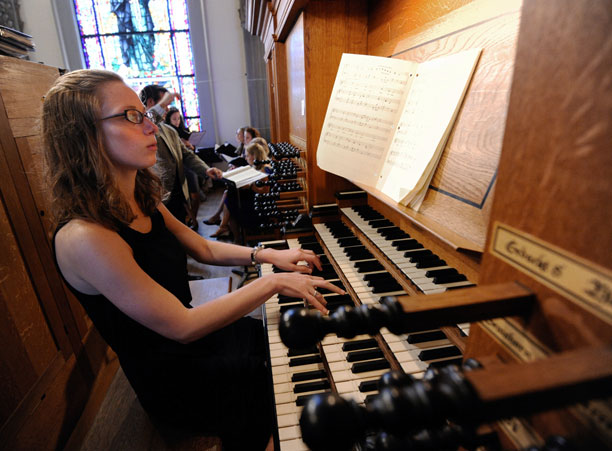
Holy Cross senior Jennifer McPherson has played in organ competitions before, but never at the international level. So when she won third prize in such a competition — along with the 1,000 euros that came along with it — McPherson was elated.

Selected from a round of 55 candidates and later nine finalists, McPherson traveled to Amsterdam to participate in the fourth Jan Pieterszoon Sweelinck Organ Competition at the Oude Kerk, the oldest stone building in the Dutch capital. The finalists competed before a jury consisting of accomplished musicians Piet Kee, Wilbert Hazelzet, Matteo Imbruno, Jos van der Kooy, Anton Pauw, Maurizio Salerno, and Henk Verhoef. At the conclusion of the four-day competition on Sept. 8, McPherson was awarded third prize.

The opportunity to play the organ at such a renowned competition was humbling, says McPherson.

“It was an incredible feeling. This was my first international competition, so I wasn’t sure what to expect,” she says. “I heard several really talented organists, a lot of wonderful music, and was honored to be a part of it.”

A music major from Eliot, Maine, McPherson was the only American selected to participate in the competition. Although the Oude Kerk organ is smaller than the Taylor and Boody Organ in St. Joseph Memorial Chapel at Holy Cross, McPherson felt her music “came alive” with the early music selections from Scheidemann, Schildt, Sweelinck, and Praetorius. “The organ in the Oude Kerk was a treat to play,” she says.

As the Organ Scholar for the class of 2013, McPherson is on a full tuition scholarship and plays the four manual, fifty-stop mechanical action pipe organ in St. Joseph Chapel. She assists the chapel music program and the College organist as needed.

McPherson has participated in American Guild of Organists Young Organist Competitions in Boston and New Jersey. At Holy Cross, she is involved in the Schola Cantorum, Peace Around the World and Coalition Against Human Trafficking.

McPherson credits James David Christie, distinguished artist in residence and College organist, for having the opportunity to develop her musical skills. “As organ scholar, I’ve been able to meet and work with so many incredible musicians, perform on some fabulous instruments, and travel to some pretty neat places,” she says. “I’m so grateful for this experience.”

Upon graduation, McPherson plans to continue her education in music with a focus on historical performance.

Related Information:

Posted in News | Comments Off on Holy Cross Senior Wins Prize in International Organ Competition

Video: Students Explore City of Worcester in Bus Tour

From the city’s musical venues to the plethora of restaurants lining Shrewsbury Street, Holy Cross students were pleasantly surprised at the many cultural offerings they discovered during a bus tour of Worcester.

The Colleges of Worcester Consortium and Worcester Regional Transit Authority teamed up to showcase the city to Holy Cross students recently. The Telegram & Gazette tagged along to capture reactions by students.

Related Information:

Posted in In The News, News | Comments Off on Video: Students Explore City of Worcester in Bus Tour

Curators of Groundbreaking Exhibit, Featuring Work of Artists with Disabilities, to Speak At Holy Cross

Dan Miller

The College of the Holy Cross will host the curators of the groundbreaking exhibit “Create,” currently on display in the Iris and B. Gerald Cantor Art Gallery, for a talk on Wednesday, Oct. 3 from 5 – 6 p.m. at the Hogan Campus Center, Room 519.  Lawrence Rinder, director of the University of California’s Berkeley Art Museum/Pacific Film Archive, and Matthew Higgs, director of White Columns in New York City, will offer their curatorial perspective on the work featured in the exhibit, which was created by artists with developmental disabilities.
 
“Create” showcases 20 artists, whose work in a variety of mediums and styles, celebrates artistic achievement that has flourished in three pioneering art centers in the San Francisco Bay Area: Creative Growth Art Center in Oakland, San Francisco’s Creativity Explored, and the National Institute for Art and Disability (NIAD) Art Center in Richmond. The exhibit runs now through Oct. 6 and Oct. 22 – Dec. 8, 2012.

Rinder is the director of the University of California Art Museum and Pacific Film Archive. He has held positions at the Museum of Modern Art, Walker Art Center, and the Whitney Museum of American Art where he was chief curator of the 2002 Biennial. Among the other exhibitions he has organized are “In a Different Light” (curated with Nayland Blake), “Bitstreams,” “The American Effect,” and “Tim Hawkinson.” He was the founding director of the CCA Wattis Institute for Contemporary Arts in San Francisco, where he also served as Dean of the College. His work has been published in numerous art magazines and journals including Artforum, The Village Voice, Fillip, and Atlantica; a collection of his essays were published by Gregory R. Miller in 2005.  He has also published poetry, fiction, and a play, co-authored with Kevin Killian.

Higgs is the director/chief curator of White Columns, New York’s oldest alternative art space, founded in 1970. From 2001-04 he was curator at the CCA Wattis Institute for Contemporary Arts in San Francisco. Prior to his position at the Wattis Institute, he was an associate director of exhibitions at the ICA, in London. Since 1992, Higgs has organized more than 200 exhibitions and projects with artists. He has contributed essays and interviews to more than 50 publications and art magazines including Artforum, Frieze, Art Monthly and Afterall. He was the recipient of the 2011 ICI Agnes Gund Award.

The Cantor Art Gallery will remain open following the presentation by Rinder and Higgs until 7:30 p.m. for viewing the “Create” exhibition.
Gallery Information

Founded in 1983 through the generosity of Iris & B. Gerald Cantor, the Cantor Art Gallery serves both as a venue for a changing series of historical and contemporary public exhibitions, as well as a vital resource for Holy Cross faculty and students, linking exhibitions to the broader liberal arts curriculum. 

The hours for the Cantor Art Gallery are Monday – Friday, 10 a.m. – 5 p.m. and Saturdays and Sundays 2 – 5 p.m. Located in O’Kane Hall, 1st Floor, College of the Holy Cross, 1 College Street, Worcester, Mass., 01610.  Admission to the gallery is free. 

For additional information please call 508-793-3356 or visit the Gallery’s website.

Related Information

Posted in News, Press Release | Comments Off on Curators of Groundbreaking Exhibit, Featuring Work of Artists with Disabilities, to Speak At Holy Cross

Could This Be the End of Affirmative Action at Holy Cross?

In October 2012, the Supreme Court of the United States will hear arguments on Fisher v. University of Texas at Austin, a case that challenges the constitutionality of race-based affirmative action in admissions programs at public colleges and universities. Many at the College of the Holy Cross, and other public and private institutions around the country, are watching this case closely for the possible repercussions it could have on the future of affirmative action plans at all higher education institutions. If the ruling opinion is to end affirmative action at public institutions, it could quickly ripple to encompass any private institution, such as Holy Cross, that accepts federal funds.

Holy Cross has a celebrated history of recruiting a diverse student body, and the College filed an amicus brief in the case with seven other Catholic colleges and universities. The brief argues that the Supreme Court has long upheld academic freedom, and the institutions’ admissions policies should be protected by the First Amendment.

The College, its students, and its alumni have a stake in this. One way or another, the end of affirmative action would change life on campus. So this fall, the College’s Rev. Michael C. McFarland, S.J. Center for Religion, Ethics and Culture, tasked with probing these difficult, ethical issues in public forums, is taking on the topic of affirmative action and its value at Holy Cross.

Add your voice to the discussion.

On Sept. 17, Harvard Law Professor Randall Kennedy gave a public lecture here on “The Supreme Court and Affirmative Action.” In his talk, he highlighted key decisions in race-based affirmative action in higher education over the last 34 years. He offered a prediction of Supreme Court’s ruling in Fisher v. University of Texas at Austin. And he laid out his own case defending race-based affirmative action as a form of restorative justice to historically disadvantaged populations.

Watch Prof. Kennedy’s lecture online here.

With that background, the McFarland Center now poses the question to its constituents, students, alumni, faculty, and staff: Does affirmative action help or hinder us in becoming a more just society?

A “fishbowl” discussion will take place on Monday, Oct. 1 at 4:30 p.m. in the Rehm Library. During the fishbowl, a small group of faculty, students and alumni seated in an inner circle will discuss the topic, before opening up the floor for questions and comments by the audience seated in an outer circle. Featured participants will include Margaret Freije, associate dean of the College; Kendy Hess, Brake-Smith Assistant Professor in Social Philosophy and Ethics; Darrell Byers ’83, director of development at WBUR; and students Patricia Giglio ’14, Ariel Jimenez ’13, Christopher Theobalt ’13 and Antonio Willis-Berry ’13.

All are welcome to attend the fishbowl. The event also will be recorded and available for online viewing in the days leading up to and following the Supreme Court proceedings. Submit your comments online to help us continue a meaningful dialogue on the future of affirmative action at Holy Cross.

Related Information:

Posted in News, Videos | 1 Comment

Presidential Election Experts Available at Holy Cross to Discuss Candidates, Domestic and Foreign Issues

Faculty experts in a wide range of disciplines from the College of the Holy Cross are available to offer distinctive perspectives on some of the hot-button political issues of the 2012 presidential and Congressional campaigns.  For more information, or for assistance scheduling an interview, please call Kristine Maloney or Cristal Steuer at 508-793-2419. Experts listed below may also be contacted for comment directly. 


2012 election issues
David Schaefer, professor of political science
508-793-2252 (office), dschaefe@holycross.edu

Schaefer, whose scholarly research and analysis focuses on American political thought, can provide expert commentary on a multitude of issues related to the election including political parties, religion and politics, young voters, foreign policy, campaign spending, campaign rhetoric, economic inequality, Congressional elections, and the presidency.

Presidential campaigns, Congressional elections
Donald Brand, professor of political science
508-793-3402 (office), dbrand@holycross.edu

Brand specializes in the study of the presidency and American politics. Available to provide pre- and post-presidential debate and election analysis, he can also address critical Congressional races, including the closely watched Massachusetts senate race. 

Foreign policy, wartime campaigns
Jerry Lembcke, associate professor of sociology
508-793-3050 (office), jlembcke@holycross.edu

A Vietnam veteran who has written and commented extensively on the Vietnam War and its impact on U.S. politics today, Lembcke can discuss candidates’ positions on foreign policy as well as the history of wartime campaigns.

Foreign policy; national security
Ward Thomas, professor of political science
508-793-3445 (office), wthomas@holycross.edu

An expert in international relations, national security, and terrorism, Thomas can provide insight on the candidates’ approaches to foreign policy; the impact of Osama Bin Laden’s and Moammar Gadhafi’s deaths on Obama’s campaign; international law as it pertains to war; international ethics, the wars in Iraq and Afghanistan; and terrorism. 

Domestic issues, history of presidential elections
Edward O’Donnell, associate professor of history
508-793-3730 (office), eodonnell@holycross.edu

A frequent media commentator, O’Donnell can discuss domestic issues such as economic inequality (and the history of the 1% vs. 99% theme) and immigration, as well as pivotal elections in American history and the role of religion in a candidate’s electability.

Racial/ethnic politics
Melissa Weiner, assistant professor of sociology
508-793-2217 (office), mfweiner@holycross.edu

A sociologist with expertise in race and racial inequalities, Weiner has been involved in a number of grassroots political campaigns and can discuss racial and ethnic voting behaviors, voter suppression, and racially coded language in campaign advertising.

Campaign rhetoric
Patricia Bizzell, professor of English
508-791-6879 (office), pbizzell@holycross.edu

Available to comment on campaign rhetoric, Bizzell is former president of the Rhetoric Society of America and serves on the editorial board of Voices of Democracy: The U. S. Oratory Project which, among other things, presents interpretive essays and teaching apparatus for important speeches in American history.  In addition, she has published works focused on rhetorical agendas in politics. 

Religion and politics; Mormonism, Catholicism
Mathew Schmalz, associate professor of religious studies
508-793-2557 (office), mschmalz@holycross.edu

A regular contributor to the Washington Post’s On Faith blog and highly sought after media expert, Schmalz has written and commented extensively on the role of religion (particularly Catholicism and Mormonism) in both the 2008 and 2012 presidential races.  A recent post for On Faith focused on the role of Cardinal Timothy Dolan in both the democratic and republican national conventions.

Religion and politics; Catholicism
Thomas Landy, director, Rev. Michael C. McFarland, S.J. Center for Religion, Ethics and Culture
508-793-3723 (office), tlandy@holycross.edu

A sociologist with expertise in religion and politics (particularly Catholicism), Landy is available to comment on the role of religion in the election.  As director of the College’s McFarland Center, he frequently organizes conferences and lectures that address critical campaign issues like health care, economic inequality, foreign policy and global social justice within the context of various religious traditions.

Posted in News, Press Release, Religious Studies | Comments Off on Presidential Election Experts Available at Holy Cross to Discuss Candidates, Domestic and Foreign Issues

College to Celebrate Life and Work of Late Prof. Joanna Ziegler

Joanna Ziegler

Harold Roth, professor of East Asian studies and director of the Contemplative Studies Initiative at Brown University, will give a talk titled “Contemplative Studies and the Liberal Arts,” on Thursday, Oct. 18 at 4 p.m. in the Rehm Library at the College of the Holy Cross. The event, which is free and open to the public, is the inaugural “Seeing, Thinking, and Living,” lecture which honors the late visual arts professor Joanna “Jody” Ziegler.

Ziegler, was a faculty member at Holy Cross from 1982 until 2010, when she passed away from illness.   Well-known for her commitment to students and for mentoring them as their graduate studies and careers progressed, she was the recipient of the College’s Distinguished Teacher of the Year Award, and the Arthur J. O’Leary Faculty Recognition Award, which is given to senior faculty members who make a special contribution to the College through their teaching, scholarship and service.

“Jody Ziegler’s commitment to her students and colleagues during her 29 years at the College, will live on in the minds and hearts of many,” shares Gary DeAngelis, associate director of the Center for Interdisciplinary and Special Studies (CISS) and organizer of the lecture. “This annual event is one small way to continue her presence at the College.”

She was the College’s first Edward A. O’Rorke Professor in the Liberal Arts, received multiple grants to support her work on ethics and contemplative practice, and was a leader in introducing reflective habits into art history classes and the wider curriculum. A specialist in late medieval and early modern religious art and architecture, she lectured throughout the United States and Europe.

Roth is a specialist in early Chinese religious thought, Taoism, the history of East Asian religions, the comparative study of mysticism and a pioneer in the developing field of contemplative studies. His publications include five books and more than three dozen articles on the early history and religious thought of the Taoist tradition and on the textual history and textual criticism of classical Chinese works, and on contemplative studies.

He is the recipient of numerous grants and fellowships from the American Council of Learned Societies, The National Endowment for the Humanities, and the Chiang Ching-kuo Foundation For International Scholarly Exchange. He also was awarded a Wriston Fellowship for Teaching Excellence from Brown University.

The event is sponsored by CISS, the Rev. Michael C. McFarland, S.J. Center for Religion, Ethics and Culture, and the visual arts department.

Posted in News, Press Release | Comments Off on College to Celebrate Life and Work of Late Prof. Joanna Ziegler

‘Pope Benedict: From Regensburg to Beirut’

In his most recent opinion piece on the Washington Post’s On Faith blog, Mathew Schmalz, associate professor of religious studies at the College of the Holy Cross, reflected on Pope Benedict XVI’s recent homily in Beirut, Lebanon, and how it compared to a similar speech he made in Regensburg, Germany, in 2006. Specifically, Schmalz highlighted the similarities between the two speeches, as both considered the relationships between faith, reason, and violence, especially in relation to Islam and Christianity. While the content of the pope’s speech was controversial in Germany, Schmalz states it fit the social context of Lebanon.

“In Beirut as in Regensburg, Benedict emphasized how the way we think about God has implications for how we act,” he wrote. “The belief that God became incarnate as a suffering servant calls Christians to a particular kind of action in the world.”

Further explaining how Benedict urges Christians to act as generous servants to others, “But acts of service, of peacemaking, are not performed by Christians only for other Christians in some sort of sectarian or exclusivist way,” Schmalz continued.

Because Lebanon is rife with conflict between Christians and Muslims, Schmalz expressed that Benedict’s most recent remarks were not only potent, but also necessary. “Benedict expressed his hope that Christians and Muslims can be servants and peacemakers not just to and for themselves but to and for each other,” he wrote.

Notably, on Sept. 21, Pope Benedict XVI tweeted Schmalz’ column to his 14,500 followers.

This “Holy Cross in the News” item by David Cotrone ’13.

Posted in In The News | Comments Off on ‘Pope Benedict: From Regensburg to Beirut’

Poet and Nonfiction Writer Christopher Merrill to Give Talk on Vocation of the Writer

Christopher Merrill

Christopher Merrill, author and former William H. Jenks Chair in American Letters at the College of the Holy Cross, will give a talk as part of the Working Writers Series on Thursday, Oct. 4 at 7:30 p.m. in the College’s Rehm Library. The event, which is sponsored by both the Creative Writing Program and the McFarland Center for Religion, Ethics, and Culture, is free and open to the public.

Merill is the author of four collections of poetry and five books of nonfiction, including “Watch Fire” (White Pine Press, 1995), “Only the Nails Remain: Scenes form the Balkan Wars” (Rowman & Littlefield Publishers, 2001), “Things of the Hidden God: Journey to the Holy Mountain” (Random House, 2005), and, most recently, “The Tree of the Doves: Ceremony, Expedition, War” (Milkweed Editions, 2011).

“The Tree  of the Doves,” which chronicles Merrill’s travels in Malaysia, China, Mongolia and the Middle East in the wake of terror, has been described as “A unique travelogue boosted by wonderfully creative thinking with a political slant” by Kirkus Reviews, while “Only the Nails Remain” has been hailed as “a modern classic” by Publishers Weekly.

Merrill, who currently directs the International Writing Program at the University of Iowa, is a member of the U.S. national Commission for UNESCO, and has received a knighthood in arts and letters from the French government. Celebrated widely, his writings have been translated into 25 languages.

Merrill lives in Iowa City with his wife and two daughters. Appointed to the National Council on Humanities by President Obama in April 2012, Merrill’s talk at Holy Cross will consider the vocation of the writer, as well as the importance of craft in one’s life.

Posted in News, Press Release | Comments Off on Poet and Nonfiction Writer Christopher Merrill to Give Talk on Vocation of the Writer

‘Love Stories’

In a recent issue of the New York Times Sunday Book Review, Leah Hager Cohen, the W.H. Jenks Chair in Contemporary American Letters at the College of the Holy Cross, reviewed Junot Diaz’s most recent collection of short stories, “This Is How You Lose Her.”

In her review, Cohen praises Diaz’s strong voice. “Junot Díaz writes in an idiom so electrifying and distinct it’s practically an act of aggression, at once alarming and enthralling, even erotic in its assertion of sudden intimacy,” she says. “His prose style is so irresistible, so sheerly entertaining,” she continues.

Cohen continues her examination of “This Is How You Loser Her” by noting that although the collection is billed as a book of love stories, Diaz is strongest when he writes about the complexity of human nature. “Diaz is most affecting when he’s writing about the inescapable undertow of family history and cultural mores, about the endless difficulty of loving oneself,” Cohen explains.

“Or maybe Díaz means to suggest that it’s human nature to be divided against ourselves, that we are all on some level conflicted, displaced creatures, making our way within the diaspora of the human heart.”

This ‘Holy Cross In the News” item by David Cotrone ’13.

Posted in In The News | Comments Off on ‘Love Stories’

‘Jesus’ marital status needs more study’

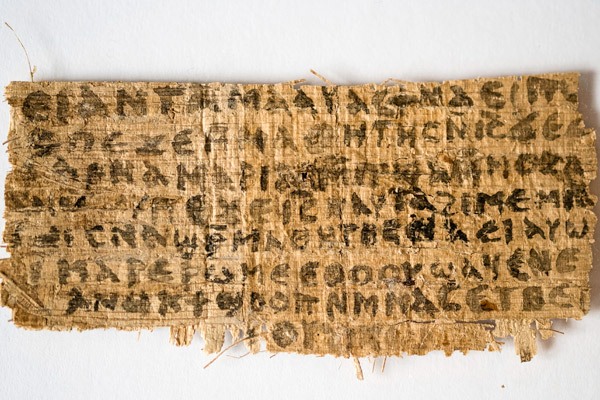
In Telegram & Gazette article, Virginia C. Raguin, professor of art history at the College of the Holy Cross, and Alice Laffey, associate professor of religious studies, were called upon to comment on the recently found papyrus that implies Jesus had a wife.

“This is a fascinating find,” said Raguin. “But there are a lot of questions that need to be answered before one can definitely say that Jesus was married.”

Equally cautious about the claims in the papyrus, Laffey suggested that although the document might be authentic, the term “wife” is likely to have a number of different meanings.


This “Holy Cross in the News” item by David Cotrone ’13.

Posted in In The News, News | Comments Off on ‘Jesus’ marital status needs more study’

Abuse of Children in Ireland Subject of Theatre Performance at Holy Cross

JamesX

Irish playwright, actor and politician Gerard Mannix Flynn will give a special performance of “James X,” his one-man play recounting the experience of children abused by church and civil authorities in Ireland, on Thursday, Sept. 27 at 7 p.m. in The Pit, a black box theater located in the basement of O’Kane Hall. The performance, sponsored by the College’s Rev. Michael C. McFarland, S.J. Center for Religion, Ethics and Culture, is free and open to the public.

“James X” is the story of a middle-aged man called to testify before an Irish government tribunal of inquiry into institutions responsible for cruel and inhumane treatment of children. The fictional James spent the bulk of his childhood being abused by every state-sponsored, often Roman Catholic-run institution to which he was sent. As he waits in the court foyer to give his testimony, he realizes he will face the same system of government responsible for his abuse, and he tells his horrific story for the first time.

Flynn himself was a victim of abuse at a church-run industrial school in Letterfrack, Ireland. Flynn said his character James X is an amalgam of real boys who experienced neglect, bone-breaking corporal punishment, and molestation at that school and other Irish institutions.

“James X” has been performed in Ireland, as part of The Culture Project in New York City last December, and at the University of California at Berkeley in March. The performance was directed by well-known Irish actor Gabriel Byrne. It is produced by Flynn’s Farcry Productions.

Flynn’s other works include a 1983 novel, “Nothing to Say;” the plays “Inside,” “Hunger and Thirst,” and “Talking to the Wall’;” and a screenplay based on “Nothing to Say” titled “Alma Mater.” He was elected to the Dublin City Council in 2009.

Following the performance, which runs one hour and 20 minutes, there will be a question and answer session.

To learn more about McFarland Center events and to find lectures online, visit www.holycross.edu/mcfarlandcenter.

About the Rev. Michael C. McFarland, S.J. Center for Religion, Ethics and Culture:

Established in 2001 and housed in Smith Hall, the McFarland Center for Religion, Ethics and Culture provides resources for faculty and course development, sponsors conferences and college-wide teaching events, hosts visiting fellows, and coordinates a number of campus lecture series. Rooted in the College’s commitment to invite conversation about basic human questions, the Center welcomes persons of all faiths and seeks to foster dialogue that acknowledges and respects differences, providing a forum for intellectual exchange that is interreligious, interdisciplinary, intercultural, and international in scope.  The Center also brings members of the Holy Cross community into conversation with the Greater Worcester community, the academic community, and

Posted in News, Press Release | Comments Off on Abuse of Children in Ireland Subject of Theatre Performance at Holy Cross

‘Helping Students to Tell Their Stories’

In an article in The Chronicle of Higher Education, Anthony B. Cashman, director of the Office of Distinguished Fellowships and Graduate Studies at the College of the Holy Cross, was called upon to offer advice on writing effective personal essays for graduate-school applications and for fellowships.

Sought out because of the high number of Fulbright scholarships awarded to Holy Cross students during his four-year tenure (30), Cashman warned against the tendency to write a personal essay that includes a laundry list of accomplishments. Cashman advised students to focus instead on only a few key details. “Think of the application from the selection committee’s point of view,” he said. “[The] job of the writer is to focus the readers on those elements that best relate to the opportunity at hand.”

Cashman provided several more pieces of advice on how to craft a successful statement, stressing that students should carefully “articulate a vision of their future.”

“In essence, the applicant needs to demonstrate that the school or fellowship will meet the individual’s needs in the short and long term…[T]he selection committee will take the person or people whom they can best help with their opportunities,” he continued.

This “Holy Cross in the News” item by David Cotrone ’13.

Posted in In The News | Comments Off on ‘Helping Students to Tell Their Stories’

Holy Cross Celebrates 40th Anniversary of Coeducation

Opening Doors

The College of the Holy Cross is delighted to announce that the 40th anniversary of coeducation at the College will be subject of a series of events throughout the 2012-13 academic year.

Students, faculty, and staff will have extensive opportunities during the year to reflect on, acknowledge, and commemorate the moment in 1972 when the College opened its doors to women students for the first time.

“In addition to recognizing an important chapter in our history, our aim during the year ahead is to recognize women who are shaping Holy Cross today and tomorrow.   That’s why the ‘Opening Doors’ theme is so important,” explains Jacqueline Peterson, vice president of student affairs and dean of students, who chairs the coordinating committee organizing anniversary events. “We know there are still more doors to open, even as we celebrate the achievements of women who have crossed new thresholds while engaging in the life of the College and the wider world.”

The yearlong series of events kicks off today, Thursday, Sept. 20 at 4:30 p.m. in Rehm Library, with alumna Rebecca Rourke Edwards ’90, author and associate professor of history at Rochester Institute of Technology, who will deliver the lecture “Seeing the Signs: Doing Deaf History at Holy Cross and Beyond.”

Then, on Saturday, Sept. 22, during Homecoming events, returning alumni and alumnae have the opportunity to tell their stories as part of an ongoing oral history project on coeducation at Holy Cross.  (Members of the Holy Cross Community with stories to share are also welcome to participate.  Stop by Hogan One, near Cool Beans, between 10 a.m. and 1 p.m. on Saturday.  No appointment necessary.)

Upcoming events:

  • The Ciocca Office of Entrepreneurial Studies annual Women in Business Conference on Oct. 20.
  • Kathleen Cain ’81 will give a talk titled “Growing up Muslim in Post-9/11 America: Identity and Well-Being in American Muslim teenagers,” on Oct. 29 at 4 p.m. in Rehm Library.
  • Fenwick Theatre’s fall production (Nov. 1-3, 8-10) will be Sophie Treadwell’s “Machinal” (1927), directed by Edward Isser of the theatre department, and considered by many critics to be one of the first great feminist dramas of the 20th century.
  • The sociology and anthropology department and women and gender studies program will host a fishbowl discussion about feminist identity at Holy Cross on Monday, Nov. 5 at 4 p.m. in the Levis Browsing Room in Dinand Library. Jen Fraser ’09, will briefly summarize her award-winning senior thesis research titled “CEOs and Secretary Ho’s? Exploring Feminist Identity and Culture at Holy Cross.”
  • Career planning will host an event titled “Knowledge is Power: A Workshop for Female Athletes,” on Nov. 5 at 6:30 p.m. in Hogan Room 408.  The panel is an opportunity for current students to learn from alumnae and former student athletes about how to transfer worth ethic, competitive mind set, and fiery determination, from the field to the office.
  • THIS EVENT HAS BEEN POSTPONED: The alumni relations office will host a panel discussion and reception for alumnae at the Time & Life Building in New York City on Thursday, Nov. 8 from 6:30-8:30 p.m. The panel discussion will be moderated by President Rev. Philip L. Boroughs, S.J., and panelists include Donna Winn ’76, member of the Holy Cross Board of Trustees; Theresa McBride, Holy Cross professor of history since 1973; and Stephanie Montilla ’13. Register online
  • The economics department will host a panel discussion on the ethics of evaluating women’s progress and work/life balance on Feb. 13 at 7:30 p.m. in Rehm Library. Featured panelist Anne-Marie Slaughter, the Bert G. Kerstetter ’66 University Professor of Politics and International Affairs at Princeton University, will give a talk titled “Measuring Success: Women, Work and Family in the 21st Century.”  Other panelists include Sheila Cavanaugh ’81, consultant and former senior vice president of Fidelity Investments, the largest mutual fund company in the United States; and Megan Fox-Kelly ’99, assistant chaplain and director of retreats at Holy Cross.
  • The visual arts department on campus is sponsoring several events. The Cantor Art Gallery will host an exhibition of women’s textiles titled “Transnational Ikat,” from Jan. 24 to March 1. A reunion of graduates, “Muses on the Mount,” from March 22 to 24, will offer a broad spectrum of events featuring professionals in collecting, arts management, exhibiting, and education.  In conjunction with this program, the Cantor Gallery will hold an exhibition of art, “SPARK,” from March 14 to April 12 featuring the work of eight alumnae.
  • The Office of College Chaplains will provide opportunities for the community to reflect on the impact of the ministry of women at Holy Cross.
  • During Winter Homecoming on Feb. 16, former coaches and athletes will be invited by current coaches and athletes to discuss the rise of women’s sports at Holy Cross.
  • This anniversary, which coincides with the 45th anniversary of the founding of the Black Student Union on campus, will provide us with opportunities to honor women of color throughout Holy Cross history.
  • Archives presents two displays currently on view in Dinand Library’s Main Reading Room: “And Then Came Women,” which provides a pictorial history of the beginnings of coeducation at Holy Cross, and “In Their Own Words,” which pairs photographs of College community members with their thoughts on coeducation.
  • Plus, many more lectures, conferences, exhibitions, and other opportunities.

Members of 40th Anniversary of Coeducation Coordinating Committee include:

Nancy Andrews, classics
David Chu, Ciocca entrepreneurial studies
Kristyn Dyer ’94, alumni relations
Ruth Ann Elias ’76, president’s office
Marybeth Kearns-Barrett ’84, chaplains’ office
Shawn Maurer, English
Theresa McBride, history
Mable Millner, student affairs
Ellen Ryder, public affairs
Jacqueline Peterson, student affairs
Helen Whall, English
Amy Wolfson, psychology, dean’s office
Donna Wrenn, human resources
Ann Zelesky, athletics

Posted in News | Comments Off on Holy Cross Celebrates 40th Anniversary of Coeducation

Holy Cross Sophomore Raises $16,000 for DEAF, Inc.

Batt and Sullivan

Ever since her middle school jazz band played a concert at the Rhode Island School for the Deaf, Nina Batt ’15 has been interested in deaf culture and American Sign Language.

Now, as a sophomore at the College of the Holy Cross, Batt is an English major, a member of the Teacher Education Program, and is hoping to incorporate her deaf studies classes into a major or minor.

After participating in deaf studies courses at the College, Batt interned this past summer at DEAF, Inc., a non-profit organization that encourages and empowers deaf, hard of hearing, deaf-blind and late-deafened individuals to lead productive lives. “For my internship,” Batt explains, “I got a taste of everything there was to do in the New Bedford regional office.”

After answering the voice telephone and the video phone (akin to Skype), maintaining facilities, and building relationships with consumers, she decided to take her commitment to the next level by running a half-marathon in DEAF, Inc.’s name. “I had been toying with the idea of running a half-marathon for a few months,” she says.

Since the race took place in Vancouver, a city with close family ties, her family decided to pack their bags in order to enjoy a vacation. But even though she was on break, Batt worked harder than ever. While training for the run, she and her mother sent out pledge letters to friends, family, colleagues, and the Holy Cross women’s field hockey team (she was a member of the team during the  2011-12 season), and together they raised $16,000 in donations. Regarding her sincere commitment to DEAF, Inc., Batt explains that she “wanted to make a difference for the people who were so willing to educate [her].” Notably, Batt ran alongside family friend and Holy Cross alumna Sue Sullivan, who graduated in 1985.

Now back in the swing of life on the Hill, Batt participates in Big Brother Big Sister, the American Sign Language Club, community service and theatre, as she is currently rehearsing for the department’s production of “Machinal,” which is set to hit the Fenwick stage in November. Already looking toward the future, she plans to pursue a master’s degree in deaf education so that she can teach English literature to deaf students. Without a doubt, Batt’s future is bright.  As Heather Johnson, director of the Teacher Education Program at Holy Cross, states, she is both an “enthusiastic” and “delightful,” student, and associate professor and chair of the department Erika Fischer describes her as “remarkable.”

Reflecting on her time at Holy Cross thus far, Batt says that she “takes the mission here seriously,” and that she is “thankful to have met members of the community who are so generous, selfless, and willing to help [her] become a true woman for others.”

Posted in Deaf Studies and Sign Languages, Education, English, News | Comments Off on Holy Cross Sophomore Raises $16,000 for DEAF, Inc.

Fourteen Holy Cross Graduates Join Teach For America

For the fourth year in a row, Holy Cross is a top contributor to Teach For America, a nonprofit organization that sends graduating seniors into classrooms across the nation. With 14 members of the class of 2012 having recently joined the program, the College ranks ninth among small colleges and universities.

Founded in 1990, Teach For America is a corps of outstanding students who pledge to teach for two years in under-resourced schools with the hopes that they will become leaders of educational equality in the future. This year, the corps is comprised of a record-breaking 10,000 members teaching in 46 urban and rural areas nationwide.

Admission to Teach For America is highly selective, as the organization recruits on more than 600 campuses, seeking student leaders from diverse academic backgrounds.

According to Amy Murphy, director of the College’s Career Planning Center, Teach for America is the leading employer for recent Holy Cross graduates. “Holy Cross students are very interested in being agents for change in their communities, in our country and in the world, which is one of the reasons they are drawn to this kind of work,” she says.

“At Holy Cross, our students are challenged to identify where their gifts, talents and passions can be in service to others. The College challenges them to develop their own concept of how to live that out,” she continues.

In Teach For America’s history of 21 years, more than 140 Holy Cross alumni have joined the corps.

Posted in News, Press Release | Comments Off on Fourteen Holy Cross Graduates Join Teach For America

Several Holy Cross Community Members to be Honored by Boys & Girls Club

Gordie Lockbaum

A number of athletes and coaches with Holy Cross ties will be honored by the Boys & Girls Club of Worcester at its Celebrity Sports Nite, to be held on Wednesday, Sept. 26, at 6 p.m. at the Wachusett Country Club in West Boylston. The event will recognize a whole range of current and former Central Mass. sports stars who continue to give back to the community.

Honorees from Holy Cross include former two-way football star and Heisman Trophy candidate Gordie Lockbaum; basketball and baseball greats Ron Perry Sr. and Ron Perry Jr.; and associate athletic director Ann Zelesky.

Posted in News | Comments Off on Several Holy Cross Community Members to be Honored by Boys & Girls Club

Inauguration: Video of Inauguration of the President

Posted in News, Videos | Tagged , , | Comments Off on Inauguration: Video of Inauguration of the President

Inauguration: Video of Presidential Address

By Rev. Philip L. Boroughs, S.J., president
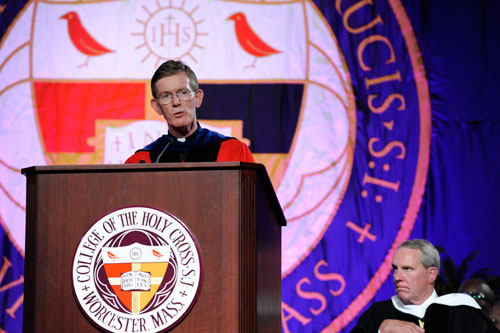
Honored guests, esteemed colleagues, beloved family and friends, brother Jesuits:

On this Feast of the Exaltation of the Holy Cross, when we celebrate the triumph of life-giving love, our extended College community gathers with government officials and Church dignitaries; academic representatives and Worcester neighbors; and many of my far-flung family and friends on picturesque Mt. St. James; where in medieval caps and gowns, with festive music and banners, academic procession and formal speeches, this assembly offers welcome and celebrates commitment as we look toward our institutional future.  I am humbled and grateful for the affirmation of our Board of Trustees who have called to me to leadership, for the enthusiasm of our students and alumni who celebrate the transformative power of a Jesuit education, for the professionalism and commitment of our faculty on whom is built our institutional reputation, and for the kindness and generosity of our staff who sustain our quality of life.

Ultimately, I am here today because of the Society of Jesus, which initially educated me and then lovingly welcomed me into this apostolic brotherhood, and has formed and sustained me over the past 45 years.  Building on the values and blessings of my family, my brother Jesuits have helped me to discern the meaning and purpose of my life and have given me a distinctive way of living and serving the world within a community captured by the spirituality of Ignatius of Loyola.   This spirituality is poignantly incarnational, in that it finds signs of the presence of God in the created world, in human community and within the human heart.  It is grounded in the divine invitation to enter into an intimate and liberating relationship with God in Jesus, blessed by the Spirit.  This relationship progressively calls Jesuits and our colleagues to identify and surrender those perspectives, assumptions, and attachments which limit our imagination and freedom; and increasingly this relationship with the divine leads us to greater awareness of the beauty and possibilities of life and thought, the challenges and inequities of the world, and the importance of discerned service for justice and the common good.  This grounding in the seen and unseen is why those of us who embrace this spiritual tradition are often referred to as “contemplatives in action,” men and women who treasure silence and listening, weighing and discerning, noticing the stirrings of mind and heart in the midst of the needs of the world, and then responding passionately and generously.

In Professor Robert Cording’s moving poem, “The Weeper,” which we have just heard, the final sentence about St. Ignatius is hauntingly powerful:

He wept, they say, because he’d suddenly feel
Entirely empty, and utterly grateful, all the doors
Of his heart, which was and was not his
At these moments, and which we know
Only as metaphor, swung wide open, able now
To receive and find room for all the world’s
Orphaned outpourings and astonishments.

It was Ignatius’ inner freedom to surrender himself completely to God and to detach from all those limiting self-understandings and compulsions which had earlier dominated his life, which allowed him to rest in radical emptiness and graced gratitude.  In his emptiness, he could relinquish his concerns and preoccupations, he could stand before the power of the Transcendent, and he could open his mind and heart to receive what was being given.  It was in fact this freedom to be empty before God which allowed him to see and hear and feel and taste what Professor Cording tenderly describes as the  “the world’s orphaned outpourings and astonishments.”   In these moments of contemplative attention his heart and mind were opened; he would marvel at the beauty and possibility of creation and, in gratitude, he longed to serve those whom his gracious God loved so much.  In an increasingly complex and fragmented world seeking new self-understanding, Ignatius saw great need and suffering, but he also saw the hand of God at work in a world of new integrating possibilities.

For Ignatius, the signs of his times pointed to the rise of City States and new political alliances; to ongoing wars and violence in Europe, the Middle and Far East and northern Africa; to continents newly discovered, to widespread poverty and plague in cities where unprotected women, children and members of the Jewish community were routinely exploited and excluded, where trade and international exploration were opening up new worlds of language, culture and scientific discovery; where the Church was being divided by radical theological differences and in need of significant reform, and where education was becoming a means of social possibility not just for clerics and the powerful but for those of talent and imagination whatever their class.  Into this world which was rapidly shedding its medieval worldview and embracing the Renaissance, a revived humanism questioned the rigidities of the past and opened up new ways of thinking and new worlds for discovery.

At the University of Paris, Ignatius of Loyola and his roommates, Francis Xavier and Peter Favre, shared the Spiritual Exercises and the desire to commit themselves totally to the service of God for the transformation of the world.  They formed our religious brotherhood which firmly planted itself in the urban centers of the day.  In the Society’s first few years, with a discerned commitment to the greater good but without a clear plan, these early Jesuits began what is now a 465 year educational tradition when they responded to the requests of the city fathers of Messina to open a school to educate their sons in ways similar to how the Jesuits trained their own.  50 years later, reflecting on a rapidly growing educational system, Jesuit theologian Diego Ledesma, posited 4 goals for Jesuit education which have endured over the centuries:  to offer students skills for practical living; to contribute responsibly to their communities as citizens; to develop the mind and the ability to think, to reason and to celebrate the intellectual life; and to help individuals to achieve their ultimate end of union with God.

Almost 300 years after the founding of that first Jesuit school in Messina, Bishop Benedict Fenwick, and Jesuit Thomas Mulledy founded the College of the Holy Cross, named after the diocesan cathedral in Boston, to offer Catholic men in New England an educational experience that reflected the values Fr. Ledesma articulated.  Matching the geography of our campus, the realization of their dream was an up-hill challenge. Unrelenting concerns over finances and admissions, the limited availability of Jesuits to teach and administer, the unsupportive social and political climate, rising religious intolerance, and a devastating fire which almost closed the college in its first decade were only some of the challenges they faced.  In spite of these daunting difficulties, their fidelity to this struggling institution is a testament to their ultimate reliance on the sustaining power of God. Further, their belief in the liberating power of education and the intellectual life, their sense of mission to assist the predominantly immigrant Catholic population find its place in the social fabric of the United States, and their deep desire to educate the Catholic community in appropriating a more complete understanding of Faith, meaning and purpose propelled them forward.

Over the past 169 years of our existence, these same passions, in the Ignatian way, duly adapted to persons, places and times, have sustained Holy Cross through many other difficult moments: a turn-of-the-century national debate over the methods of the liberal arts curriculum which radically challenged and eventually refocused the fundamentals of humanist education in the tradition of the Ratio Studiorum; the economic effects of the Great Depression; a resizing of the student body and curriculum during and after the Second World War; the social, cultural and religious upheavals of the 60s and 70s which challenged our accustomed ways of proceeding, and consequently stimulated significant professionalization of academic standards, diversified our student body, welcomed co-education, appropriated the reforms of the Second Vatican Council, reformulated the role of athletics, and eventually moved us into national rankings. At each moment in our history, then, and with sometimes agonizing caution, deliberation, and prayer, Holy Cross has continued to cherish and appropriate what is unique to our Jesuit and Catholic heritage, has continued to raise the critical questions of meaning and purpose for our students,  has increasingly emphasized the importance of the intellectual life, and has prepared our graduates for vocational and career choices which make a disproportionate difference in our world.

At this point in our institutional history, as once again we enter a period of change and transition, we are called to pause and assess where we are and what God and this moment in time are asking of us.  While the campus has never looked as beautiful and welcoming, and our student body has never been as selective, and our faculty are renowned not only for their academic achievements but also for the quality of their engagement with our students, and our community-based learning  and several shared enterprises have transformed our engagement with the city; and our campus liturgical life and retreat programs provide transformative opportunities for adult Faith, this moment of transition prompts a discerned reflection about who we are and how we will flourish in the future.We recognize that it is not only our internal transitions that cause us to reflect on our mission and institutional effectiveness, but the world around us is changing at an increasingly rapid pace and higher education is especially vulnerable to the uncertainties that are gathering.

For the past 4 years our world has been involved in a financial crisis second only to the Great Depression, and financing the ever rising costs of higher education is becoming increasingly impossible for the majority of American families. At a College which has proudly identified our commitment to need-blind admissions with our mission to be inclusive and diverse, we wonder how we can sustainably manage the need for skyrocketing financial aid while supporting our desire to be an inclusive community. The role of technology, often viewed as a potential cost-saver in higher education, as well as the provider of more targeted and nimble delivery of academic content, is forcing us all to think about what we need to know, how we deliver what we need to know, and how technology might enhance and not diminish the sacred relationship between faculty and student which makes a liberal arts education so transformative.

In each sector of the College community, as our respective areas of expertise continue to ask more of faculty and staff to meet ever-expanding professional standards, as communication technology has intensified exponentially the pace of our lives, and as pressure on our students not only to be well-rounded but also exceptional in multiple areas of achievement, we are all wondering if life can be sustained, if not balanced, between the competing expectations of professional life, family needs, civic and social responsibilities, and commitments to maintain our physical, psychological and spiritual well-being.

As a Jesuit institution where the number of Jesuits continues to diminish and colleagues are increasingly taking on the promotion of our institutional mission, we wonder what new roles and forms of engagement this appropriation will take. And as an American Catholic College in a season of political stridency and decreasing civility when the quality of religious freedom is being debated on many fronts; and within the Church itself, probing questions on the enduring significance of the Second Vatican Council, the implications of our call to social justice, and the uncertain relationship between role of law and its correlate, human compassion; we wonder what it means for us to be a private, Catholic Liberal Arts College in the Jesuit tradition.  As our students, their parents and the public ponder the efficacy of a liberal arts education when considering its cost and the privilege it denotes, we ponder how best to communicate the enduring value of this educational experience.

This moment of intense challenge and turmoil, in many ways not all that different from those of the past, also offers us an opportunity to turn again to the virtues and practices which sustained this educational community over time. Whether or not we share a common religious tradition, our institutional history of remarkable leaders who lived as “contemplatives in action” offers each of us an opportunity to evaluate the quality of our individual and collective reflectivity which is essential not only for mature religious life, but in a parallel way all creative intellectual endeavors, as well as any sustained balance in our lives.  Institutionally, our commitment to build a college contemplative center will offer us a dedicated place for prayer and reflectivity, as well as an opportunity for us to develop a variety of programs not only serving our students, but also our faculty, staff and alumni.  The significance of this center and its programs may also stimulate us to begin a campus-based conversation on the rhythms of life that so many of us are finding dehumanizing; as well as to discern common expectations which prioritize our academic commitments of teaching, learning, and research and help us to integrate appropriately spiritual, artistic, athletic, and social co-curriculars, as well.

Our ability to engage thoughtfully the ongoing implications of a struggling global economy will require us to redirect aspects of our financial plan for the foreseeable future. How we listen, discern, and creatively act to sustain our academic excellence and retain our financial stability, and how we moderate our capital expectations in light of limited resources will be enhanced by our freedom to evaluate some of our traditional ways of proceeding and to imagine new ways of operating.

As a Jesuit enterprise, this moment of transition also invites us to continue to reflect on the global character of the educational experiences we offer on and off campus, and the make-up of our campus community.  As demographic shifts in the US population move west and south, and as our world becomes increasingly interconnected, how might we attract and retain students, faculty and staff who will add increasing diversity to our campus identity?  And as the Church and the Society of Jesus are promoting interreligious understanding as a necessary condition of global engagement, social justice and peace, and in light of recent violence and death in the Middle East, how might our educational experiences engage and advance our appreciation for diverse religious traditions and spiritualities?

With a national election upon us, we are reminded that discerning the contours of responsible citizenship requires not only sensitivity for the legitimate rights and needs of all those who live in this city and country, but as a nation blessed with a disproportionate percentage of global resources, we are asked to discern and embody our social responsibility for the human family.

Finally, as a community of educators, we have an opportunity to define in our time what contemplation in action means at Holy Cross.  We can choose to be reflective, to live in the poet’s “graced emptiness” that heightens our sensitivities, frees our imaginations, and moves us toward generous and just living. We can choose to serve our institutional common good and our responsibilities to the world of need and possibility around us. In these challenging times we can choose to act with such integrity and ingenuity in making difficult decisions that others see in us ways of linking prayer, reflectivity and discerned choices that inspire and energize.

In his recent book, “College, What it Was, Is, and Should Be,” Andrew Delbanco highlights an entry from an 1850’s diary written by a student at a small Methodist college.  Delbanco writes:

One spring evening, after attending a sermon by the college president that left him troubled and apprehensive, he made the following entry in his journal: “Oh that the Lord would show me how to think and how to choose.” That sentence poised somewhere between a wish and a plea, sounds archaic today…..And yet, I have never encountered a better formulation…of what a college should strive to be:  an aid to reflection, a place where young people take stock of their talents and passions and begin to sort out their lives in a way that is true to themselves and responsible to others.

For us at Holy Cross, this prayer first spoken long ago isn’t an archaic formulation, but a living one; one that is grounded in our Ignatian practice of being “contemplatives in action.” May this moment of new beginnings that we celebrate today, help us to listen, discern, choose and act to create a future with peace and hope.

Posted in News, Videos | Tagged , , | Comments Off on Inauguration: Video of Presidential Address

Inauguration Photo Gallery: Mass for Feast of the Exaltation of the Holy Cross

Posted in News, Photo Galleries | Tagged , , | Comments Off on Inauguration Photo Gallery: Mass for Feast of the Exaltation of the Holy Cross