Holy Cross Delegation Heads to South Africa for Global Leadership Summit

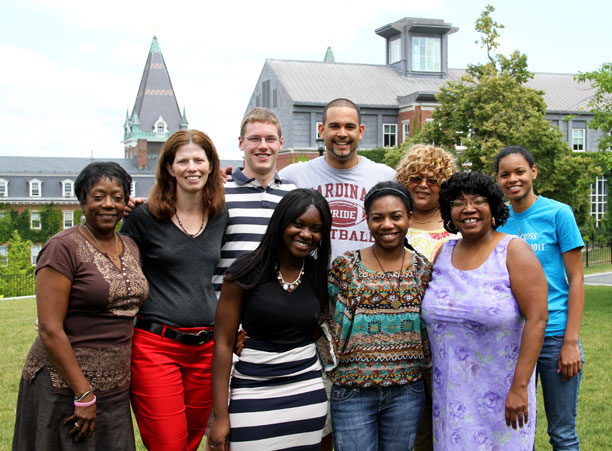
A 9-person delegation of students, faculty and administrators from Holy Cross is currently attending a two-week global leadership summit at the University of the Free State in Bloemfontein, South Africa. They are joining about 180 staff and students from universities in the United States, Asia and Europe.

The focus of the summit is on international engagement in addressing salient issues around change leadership, diversity and racial reconciliation in higher education through critical dialogues between staff and students from all over the world.

Eminent scholars and politicians are scheduled, including retired Archbishop Desmond Tutu and a number of ambassadors. The summit is taking place from July 8 through July 20.

UFS is a former apartheid university. It was founded as a white-only Afrikaner university and is now desegregated and offers classes in both Afrikaans and English. The summit is part of the UFS Leadership for Change Program, a student leadership development program aimed at nurturing young leaders to become change agents as students at their universities and as a means of embedding internationalization in its strategic priorities. As part of the program, Holy Cross was one of nine colleges in America where USF students were placed in 2010. Seven students were exposed to the academic, social, cultural and residential lives of students. Their visit garnered attention from the Worcester Telegram & Gazette and New England Cable News. Another group of students from the UFS visited Holy Cross again this past academic year.

The summit, with the theme “Transcending Boundaries of Global Leadership,” is a reciprocal program of the Leadership for Change initiative.

Five Holy Cross students are attending the summit, including Roobvia Bernadin ’15, a music major from Boston, Patricia Feraud ’15, a sociology major from Worcester, Mass., Mark Legare ’14, a political science major with an anthropology minor from Medfield, Mass., Manny Mendoza ’14, a political science major with a premed concentration from Bronx, N.Y., and Yulissa Nunez ’14, an English major in the Teacher Education Program from Lawrence, Mass.

They are being accompanied by Virginia Coakley, assistant chaplain; Mary Conley, associate professor of history; Mable Millner, assistant dean and director of multicultural education; and Jacqueline Peterson, vice president for Student Affairs and dean of students.

An intensive program is planned. Components include:

  • Introduction to UFS challenges and successes, contextualized by international experiences in similar domains, followed by dialogues in small international groups
  • Lectures, research seminars, meetings to discuss possibilities for collaborative projects
  • International and UFS staff dialogue sessions organized by UFS International Affairs, Student Affairs, and various other units on campus, including the International Institute for Studies in Race, Reconciliation and Social Justice
  • International and UFS student dialogue sessions
  • A series of “In Conversation With…” dialogue sessions with prominent national and international figures
  • A visit to the Qwaqwa campus
  • A varied elective program of cultural excursions

In advance of the summit, Holy Cross students read material on South African history and American civil rights history, including “Coming of Age in Mississippi” by Anne Moody, Nelson Mandela’s autobiography, and background reading on Malcolm X and Martin Luther King Jr.

Following the summit, the delegation will visit Cape Town for three days, where they will reflect on their experiences and take historical tours at places that have a connection to apartheid or anti-apartheid, including Robben Island where Nelson Mandela spent years imprisoned during the apartheid era, and District Six where more than 60,000 of its inhabitants were removed during the 1970s by the apartheid regime.

News Coverage

Posted in In The News, News | Comments Off on Holy Cross Delegation Heads to South Africa for Global Leadership Summit

Reflections on Rev. John E. Brooks, S.J. ’49, Delivered on July 8 at His Wake

By Frank Vellaccio

When Fr. Savard asked if I would be willing to give a short reflection on my experience of having known and worked with and for Fr. Brooks for 38 years, I immediately imagined Father looking down from heaven and thinking, “I should have left clearer and more detailed instructions.” Despite this, I quickly agreed because Father’s passing has left me with such intense feelings of loss and emptiness that I yearned for an opportunity to begin the process of replacing them with renewed hope and vigor. I also knew that Father would want at his wake some laughter mixed with all the tears.

My earliest memory of Fr. Brooks was at the President’s reception in September of 1974 when I first started at the College. I was determined to meet my boss even though I had heard that he did not suffer fools gladly. Each time I eyed this dark-haired, stately man, he was surrounded by people. Feeling increasingly intimidated and finding solace in the shrimp bowl, I kept looking for my opportunity to introduce myself. The clock ticked on and the crowd thinned out and still the time didn’t seem right. For a brief moment, I turned to talk to a fellow shrimp eater, and by the time I turned back it appeared that Father had made a quick escape. Totally disgusted by my failure to meet him I left Hogan just as it began to pour. As I walked down the road with my head down in the rain without an umbrella, a large car slowed, and, as it was passing—a window lowered and a voice said—“It’s raining, do you want a ride?” Depressed I just grunted, “No, thank you,” without looking. As the car went past I glanced up in time to see the back of Father’s head. In the end he had given me the opportunity I had been waiting for and I botched it. I went home and told Cathy not to get too settled in for we wouldn’t be in Worcester for very long. I remembered this story the day Father asked me to be the first lay Dean of the College, and I thought, “I am not turning down the offer of a ride from him a second time.”

Another early memory of Father was when I was on the Educational Policy Committee—the EPC—which at that time was the College’s most important committee. Being new to the academic political scene, I was unaware of the fact that, due to Father’s somewhat authoritative style, many lay faculty yearned for a governance structure where the President had a less prominent role. I remember a meeting at which a faculty member was making a noble attempt at explaining to Father that the EPC discussions were often cursory and abbreviated because Father’s style and lack of patience often intimidated faculty, and as a result they were reluctant to express their opinion. Father’s face became somewhat reddened (a condition that often overcame him), and he slammed his fist on the table and yelled, “That is the most ridiculous thing I ever heard!” At which point the discussion abruptly ended and we went on to another topic. I thought at that moment this was a man I would follow into battle. And there were many battles we fought together and none we lost.

Father and I traveled quite a bit when I was Dean, including to Australia. During our 14-hour flight from Los Angeles to Sydney, halfway over the Pacific with nothing but the vast ocean under us—the oxygen masks dropped from their compartments and immediately a voice came over the intercom saying, “This is a real emergency, the cabin is rapidly becoming de-pressurized.” Convinced there was absolutely no air left on the plane, I desperately lunged for the mask, sucking into it for everything I was worth. Hyperventilating and intoxicated from my new oxygen-rich atmosphere, I began to accept the inevitability of one of four fates—death on impact, death from drowning, death by sharks, or perhaps worse of all, being stranded on a life raft with Fr. Brooks and after several weeks probably being eaten by him. This thought jarred my consciousness and suddenly I remembered to check to see if I could help Father. There he was sitting next to me calmly sipping his scotch and reading a magazine, totally ignoring the yellow mask hanging before him. Unable to be inspired by his example, I screamed through my mask, “Father, we are going to die!” He slowly turned and in his priestly fashion said, “Frank, relax. You might be worried that in the end we are headed down, but I am confident we are both staying up here.” At that moment I thought, as my life flashed before my eyes, how lucky I was to be working for this great man of immense faith.

There is of course the myth, and then the man. Let me try to set it straight. There are only two things that Father would have left Holy Cross for—to be Commissioner of baseball and Sophia Loren. He was an intensely competitive man and truly hated seeing Holy Cross lose any athletic contest, no matter how big or small. In fact, he was unwilling to accept mediocrity at any level in any area, in any shape or form for any reason. He loved to laugh, to read, to eat and—most important—to be in control. He never lost an argument with anyone he liked, and he never admitted making a mistake because he never remembered making one.

It is ironic that after many years of working for Father, I am now so involved in strategic planning and the elaborate process it involves—since Father didn’t consider strategic planning, if he considered it at all, a group exercise. In fact, he considered process to be the cleaning up others did after he made a decision. I was talking to Father once about his style of leadership and I said that he ruled by benevolent dictatorship. He only questioned the word ‘benevolent.’

By romanticizing about Father’s leadership, I in no way intend to demean how we go about things today. Back then was another time and place. It was Brooks’ time and Brooks’ place, and he never wasted a moment of that time fashioning this place into the finest undergraduate college in the country—bar none.

How did he do it? He was first and foremost a true leader because he was himself a devoted follower—a follower of Jesus Christ. His knowledge of, devotion to, and absolute love for Jesus was the product of a total fusion of his mind and heart. He was a truly brilliant man who used his keen intellect to probe, analyze and discern the mystery that is Christ. But his discernment was energized and fueled by the true and unconditional love he had for Jesus in his heart, and it was this synergy that made him both the fervent follower and the charismatic leader—for he saw the possibility of fulfilling his discipleship to Christ through his leadership of the College of the Holy Cross. And I believe it was this connection that made him love the Cross so passionately and profoundly, right up to his very last minute on this earth. Failure to Fr. Brooks was not a conceivable option, for to fail the Cross was to fail Christ. And for him failure lived in laziness, indecision, in hopelessness, insecurity and weakness, and he would have no part of any of these. He inspired all of us to strive for excellence in all we did because he asked no more from us than he demanded of himself, and he was relentless and unfailing in that pursuit.

I will miss him more than I can explain and more than I think I realize. But I have no doubt that the emptiness I feel now will be filled with hope and renewed vigor, for Fr. Brooks has left us with a lifetime of lessons and a path to follow. As long as we follow that path armed with those lessons, we will bring the Cross to heights that are beyond perhaps what even Father imagined.

Frank Vellaccio is the senior vice president of Holy Cross.

Posted in News | 1 Comment

Former Holy Cross President Rev. John E. Brooks, S.J. ’49, Laid to Rest

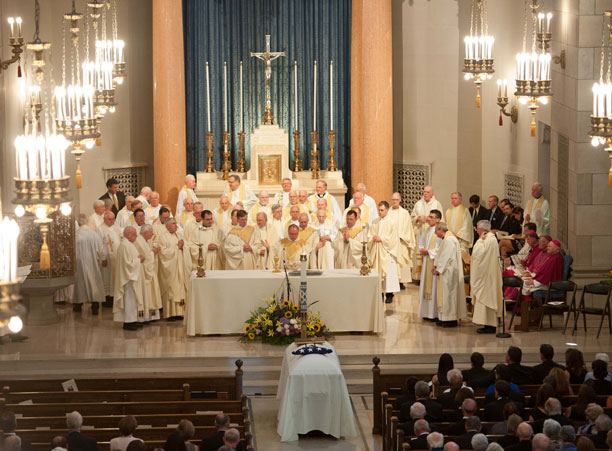
Hundreds filled St. Joseph Memorial Chapel this morning for the funeral Mass of Rev. John E. Brooks, S.J. ’49, who led Holy Cross through unprecedented growth and transition during his nearly quarter century tenure as president. Following the service, he was laid to rest at the Jesuit cemetery on the campus.

Fr. Brooks served as president from 1970 to 1994. The highlights of his career included recruiting African-American students in the late 1960s, and transitioning Holy Cross to coeducation in 1972.

Alumni from those two groups, who had lasting relationships with Fr. Brooks, served as honorary pallbearers. The African-American men included Stanley Grayson ’72, Eddie Jenkins ’72, Dhfir Jihad ’73, Malcolm Joseph ’71, Arthur Martin ’70, Walter Roy ’72, and Theodore Wells ’72. The women included Kristyn Dyer ’94, Ruth Ann Elias ’76, Ellen Keohane ’83, and Bernadette Semple ’82.

Fr. Brooks died July 2 at UMass Memorial Hospital — University Campus in Worcester, at the age of 88, after complications from lymphoma.

The Mass was concelebrated by Rev. Philip Boroughs, current president; Rev. John D. Savard, rector of the Jesuit community at Holy Cross; and Rev. Myles N. Sheehan, the provincial of the New England Province of the Society of Jesus.

Worcester Bishop Robert J. McManus, retired Bishop Daniel P. Reilly, and retired Auxiliary Bishop George E. Rueger presided at the Mass.

Clergymen, members of the Holy Cross community, and dignitaries, including U.S. Rep James P. McGovern and New England Patriots owner Robert Kraft, were among the mourners.

In his homily, Rev. Earle L. Markey S.J. ’53, associate director of Admissions, recounted the many initiatives Fr. Brooks undertook in making Holy Cross a nationally-renowned liberal arts college: recruiting an excellent faculty and bright students, adding new buildings, introducing new academic programs, helping create the Patriot League, and building the endowment — all while staying true to the College’s Catholic roots.

“In the midst of great change, John always confirmed that the College remains a Catholic college,” he said. “He never wavered from his view that the College of the Holy Cross served the Church as an instrument of intellectual competence, where the Church met the world and world met the church. It was a place where faith and reason could meet and be reconciled each to the other.”

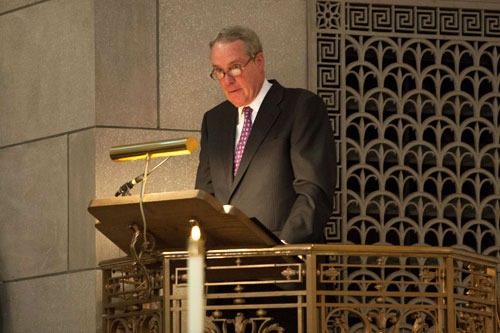
P. Kevin Condron ’67, chair of the board of trustees, said that when writing his eulogy, he had difficulty coming up with words to capture the uniqueness that was Fr. Brooks.

“His influence and impact were so extraordinary that the very campus we gather at today, his beloved Holy Cross, stands as a eulogy to the man himself,” he said.

Fr. Boroughs said that Fr. Brooks became “not just the president but the personality of Holy Cross.”

“His commitment to academic excellence, to diversity and inclusion, to a measured approach to athletics, to the professional development of the faculty, to critically-engaged theology and to our Catholic and Jesuit identity has become the imprint of all that we do today,” he said.

Photography by Rob Carlin


Related Information:

Posted in News | Tagged , , | 4 Comments

Eulogy for Funeral of Rev. John E. Brooks, S.J. ’49

By P. Kevin Condron ’67

In Fr. Brooks’ later years, he would speak openly about some of his last wishes and even his desires for his funeral. A fervent Crusader to the end, he would tell me in that big, booming Brooks baritone, “Kevin, don’t let them sing ‘On Eagles Wings’ at my funeral! There will be no eagles celebrating this Crusader.”

Bishop McManus, Bishop Reilly, Bishop Rueger, Jesuit brothers, loving family and admiring friends of Fr. John Edward Brooks, Good Morning.

We gather this day to express our temporary “goodbyes” to our beloved Fr. Brooks, to celebrate his passage from this life to a new and everlasting life, to offer all the comfort and consolation we can command to his sisters, Mildred and Marion, his sister-in-law Dorothy, and his brother, Paul, his nieces and nephews and to the countless people who called Fr. Brooks a “friend.”

In preparing these remarks, it became abundantly clear that neither I nor anyone else could find the proper words to capture the uniqueness that was Fr. Brooks. His influence and impact were so extraordinary that the very campus we gather at today, his beloved Holy Cross, stands as a eulogy to the man himself. I personally was both honored and overwhelmed when I was asked to speak these words of remembrance today. Humbly, I do not feel that I, or frankly any person, could do justice to the life of the towering figure we celebrate here today. Words truly cannot capture the importance of the life Fr. Brooks led. The people he touched, the students he molded, the college he shepherded and loved for so long are all benefactors for having existed within the ambit of his influence. A list of his accomplishments, vast and impressive as they are, does little to capture the flesh and blood of the man, the loving heart and the inquisitive mind. So I will instead share just a few thoughts on this incredible man that so greatly enriched all of our lives.

It is, of course, appropriate that we gather here at St. Joseph Chapel, in the heart of this lovely campus to celebrate Fr. Brooks’ life. For the College of the Holy Cross was his heart, his love, his life’s work and his enduring passion. Throughout the 49 years Fr. Brooks spent here atop Mount St. James, he always had a crystal clear view of what Holy Cross should be. He wanted Holy Cross to be a Catholic, Jesuit liberal arts college committed to the highest standards of excellence. His passion and love for all things Holy Cross led him to insist on excellence in the student body, excellence in the faculty, excellence in the campus, excellence in fundraising. He held himself to the highest standard and expected the same from everyone and everything. He would accept nothing less for his Holy Cross. In 1993 on the occasion of the Holy Cross Sesquicentennial Mass, Joseph Cardinal Bernardin, Archbishop of Chicago, made the following comment about Fr. Brooks: “He has that beautiful ability to combine the spiritual depth of a man of prayer with the wisdom and insight of a scholar and the decisiveness and good judgment of a skilled administrator.” The Cardinal got it exactly right.

However, as incredible as Father’s works were as a college president, it was his warmth and charm that made him so popular to so many. The German Jesuit theologian Karl Rahner tells us that Jesuits must be selfless and serviceable, and that the ultimate task of a Jesuit is to help others experience God directly. They must do this while still being someone to whom we can speak and with whom we can converse. No man better exemplified this duality of service to God and selfless openness than Fr. Brooks. For many of us, his life and many accomplishments stand as an example of God’s work here on earth. For all of us, his humble and approachable manner made him a joy to have in our lives. He had such a kind and fatherly way about him that people were naturally drawn to him and wanted to help him. I saw it over the years with the staff that worked at Holy Cross, I saw it with the alumni who were so willing to offer their financial support and I saw it with his final illness with the doctors and staff at UMass who became so attached to him. Fr. Brooks loved people, he loved to interact with them, match wits and share stories. His warmth was genuine and those of us fortunate enough to be in his orbit basked in that glowing light of friendship and love.

A friend to many, Fr. Brooks was first and always, a priest. A man who devoted his life to spirituality and living the Jesuit ideals. What made Fr. Brooks so special was that he approached his theology as an ever-evolving vocation. His faith was unwavering, deep and pure. But, in the Jesuit tradition of Ratio Studiorum, Fr. Brooks was always learning, evolving and challenging both his own views and that of the church and the world at large. The renowned Superior General of the Jesuits, Fr. Pedro Arrupe, in an oft quoted speech to the “Tenth International Congress of Jesuit Alumni of Europe,” spoke the now famous words that we should strive to be “men and women for others.” At the time, the words were somewhat controversial though they are now woven neatly into the tapestry of Ignatian ideals. Those words, provocative as they were, were spoken in 1973. Here on the Hill, under the leadership of Fr. Brooks, Holy Cross embraced integration in the late 1960s and the college was open to women in 1972. Ever the visionary, Fr. Brooks had a real passion for social justice, which led him to transform Holy Cross into a leading institution for human rights and social change. I submit to you today that this is the true definition of a Crusader.

For all the work Fr. Brooks did changing our college and, in his own way, the greater world around him, he was, at his heart, a teacher. He loved interacting with students, challenging their ideas and learning from them as they did from him. The classroom was his field of play and he was forever interested in the unending pursuit of knowledge gained through rigorous study and passionate debate. He taught one seminar every year, and planned to teach again this fall. My relationship with Fr. Brooks began in the mid sixties when I was a student and he was Chair of the Theology department. Later we became better acquainted through our involvement with issues surrounding the city of Worcester. In the early 1990s Father invited me to join the Board of Trustees. As we worked together for an institution that we both so dearly loved, our relationship evolved. Always the teacher, Fr. Brooks became my mentor. For me, it was a chance to learn at the master’s knee. For him, it was more teaching—the profession that sustained him and engaged him every moment of his life. I don’t know if I was a good a student, but I do know that I will be forever grateful for having had the chance to learn life’s great lessons from a teacher like Fr. Brooks.

In closing, having already mentioned a few renowned theologians and scholars, I think it appropriate that the final words of today’s remembrance come from the great man himself. Fr. Brooks was a prodigious letter writer and, as those in this church who have received one can attest, his words were always insightful, rich and eloquent. I received a copy of a letter Father wrote just two months ago. It was written to Mark Shriver, class of 1986, congratulating him on his new book about his father Sargent Shriver, titled A Good Man. In the letter Father shares his thoughts on approaching death. These words, written just two months before his own passing with such clarity and prescience, offer an insight into the man and his approach to the life everlasting. In the letter, Fr. Brooks drew a parallel between Sargent Shriver’s willingness to accept death with that of the Jesuit priest and poet Gerard Manley Hopkins.

Fr. Brooks wrote:

“May I suggest that like Hopkins, your Dad saw death not as departing from the life he loved, but rather as a passing on to a new life he loves. In his deep faith, your Dad, like Hopkins, had the capacity to see death not as an irrevocable departure from a life he loved, but rather as a passing into a new life he knew he would love. His faith, which he continuously nourished throughout his life, enabled him to grasp the ultimate relationship between life and death. And for that gift we should all be deeply grateful!”

For all of us gathered here today, I say that we are the ones who are deeply grateful for the gift of the incredible life of Fr. John Edward Brooks.

And so to Fr. Brooks we say . . .

“Life’s race well run.
Life’s work well done.
Life’s victory won.
Now cometh the rest.”

P. Kevin Condron ’67 is chair of the board of trustees at Holy Cross.

Posted in News | 2 Comments

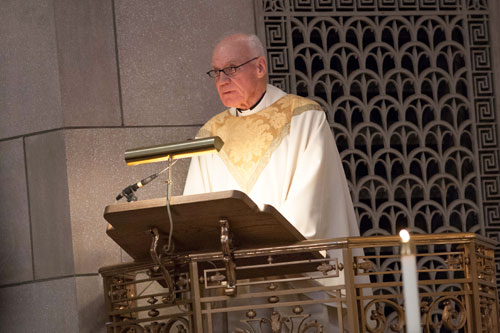
Homily for Funeral of Rev. John E. Brooks, S.J. ’49

By Rev. Earle Markey, S.J. ’53

Bishop McManus. Bishop Reilly. Bishop Rueger. Father Provincial Myles Sheehan of the Society of Jesus. Thank you for your presence here today. You honor Fr. Brooks and all of us.

To John’s family: Mildred, Marion, Paul and Dorothy, and all your family. We express our sincerest condolences and assure you of our continued prayers for John and all your family.

To understand John Brooks’ devotion and loyalty to the College and to the Society of Jesus, one must first understand his major spiritual motivation and intellectual obsession. It was, like that of St. Ignatius himself, his obsessive search for the meaning and reality of the person of Jesus Christ. He was a voracious reader—as a visit to his room in the Jesuit residence would attest. He read all that he could find about the Jesus of the Gospels, the Jesus of history, the Jesus of modern cinema, and everything else about Jesus. Not only that, every year, as teacher, as Dean and as President, he taught a seminar on the theology of Christ. He called the course: “Modern Christology.” He required each student in the seminar to select a prominent theologian, Catholic or not, and to report their interpretation of the theologian’s understanding of Christ. Only students who didn’t mind reading volumes need apply! Their final exam was to respond to the questions of a panel of invited professors of religious studies—followed by a celebratory banquet of all involved. And now he knows Christ face to face! It was his life’s goal, his motivation, and his purpose.

He began his presidency with the purpose of bringing the College into the 21st century, and making the College a liberal arts college competitive with the best in the nation. He never wavered from that goal and said, at his retirement, that he honestly never made a decision that he did not think was in the best interests of the College. He said he may not have been right all the time, but he never made a decision that he did not think was in the long-term good of the College.

He began early to professionalize the faculty, entering into sometimes contentious debates about guidelines and procedures for tenured faculty positions. He prepared the way for coeducation—the decision he called the “single most important decision he made.” As in recruiting talented and promising African-American students, so too in the recruiting of women, he recognized their potential for leadership in a society that was becoming more advanced in learning and more tolerant in social matters. For him, the purpose of the College was to recruit and educate the leaders of the future. Those he recruited he saw as potential leaders, and he made no concessions for them. He knew they could face the challenge that everybody else had to face, academically. He would nurture them, but he would not coddle them. They would have the same courses and obligations of every other student—no reduced class loads, no special classes or programs lighter than anybody else’s. Time has proven him right. Outstanding leaders have emerged from amongst the women and minority students he recruited.

But to professionalize the faculty, rebuild the substructure of the campus, add new buildings and introduce new academic programs, money was required—plenty of it. The College’s endowment was approximately $6 million as he assumed the presidency. Last year’s bills were being paid by this year’s tuition—a sure formula for fiscal disaster. Father Brooks assumed the office of the President at a time when the financial crisis was at its peak. He was directed by the Board of Trustees to limit the deficit and begin to operate on a balanced budget, beginning in the fiscal year 1972. And balance the budget he did, but not without some understandable discomfort to several of his constituencies. As time went on, he balanced the budget each year, raised faculty salaries and benefits to competitive levels, rebuilt the physical plant, added buildings to the campus and, at his retirement, left an endowment of $150 million to be used for future institutional growth. This was a targeted number in his own mind since the beginning of his presidency. For this remarkable accomplishment, the Worcester Telegram in the September 27, 1995 editorial section awarded: “A tip of the hat to Holy Cross College for being recognized as the most efficient liberal arts college in the country, with the highest ratio of academic return for money spent to educate students. The ranking comes from U.S. News and World Report, in a survey that considered total budget and national academic standing.” John always wanted to be first in competition, and if Holy Cross could not be first in the nation in athletics, I suppose this honor would be one that he cherished the most.

John began the process of modernizing the College by visiting over 40 regional clubs each year. His message was always the same—one that did resonate with the vast majority of alumnae and alumni who regularly attended these regional meetings. It was this:

“The educational spectrum in the United States is very wide. We at Holy Cross have selected a very narrow part of that spectrum in which to excel. We focus our attention and our efforts on the Liberal Arts for undergraduates. Other educational institutions will focus on different aspects of that spectrum, either as colleges or universities dedicated to various disciplines in direct preparation for employment. Other institutions can better educate directly for professional life and offer graduate programs. We can excel at the Liberal Arts, a traditional foundation for future professional education.”

With this goal in mind, to pursue excellence in the Liberal Arts, he set about recruiting an excellent faculty, a very bright student population, building a state of the art Library addition, classrooms and labs. When one considers the limited endowment and aging Jesuit faculty, as well as an aging physical plant, one can only marvel at Father Swords’ and Father Brooks’ single-minded wisdom and commitment to their goal of making the College of the Holy Cross an outstanding, highly respected Liberal Arts college for the 21st century.

We have many snapshots of his single-minded determination. Once, on a drive to New York City with Father Frank Miller for an alumni fundraising meeting, John sped down the Connecticut Turnpike and hit a deer straight on. The poor animal flew over the windshield after rearranging the car’s front grill and hood—blood and fur splattered the windshield and roof. But he drove on. Never stopped until he got to New Rochelle. After a few stares of disbelief by parking attendants, he and Frank attended the meeting, and when it ended, they both got into the damaged car and drove back to Worcester. John took the car to the motor pool at the College the next day, and stunned the mechanic there when he told him that he had hit the deer in Connecticut on the way to New York and returned from New York the same day without stopping for repairs. Father Brooks just shrugged, and Father Miller remained tight-lipped.

A few days before he was to be the main speaker at the Friendly Sons of St. Patrick’s annual dinner on St. Paddy’s Day in New York City – a big deal – John slipped on the ice outside a Logan Airport passenger terminal. He broke his shoulder and was in obvious pain and great deal of discomfort. However, with the shoulder in a sling and an arm of his coat jacket hanging limply by his side, he gave a very well-received and appreciated talk to this large gathering of prominent New Yorkers.

John was also single-minded in his support of College teams. He was once asked to officiate at the wedding of a daughter of an alumnus. He officiated at many such weddings and was willing to honor this request also. However, the date and time of the wedding was in conflict with the annual Holy Cross-Boston College football game to be played at Sullivan Stadium in Foxboro. He agreed to officiate at the wedding provided the wedding was moved to the morning. The time of the wedding was so moved and John officiated at the wedding.

Some of John’s many successes and accomplishments have been heralded in books, magazines and newspapers. John Feinstein’s best-selling book “The Last Amateurs” is a testimonial to the academic and social wisdom of founding the Patriot League. Not everybody saw it that way, and he met some opposition to the founding of the league. He always laughed about the time he was the Grand Marshal of the Worcester St. Paddy’s Day parade. As his open air vehicle passed a local watering hole—that had been open since early morning, it seemed—one of the patrons yelled to him: “Hey, Father Brooks, when are you going to get out of that Patriot League?”

Another time, after the commissioning ceremony of the NROTC cadets on graduation day, Father Brooks stopped to talk to several parents of the newly commissioned cadets. He was introduced to the mother of one of the cadets and when she heard the name “Father Brooks,” she exclaimed, “Oh, you are the one who got us into that Pineapple League!” Later John remarked to me: “She must have been drinking.” His response to all criticism of the league was simply: “The sign at the entrance to Linden Lane reads COLLEGE of the Holy Cross. Not football team of the Holy Cross or basketball team of the Holy Cross—it only says COLLEGE of the Holy Cross.”

Of all the issues a college administration must deal with, both now and in the past, athletics is probably the thorniest of the issues. No matter what your policies, you can never satisfy everybody. The best you can do is hire people who understand the proper role of athletics on a college campus and try to balance the demands of competition with the demands of academic integrity. John was, above all, an educator of great integrity, sincere in his search for excellence, both in athletics and in academic matters. If anything, he was an overzealous fan and a demanding academician. He saw the Patriot League as a way of preserving the College’s academic reputation while, at the same time, preserving its athletic traditions. He sought excellence on a Patriot League level and not necessarily on a national level. He really did not downgrade Holy Cross athletics, he merely realized how the times are changing on the intercollegiate athletic scene and, with his clear vision of the future, placed the College’s athletic teams on the appropriate level of competition.

In the midst of great change, John always confirmed that the College remains a Catholic college. He never wavered from his view that the College of the Holy Cross served the Church as an instrument of intellectual competence, where the Church met the world and world met the church. It was a place where faith and reason could meet and be reconciled each to the other. He believed that it is better to teach a poor man how to fish, something he could do for the rest of his life, rather than simply give him fish for a family dinner. That is an old missionary guideline.

John Brooks clearly understood the words of St. Ignatius when he founded his first school in Messina, and urged the founding of many other schools in Europe in the mid-1500s. St. Ignatius saw many reasons for founding schools but his most significant reason was the following: “From among those who are merely students, in time some will depart to play diverse roles—one to preach and carry on the care of souls, another to the government of the land and the administration of justice, and others to other callings. Since young boys become grown men, their good education in life and doctrine will be beneficial to many others, with the fruit expanding more widely every day.”

And so we see time and events have proven that John Brooks was the right man at the right time in the right place as President of the College of the Holy Cross. We will miss his wise guidance, but he has left a legacy that will not end as long as the College of the Holy Cross remains a relatively small, Jesuit Liberal Arts College.

It was Divine Providence that nurtured and prepared John for his entire life’s work at the College of the Holy Cross. As there is Providence in the fall of a sparrow, there is a Providence that shapes our ends. We pray today that God’s Divine Providence, which watches over the birds of the air and gilds the lily of the field, will bring John, who believed in Christ and was buried with Him in baptism, to share in His Resurrection and Eternal Life. This is our Christian hope that sustains us in life’s darkest moments. The Prophet Micah reminds us: “This is what the Lord your God asks of you: only to act justly, love goodness and to walk humbly with your God.” John heeded the Prophet’s advice.

How appropriate are the words of Father Bill Donaghy’s sonnet:

“He sleeps beyond the boys, the books and the bell,
Beneath the Cross, who served the Cross so well.”

May he now rest in the peace and eternal joy of the Risen Christ.

Rev. Earle Markey, S.J. ’53, is the associate director of admissions at Holy Cross.
Posted in News | Comments Off on Homily for Funeral of Rev. John E. Brooks, S.J. ’49

Welcome Remarks for Funeral of Rev. John E. Brooks, S.J. ’49

By Rev. Philip L. Boroughs, S.J., president

On behalf of the extended Holy Cross community, I would like to welcome you to this celebration of the life and ministry of Father John Brooks, S.J., 29th President of Holy Cross. We are faculty and staff, grounds-keepers and students, Trustees and food service personnel, alumni and Public Safety officers, coaches and chaplains. We welcome members of the episcopacy and public officials, business leaders and neighbors, fellow academics and members of the local clergy, as well as the broader Jesuit community, and most especially Father’s extended family: his sisters, Mildred and Marion, his brother, Paul, sister-in-law, Dorothy, and their children Maureen, Paul, John and their families, and many cousins. This morning, we are united in our sorrow and our deep affection for Father John Brooks, and we come together in this sacred space with gratitude for all the ways our loving God has blessed us through him. We also draw on Father Brooks’ deep Faith and Hope to augment our shared desire that our gracious God who has given us all the gift of life, will also bestow on us eternal life in Christ.

My predecessor, Father Michael McFarland, S.J., cannot be with us today as he is representing the New England Province at an international meeting of Jesuits in Nairobi, Kenya, but he joins us in spirit and prayer, as do many other members of our Holy Cross family who are abroad but have sent us their condolences and prayers. Although I am a more recent member of the Holy Cross community, I was very blessed to spend a great deal of time with Father Brooks in the final week of his life. I can assure you that as he was in life, he was in death: thoughtful, engaged, and peaceful; he very deliberately thanked each nurse, doctor and technician by name as they treated him; and he faced his future with a calm certainty that he would see his loving God face-to-face. He wasn’t anxious or fearful, but rather centered and receptive to the wonder of this new experience.

Until the very end, John kept that brightness in his eyes signaling his enjoyment of the beauty of life, the interchange of ideas, the diversity of human personalities, and always his passion for Holy Cross. As a formed Jesuit, he never worked anywhere else; and over the years he became not just the president but the personality of Holy Cross. His commitment to academic excellence, to diversity and inclusion, to a measured approach to athletics, to the professional development of the faculty, to critically-engaged theology and to our Catholic and Jesuit identity has become the imprint of all that we do today. He was a man with a determined will and great strength of character, but not an over-sized ego. He always recognized the leadership of his friend and predecessor, Father Raymond Swords, and the talents and gifts of his administrative team, faculty and students.

In 2009, Father Brooks was interviewed as part of the New England Province Oral History Program. The interviewer asked him about his life and family, his formation and ministry, and then concluded by asking him: “As he looked back over his life, had he felt the presence and influence of God’s providence?” This is how Father Brooks responded:

“Yes, definitely.  God is always at work in our lives. There is no way I could have survived twenty-four years as President of Holy Cross without God’s presence every day.

“As for my personal life, I have a much deeper understanding and gratitude towards God than I ever had in my younger days.  I don’t find myself complaining much these days.  I’m much more aware of the fact that my entire life has been a gift.  There is nothing I’ve done entirely on my own.  While in the past I undoubtedly took many of life’s gifts for granted, I’ve now reached a stage of life where I know more than I once did of the importance of the role God plays in my life.  I’ve had a very happy life in the Society of Jesus, for which I am genuinely grateful.”

At one point last Monday morning, when Father Savard had returned to Ciampi Hall to get Father Markey, I was sitting next to Father Brooks’ bed praying. I recalled a reading from the liturgy a few weeks earlier from the Second Book of Kings where the prophet, Elijah, preparing to be taken up into heaven, departs for the Jordan. Elisha, his faithful disciple accompanies him, knowing what is about to take place. After they crossed the river, Elijah says to Elisha: “Ask for whatever I may do for you, before I am taken from you.” And Elisha answers: “May I receive a double portion of your spirit.” Well, I laughed a bit at that, since it seemed a bit presumptuous of me to ask John for a double portion of his spirit; and I was sure that if he answered my prayer, you might not be able to put up with me! But I did ask John to bless me with his courage, his wisdom, and his vision in my service to Holy Cross. Today, as we celebrate the life and ministry of Father John Brooks, may we all be similarly blessed as he crosses into God’s loving embrace.

Rev. Philip L. Boroughs, S.J., is the current president of Holy Cross.

Posted in News | Tagged , , | 1 Comment

How to Best Provide Humanitarian Relief Subject of Jesuit Conference

Watch the nightly news and it seems like there is no shortage of global humanitarian disasters. The food crisis in the Horn of Africa. Homes splintered by devastating tornadoes in Joplin, Mo. Genocide and gender-based violence across refugee camps in Africa. Epic floods in the Philippines and Pakistan.

Finding a suitable response to global humanitarian issues, such as these, was the focus of the third biennial Jesuit Universities Humanitarian Action Network (JUHAN) student leadership conference this month.

From Santa Clara to Holy Cross, and Qatar to Beirut, more than 100 students, faculty, and professionals brought their minds and hearts to Fairfield University in Connecticut. Titled “Global Perspectives on Humanitarian Action,” the goal of the intensive three day conference was to gain deeper understanding of humanitarian advocacy through networking, training, and reflection.

In addition to myself, the Holy Cross delegation included Malik Neal ’13, Vivian Daly ’13, Nicholas Ricciardi ’13 and Caitlin Cantor ’15. We were accompanied by Diane Fox, visiting assistant professor of sociology, and Timothy R. Austin, vice president for academic affairs and dean of the College.

“One great and wonderful difference compared to other years was the expansion of JUHAN to include students and teachers from Jesuit colleges and universities around the world”, says Diane Fox. “As one of the students from Mexico put it ‘humanitarian’ has a different meaning in Mexico. The exploration of such differences of experience and meanings is a great chance for our students to challenge and expand their understandings of the world we share.”

We were all eager to attend presentations on Sri Lankan child soldiers, Jesuits in social justice, genocide prevention, dilemmas in Somalia, India and development and more. The presenters represented diverse backgrounds, universities and humanitarian organizations such as Catholic Relief Services, International Rescue Committee and World Youth Alliance. Their inspiring stories created an environment where everyone could imagine themselves as “men and women for others.”

This year’s conference was structured differently than previous ones. This time, students simulated actions of non-governmental organizations or international organizations. The ongoing crisis between tribes in South Sudan and Sudan was the central focus of one exercise. Each college delegation read articles on the subject and as an NGO or international organization had to create responses and requests for aid such as water, transportation, security, clothing, and medicine. This structure offered a tangible approach in critical thinking, collaboration, and communication skills — something students can put to action at their respective campuses.

“Holy Cross students are always quick to react to humanitarian crises,” says Austin. “In the past decade, we’ve stepped up in response to the 2004 Indian Ocean tsunami, to the 2010 Haiti earthquake, the Darfur genocide, and to many other crises around the world.”

There has also been discussion about incorporating humanitarianism into the academic curriculum.

“A significant goal of JUHAN since its founding has been to provide courses, and perhaps even a concentration, in humanitarian action,” he says. “The national organization seems closer to delivering on that promise and Holy Cross will need to evaluate how the academic content it designs fits with a liberal arts curriculum.”

Expect this year’s participants to expand their newfound knowledge and relay the information they learned at JUHAN back to fellow Holy Cross students. There are many ways of doing this.

“Our JUHAN delegates can certainly help by working with recognized student organizations such as Pax Christi and Oxfam,” Austin says.

Other possible ideas include initiating student-faculty humanitarian research, coverage of humanitarian issues in the Crusader student paper, joining Eco-Action and World for Peace, or simply presenting photo exhibits on natural disasters. More advocacy generates more awareness. The hope is that the more we actively involve the campus, the more brain power we can get to solve complex humanitarian crises.

Maya Rock ’13, of Sparta, N.J., is a sociology major with a concentration in Women’s and Gender Studies.

Related Information:

Posted in Gender, Sexuality, and Women's Studies, News | 1 Comment

In Memoriam: Rev. John E. Brooks, S.J. ’49, 1923-2012

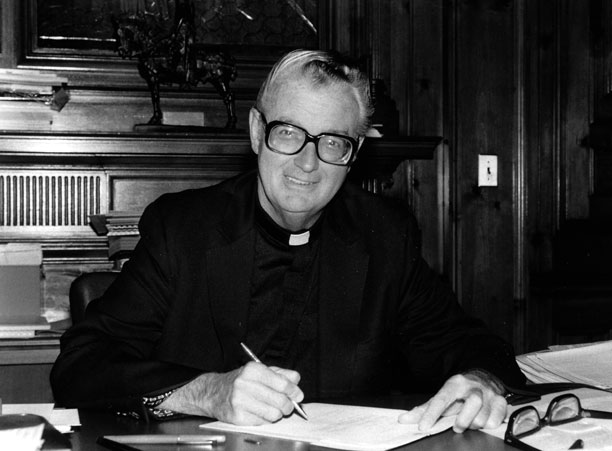
Rev. John E. Brooks, S.J., the longest serving president of the College of the Holy Cross, died on Monday, July 2, 2012, at UMass Memorial Hospital—University Campus in Worcester, after complications from lymphoma. He was 88.

During his tenure as the College’s 29th president from 1970 to 1994, Fr. Brooks presided over a period of enormous change at Holy Cross, New England’s oldest Catholic college. In addition to moving the College to coeducation and recruiting a significantly more diverse student body, he helped strengthen Holy Cross financially, energize the alumni network, and build the College into one of the country’s top liberal arts institutions. At the time of his death, Fr. Brooks was actively working, serving as President Emeritus and Loyola Professor of the Humanities in the Religious Studies Department. He continued to teach a seminar in Contemporary Christology, remained engaged in fundraising and the business of the College, and had close ties with legions of alumni. In the past year, his leadership at Holy Cross received widespread attention after the publication of the book “Fraternity,” chronicling the bold steps he took in the late 1960s and early 1970s to recruit African-American students to the College.

1923-1966
Born July 13, 1923 in Dorchester, Mass., to the late John E. and Mildred (McCoy) Brooks, Fr. Brooks grew up the oldest of four children in the West Roxbury section of Boston. He graduated from the Boston Latin School and entered Holy Cross as a freshman in 1942. Fr. Brooks volunteered for service in the U.S. Army in 1943, and trained in the Signal Corps. He served in World War II campaigns in Northern France, the Rhineland, Ardennes and Central Europe until his discharge from the Army in January 1946. He graduated from Holy Cross in 1949 with a bachelor’s degree and major concentration in physics. After pursuing graduate studies in geophysics at Pennsylvania State University, he entered the New England Province of the Society of Jesus in 1950. He earned an M.A. in philosophy in 1954 from Boston College, and immediately returned to Holy Cross as an instructor of mathematics and physics. In 1956, he began his study of theology at Weston College and was ordained a priest on June 13, 1959 by the late Richard Cardinal Cushing of Boston. Having completed a year of ascetical theology study at the Jesuit Tertianship in Pomfret, Conn., he also earned an M.S. in geophysics from Boston College. Assigned to pursue graduate studies in theology, in 1963 he earned a Doctor of Sacred Theology degree from the Gregorian University in Rome, during the early years of the Second Vatican Council.

He returned to Holy Cross as a faculty member in the Religious Studies Department in 1963, and was named department chair in 1964.

Fr. Brooks made his final vows as a Jesuit in August 1966.

Bold decisions
Immediately following the death of Martin Luther King, Jr., in April of 1968, Fr. Brooks traveled to high schools up and down the East Coast to recruit African-American high school students to attend Holy Cross. Among the dozens of students he brought to Holy Cross were Clarence Thomas ’71, the future Supreme Court justice; Edward P. Jones ’72, who would go on to win a Pulitzer Prize for literature; Theodore Wells ’72, who would become one of the nation’s most successful defense attorneys; Stanley Grayson ’72, future New York City deputy mayor who would break the color bar on Wall Street; and Eddie Jenkins ’72, who would play for the Miami Dolphins during their 1972 perfect season.

Also in 1968, Fr. Brooks was appointed Academic Vice President and Dean of the College, and in 1970, he succeeded the Rev. Raymond J. Swords, S.J., whose 10-year presidency was the longest at the College at the time. Fr. Brooks was the first president elected by a combination Jesuit-lay Board of Trustees.

In 1970, he announced that the previously all-male Holy Cross was to admit women, and in the fall of 1972 approximately 300 women entered Holy Cross.

Throughout his tenure as president, Fr. Brooks was an indefatigable fundraiser, annually traveling across the country, delivering talks to dozens of regional alumni clubs and meeting with supporters and donors. In partnership with his friend and colleague, the late Francis X. Miller, S.J. ’46, vice president of development, they strengthened the famous Holy Cross alumni network and built a lasting foundation of loyalty among Holy Cross graduates.

In 1986, with presidents from Bucknell, Colgate, Lafayette, and Lehigh universities, he helped found what has become the Patriot League, originally begun as a Division I football league, now expanded to be inclusive of all sports and to this day recognized for its promotion of high academic achievement among participating student-athletes. He was inducted into the Institute for International Sport’s Scholar-Athlete Hall of Fame in 2003.

Expanding campus opportunities, interreligious understanding
Fr. Brooks was also instrumental in expanding the cultural offerings at Holy Cross, particularly art and music. He founded the College’s first art gallery in 1983, and today the campus and the Iris and B. Gerald Cantor Art Gallery are known for extensive collections as well as an acclaimed exhibition program. Fr. Brooks also commissioned the College’s award-winning Taylor and Boody Organ, designed in the tradition of 16th and 17th century Dutch and north German organs, which was completed and dedicated in 1985. The Rev. John E. Brooks, S.J. Concert Hall was named for him, and the full-tuition Brooks Music Scholarship was established in his honor.

Fr. Brooks was president in 1990 when his friend and Holy Cross trustee, the late Jacob Hiatt, along with his daughter and son-in-law, Myra and Robert Kraft, made a major gift to Holy Cross and Brandeis University to endow two professorships in comparative religion: the Kraft-Hiatt Chair in Judaic Studies at Holy Cross and the Kraft-Hiatt Chair in Christian Studies at Brandeis University. To this day, the Kraft-Hiatt fund supports campus and community-wide educational initiatives that foster understanding of Judaism and Jewish culture, and dialogue between Jews and Christians.

Honors and remembrances
Fr. Brooks received an honorary Doctor of Letters degree from Holy Cross in 1994. He also received honorary degrees from St. Ambrose College, Worcester Polytechnic Institute, St. Anselm College, Assumption College, Anna Maria College, and the University of New England. He served on the boards of Spring Hill College, Canisius College, St. Peter’s College, and Anna Maria College. He was also a trustee of The Gregorian University Foundation and St. Sebastian’s School, among many other educational, cultural, and research organizations he helped lead.

He was past president of the New England Association of Schools and Colleges, and the New England Colleges Fund, Inc. He also served as chair of both the Association of Independent Colleges and Universities of Massachusetts and the Colleges of the Worcester Consortium.

Fr. Brooks is survived by his sisters Mildred E. Brooks and Marion L. Brooks, both of Needham, Mass; his brother Paul F. Brooks of Manchester, N.H.; and sister-in-law Dorothy G. Brooks of Needham. He is also survived by niece Maureen Shambo, of Merrimack, N.H.; nephew Paul F. Brooks and his wife Tammy of North Attleboro, Mass.; nephew John E. Brooks of Manchester, N.H.; cousin Roger Sullivan and his wife Marguerite and cousin Barbara Sullivan, all of Hingham, Mass.; and many grandnieces and grandnephews whom he loved very much.

In lieu of flowers, donations can be made in his memory to the College of the Holy Cross, One College Street, Worcester, Mass. 01610; Attention: Development Office.


Information for campus visitors

Wake: Sunday, July 8, 2 to 5 p.m., with vigil service and reflections at 4:30 p.m., Mary Chapel (lower level of St. Joseph Memorial Chapel)
Parking is available in the Hogan Campus Center lots (enter Gate 7); Loyola lot (enter Loyola Gate off McKeon Road); or Linden Lane. Shuttle service will be available from campus parking lots to the chapel. Enter Mary Chapel by side door near St. Joseph statue and proceed to the chapel’s gathering space, accessible by elevator or stairs.

Funeral Mass: Monday, July 9, 10:30 a.m., St. Joseph Memorial Chapel

Parking is available in Hogan Campus Center lots (enter Gate 7) and Loyola lot (enter Loyola Gate off McKeon Road). Shuttles will be available from campus parking lots to chapel. The funeral will be simulcast in Mary Chapel (lower level), where there will be overflow seating. Eucharistic ministers will bring communion to the lower chapel. No tickets are being issued for the funeral.

Following the funeral, a brief graveside service and private burial will take place in the Jesuit cemetery on campus. Speakers will be set up near the chapel plaza, so those wishing to listen to audio of the service can be accommodated.

Public Safety and Worcester Police officers will be stationed to direct traffic and assist those with handicap or accessibility needs.

Directions and campus map are available here.


Posted in News | 15 Comments

NBC’s ‘Today’ Show Features Holy Cross and ‘Fraternity’

On July 4, Holy Cross and “Fraternity” — the story of Rev. John Brooks’ efforts to recruit African-American students to campus in the late 1960s — again took place in the national spotlight as NBC’s “Today” show devoted a segment to the book that has been called “one of the publishing successes of the season.”

During the 8 a.m. hour, Fr. Brooks and several of the alumni featured in “Fraternity” shared their experiences on campus during a turbulent and racially-tense time in our nation’s history.

Read more about Fraternity,” Fr. Brooks, and the extraordinary group of black alumni featured in the book — including Clarence Thomas ’71, Supreme Court justice; Edward P. Jones ’72, Pulitzer Prize winner for literature; Theodore Wells ’72, one of the nation’s most successful defense attorneys; Stanley Grayson ’72, former New York City deputy mayor who broke the color bar on Wall Street; and Eddie Jenkins ’72, who played for the Miami Dolphins during their 1972 perfect season.

Posted in News | Comments Off on NBC’s ‘Today’ Show Features Holy Cross and ‘Fraternity’

‘The Magic Bus’

Libby

In a Worcester Mag cover story, writer Matthew Robert boarded the Library Express— a state-of-the-art, traveling library, which is affectionately known as “Libby”—on the second day it was in operation to give a first-hand account of what it is like aboard. 

He writes: “The kids perused the shelves like sophisticated shoppers, checking out copies of books like “Stink,” and “High School Musical 2.” As the classes moved progressively from oldest to youngest, the kids grew smaller, but the enthusiasm and armloads of books stayed the same, until they appeared all but hidden behind their finds, like caricatures of college coeds.” 

Edward Augustus, director of government and community relations at Holy Cross,  told the writer “that this partnership between the city, the Worcester Public Library Board of Directors and College of the Holy Cross, which has pledged $80,000 annually for five years to support maintenance, fuel, technology and staff, will ensure that Libby is around for a long time.”
  
City Manager Michael V. O’Brien added that “the Library Express is a means for the library to reach out to neighborhoods to make services, including technology, more accessible to our citizens. Access to technology,” he says, “remains one of the most critical needs of city residents.”

This “Holy Cross in the News” item by Cristal Steuer.

Posted in In The News, News | Comments Off on ‘The Magic Bus’

Cantor Art Gallery to Showcase ‘Create’; 135 Works by Artists with Disabilities

Burleson_Lamps

The Iris and B. Gerald Cantor Art Gallery at the College of the Holy Cross will exhibit artwork produced over the last 20 years at the leading centers for artists with disabilities in the U.S. The exhibition, titled “Create,” honors the history of three pioneering arts programs in California and celebrates the talent of the remarkable individuals whose work is featured. The exhibit will be presented in two installments: Aug. 29 – Oct. 6 and Oct. 22 – Dec. 8, 2012.

San Francisco’s Creativity Explored, Oakland’s Creative Growth Art Center, and Richmond’s National Institute for Art and Disabilities Art Center (NIAD) were founded by Florence Ludins-Katz, an artist and educator, and Elias Katz, a psychiatrist, who developed each of these programs beginning in the 1970s. Their methodology, progressive in its approach, combined access to group studio practice and professional work practices, and gave the artists an avenue to be included in the broader arts community. Today, individuals who are involved with these programs continue to produce artwork for exhibition and sale, visit galleries and museums regularly, and have access to artist mentors who assist them with developing methods and technical skills.

Work created by individuals engaged in these communities defies the stereotype of what art created by people with disabilities should look like. Lawrence Rinder, co-curator of the exhibition and director of the Berkeley Museum of Art and Pacific Film Archive (BMA/PFA)at the University of California has stated, “The artists featured in this exhibition—all of whom have some form of developmental disability—possess the talent, independence, and depth of feeling that makes the most powerful art possible.”

Matthew Higgs, director of White Columns, the oldest alternative art space in New York, is also co-curator of the exhibition.

Due to its scope—more than 135 works by 20 artists will be shown—the exhibition will take place in two installments over the course of the fall semester at Holy Cross. Organized by Independent Curators International (ICI), this is the first stop on a national tour, and the first time the exhibit has traveled to the Northeast. “I know the importance of this work because of my experience curating a show with many of these same artists more than 20 years ago when I was working at UC Davis,” says Roger Hankins, director of the Cantor Art Gallery. “Bringing this work to campus was something I was committed to doing.”

ICI, an organization based in New York, was established in 1975 and is dedicated to acting as a conduit for emerging ideas and collaborations in the contemporary art world. In that same spirit, the Cantor Art Gallery will work with local agencies that serve individuals with challenges, including the Seven Hills Foundation, to provide inclusive programming. Curators Lawrence Rinder and Matthew Higgs will speak at the Hogan Campus Center on Wednesday, Oct. 3.

“We’re hoping to engage as many visitors as possible—people with and without disabilities, contemporary art experts and enthusiasts, those interested in the disability movement, as well as individuals who simply want to experience the ability of art to empower, enlighten, and engage us all,” says Hankins.

The exhibition and the accompanying catalog were made possible, in part, by Dr. James B. Pick and Dr. Rosalyn M. Laudati, and the continued support of the BAM/PFA Trustees. Additional support for the tour is made possible in part by The Andy Warhol Foundation for the Visual Arts, The Horace W. Goldsmith Foundation, and the ICI Board of Trustees.

About the Curators

Lawrence Rinder is the director of the UC Berkeley Art Museum and Pacific Film Archive, having previously held the positions of dean of the California College of the Arts and contemporary art curator at the Whitney Museum of American Art. He is also a writer of art criticism, poetry, drama and fiction.

Matthew Higgs is the director/chief curator of White Columns, New York. From 2001-04 he was curator at the CCA Wattis Institute for Contemporary Arts in San Francisco. Prior to his position at the Wattis Institute, he was an associate director of exhibitions at the ICA, in London. Since 1992, Higgs has organized more than 200 exhibitions and projects with artists. He has contributed essays and interviews to more than 50 publications and art magazines including Artforum, Frieze, Art Monthly and Afterall.

Artists in Exhibition

Mary Belknap, Jeremy Burleson, Attilio Crescenti, Daniel Green, Willie Harris, Carl Hendrickson, Michael Bernard Loggins, Dwight Mackintosh, John Patrick McKenzie, James Miles, Dan Miller, James Montgomery, Marlon Mullen, Bertha Otoya, Aurie Ramirez, Evelyn Reyes, Lance Rivers, Judith Scott, William Scott, and William Tyler.

Catalog

A fully illustrated 176-page catalog (ISBN: 9780971939790, paperback; 180 pgs; color-illustrated) published by University of California, Berkeley Art Museum & Pacific Film Archive will accompany the exhibition. The publication features images of the art, an essay by Lawrence Rinder, and biographies of each of the artists by poet, author, and playwright Kevin Killian. “This publication serves as an impressive record of the exhibition and offers thoughtful insights about the significance and compelling history of these organizations, which deserve to be shared with audiences around the world,” says Hankins. 

Please note: A complete schedule of events and extended hours associated with the “Create” exhibition will be available in August.

Gallery Information

Founded in 1983 through the generosity of Iris & B. Gerald Cantor, the Cantor Art Gallery serves both as a venue for a changing series of historical and contemporary public exhibitions, as well as a vital resource for Holy Cross faculty and students, linking exhibitions to the broader liberal arts curriculum. 

The hours for the Cantor Art Gallery are Monday – Friday, 10 a.m. – 5 p.m. and Saturdays, 2 – 5 p.m. Located in O’Kane Hall, 1st Floor, College of the Holy Cross, 1 College Street, Worcester, Mass., 01610.  Admission to the gallery is free. 

For additional information please call 508-793-3356 or visit the Gallery’s website. 

Independent Curators International (ICI) (curatorsintl.org) connects emerging and established curators, artists, and institutions to forge international networks and generate new forms of collaboration through the production of exhibitions, events, publications, and curatorial training. Headquartered in New York, the organization provides public access to the people and practices that are key to current developments in curating and exhibition-making around the world, inspiring fresh ways of seeing and contextualizing contemporary art. Since it was established in 1975, ICI has worked with over 1,000 curators and 3,700 artists from 47 countries worldwide.

Posted in News, Press Release | Comments Off on Cantor Art Gallery to Showcase ‘Create’; 135 Works by Artists with Disabilities

‘Wanted: Companies To Hire Teens’

Bryan Engelhardt and and Anthony Spagnoletti '14

In an op-ed for the Worcester Business Journal, Bryan Engelhardt, assistant professor of economics at the College of the Holy Cross, and Anthony Spagnoletti , a member of the class of 2014, write about why teenagers who are looking for jobs are in trouble.

According to the piece, the national unemployment rate for people ages 16 to 19 is 24.9 percent, which hasn’t been seen since the Great Depression. They write: “With school out and more local teens looking for jobs, it’s clear that many will come up empty and wind up disappointed this summer. For a teen, the cost of a jobless summer is much greater than missing out on a weekly paycheck. Without job experience, many teens will not learn valuable workplace skills including accountability, time management and self-respect: keys to future employability and success.”

This “Holy Cross in the News” item by Cristal Steuer.

Posted in In The News, News | Comments Off on ‘Wanted: Companies To Hire Teens’

Music Professor to Present Rare Research in Rome

Daniel DiCenso

Known for his popular hip-hop, rap and blues classes among Holy Cross students, and for organizing hip-hop festivals for Worcester area high school students, Daniel DiCenso ’98, assistant professor of music, is chasing after his other passion this summer—rare, early music sources.

Right before DiCenso returned to the College to teach in 2008, he traveled to Monza, Italy, to research a manuscript that was cataloged as a 10th- or 11th-century source of Gregorian chant (liturgical music used in the Roman Catholic Church). “Very little was known about the manuscript, but the catalog description didn’t seem to jibe with the date,” DiCenso observes. “When I arrived in Monza I was shocked to discover that the manuscript actually might date back to as early as 850 A.D.”

These findings are significant because early sources of Gregorian chant survived in France and Switzerland, but scholars thought that no early Italian sources were in existence. “This Monza manuscript is a kind of ‘missing link’ between a body of music that was allegedly exported from Rome to all Christian churches during the eighth and ninth centuries,” he explains.

How could this happen? Because a complicated cataloging error had dated the manuscript incorrectly, therefore, no one paid much attention to the chant it contained. Until DiCenso began his work on the Monza manuscript, which he describes as “one of the three earliest sources of Gregorian chant in existence, the only source of its unique type, and the earliest source to contain a complete chant formulary for the famous ‘Requiem’ Mass, which was the inspiration for famous works by later composers such as Mozart and Verdi.”

DiCenso has recently been invited to present this research at the Pontifical Institute for Sacred Music in Rome on July 8, 2012 as part of conference session sponsored by the Cantus Planus study group of the International Musicological Society.  “All of the chant scholars participating in the special session are excited by the rare opportunity to present our research at the Pontifical Institute, but for me there is a special significance given that my research deals directly with questions about the history of the liturgy in Rome.” 

The Pontifical Institute of Sacred Music was founded by Pope Pius X in 1910 to teach the disciplines of liturgical music in terms of practical, theoretical and historical knowledge, to promote the dissemination of the traditional sacred music, and to encourage artistic expressions appropriate to today’s culture.

“This source is new and important evidence that both complicates and challenges the dominant view of chant transmission,” explains DiCenso’s colleague Jessica Waldoff, associate professor of music. “Dan’s research is groundbreaking.” 

DiCenso’s project is titled: “More Roman than ‘Gregorian,’ More Frankish than ‘Old Roman:’ What a Newly Rediscovered Italian Source Reveals about the Roman and Frankish Character of Chant Transmission in the Mid-Ninth Century.” 

His work on this Monza manuscript is part of a larger study to edit all of the existing sources of Gregorian chant for the Mass up to the end of the ninth century.  “All of the earliest sources have not been edited,” Daniel explains, “and so producing a volume that collects all of these sources together in one place would be a significant scholarly advancement in the field.”

Recently awarded the Robert L. Ardizzone (’63) Junior Faculty Research Award by Holy Cross, he is using this to work on the Monza manuscript this summer, and also meet with the few experts in the world who have the expertise to verify his findings—as well as view and research other manuscripts in Monza, Bergamo and Milan. 

The chant doesn’t stop there. At Holy Cross, DiCenso recently taught a course titled “Chant as Popular Music,” which featured a class trip to the Benedictine Abbey Regina Laudis, in Conn., to hear live chant being sung in the context of a Vespers service.  This upcoming spring semester he hopes to offer a course called “Gregorian Chant,” and this fall he will teach chant in a class titled “History of Western Music.”

DiCenso earned his B.A. in music from Holy Cross, an M.A. in music from the University of Pennsylvania, an M.A. in classical studies from Villanova University, an M.S. in education from the University of Pennsylvania, a Ph.D. in education from the University of Pennsylvania, and his Ph.D. in musicology from the University of Cambridge in 2012, where he was the first Holy Cross student to earn a Gates Scholarship.  Last academic year he served as coordinator of the Medieval and Renaissance Studies Program.  DiCenso resides in Boston, Mass.

Posted in Italian Studies, News | Comments Off on Music Professor to Present Rare Research in Rome

Blog: Shapleigh ’13 Eager to Learn About Non-Profit Development and Administration

NAME Katharine Shapleigh ’13

HOMETOWN St. Louis

AREAS OF STUDY Studies in world literature major with Peace and Conflict Studies concentration

WHERE SHE’S INTERNING Tuesday’s Children, a non-profit family service organization committed to supporting all those impacted by the events of Sept. 11, 2001 and, more recently, to those impacted by terrorist incidents worldwide. Shapleigh will intern as part of the marketing and public relations team, assisting with tasks such as researching and assessing marketing initiatives as well as assembling press kits and press releases.

INTERNSHIP DURATION May 29 – August 3

WHAT SHE’S MOST LOOKING FORWARD TO “Learning as much as possible about non-profit development and administration, as well as meeting families that participate in activities and services offered by Tuesday’s Children.”

WHY SHE’S BLOGGING “Reading past Summer Internship Program blogs inspired me to apply to an internship in New York City and assured me of the quality educational experience provided by SIP sites. I’d love to share my experiences with other students, and I am looking forward to writing about both my internship at Tuesday’s Children and the Big Apple I have all summer to explore!”

CAREER GOAL “To work where I can continue to learn, challenge myself, and best serve others.”

ABOUT SIP Internships through the College’s Summer Internship Program are developed through the strong network of Holy Cross alumni, parents, and friends throughout the country and are earmarked and designed specifically for Holy Cross students. This year 150 students have internships at 146 sites offered through the program.

Read the blog »

Related Information:

  • Check out our admissions and photo blogs, along with many of our other online journals at me.holycross.edu
Posted in News | Tagged | Comments Off on Blog: Shapleigh ’13 Eager to Learn About Non-Profit Development and Administration

Holy Cross Athletics Ranks Fourth Nationally With 17 NCAA Public Recognition Awards

Seventeen College of the Holy Cross varsity athletic teams have received Division I Academic Progress Rate public recognition awards from the NCAA. These teams posted multi-year APR scores in the top 10 percent of all squads in their respective sports. The public recognition awards are part of the broad Division I academic reform effort.

With 17 teams receiving academic success honors, Holy Cross tied for the fourth-most awards in the nation. Other schools with at least 17 teams receiving public recognition awards include Dartmouth (23), Brown (20), Harvard (18), Bucknell (17), Notre Dame (17), Pennsylvania (17) and Yale (17).

Read the entire story on GoHolyCross.com

Posted in News | Comments Off on Holy Cross Athletics Ranks Fourth Nationally With 17 NCAA Public Recognition Awards

Blog: Gallagher ’13 to Intern at Legal Clinic at Bronx Nonprofit

NAME Kevin Gallagher ’13

HOMETOWN Northfield, N.J.

AREAS OF STUDY Economics major with a concentration in Latin American and Latino Studies

WHERE HE’S INTERNING “As a legal clinic intern at Part of the Solution in the Bronx, N.Y., I will be assisting with client intake for eviction prevention and public benefits matters, preparing and participating in administrative hearings, and attending community based trainings in relevant areas of law. I will be working directly with the three attorneys on the staff of the legal clinic.”

INTERNSHIP DURATION June 18-Aug. 17

WHAT HE’S MOST LOOKING FORWARD TO “Having the opportunity to gain a better understanding of the various legal services offered by the organization while at the same time being able to help the members of the Bronx community. Additionally, I am extremely excited to live in Manhattan for the summer.”

WHY HE’S BLOGGING “Blogging about my internship with Part of the Solution will allow me to reflect on my daily experiences while working and living in New York City, and give future students a chance to learn about the internship.”

CAREER GOAL “To find a career that will permit me to utilize everything that I’ve learned over the years as a student at Holy Cross and one that will allow me to wake up every morning and truthfully say that I love what I’m doing.”

ABOUT SIP Internships through the College’s Summer Internship Program are developed through the strong network of Holy Cross alumni, parents, and friends throughout the country and are earmarked and designed specifically for Holy Cross students. This year 150 students have internships at 146 sites offered through the program.

Read the blog »

Related Information:

  • Check out our admissions and photo blogs, along with many of our other online journals at me.holycross.edu
Posted in News | Tagged | Comments Off on Blog: Gallagher ’13 to Intern at Legal Clinic at Bronx Nonprofit

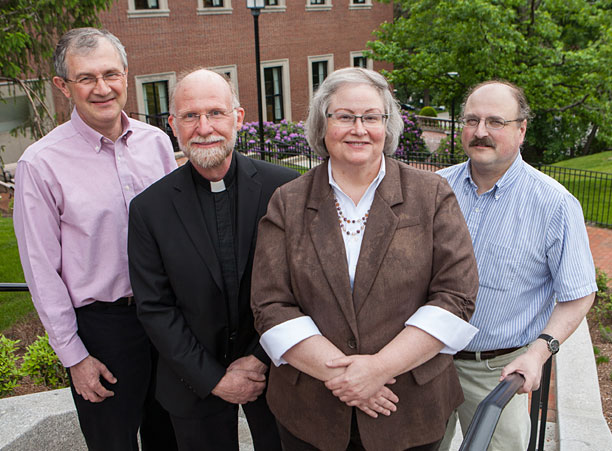
Four Faculty Members Promoted at Holy Cross

Tenure

Four faculty members at the College of the Holy Cross have been promoted to the rank of professor. These promotions will be in effect for the 2012-2013 academic year.

David B. Damiano, of the mathematics and computer science department, received his A. B. from Dartmouth College and his Ph.D. from Brown University. A member of the Holy Cross faculty since 1984, he received the 2011 Distinguished Teaching Award, which recognizes and honors the teaching excellence of the College’s faculty; and an Arthur J. O’Leary Faculty Recognition Award in 2005.  In the spring of 2010, he was a co-recipient of a grant to conduct workshops with middle and high school teachers in the Worcester Public Schools and the Dioceses of Worcester Schools. His research interests include differential topology and geometry and applied mathematics and he has authored undergraduate mathematics texts on linear algebra and multivariable calculus. He has also advised numerous student research projects and theses in pure and applied mathematics. He has served on numerous college committees including the Committee on the Curriculum, the Committee on Tenure and Promotion, and Committee on Faculty Affairs. He recently served a two-year term as Speaker of the Faculty.  In addition, he served terms as chair of the mathematics and computer science department, director of the College Honors Program, and director of the First Year Program.  He has also been a faculty mentor in the College’s Mentor Program. Damiano resides in Westborough, Mass.

Matthew B. Koss, of the physics department, earned a Ph.D. from Tufts University in experimental condensed matter physics. A member of the Holy Cross faculty since 2000, he was the Lead Scientist on the Isothermal Dendritic Growth Experiment (IDGE), which flew on the Space Shuttle Columbia in 1994, 1996 and 1997, and was the Principal Investigator of the Transient Dendritic Solidification Experiment (TDSE), a flight experiment considered for operation on the International Space Station. He has authored or co-authored more than 50 technical papers, including op-eds in the New York Times and The Boston Globe, and has prepared or presented more than 100 technical talks, including testimony before the House of Representatives Committee on Science. Koss’ research interests include dendritic solidification, the physics of baseball, and the interaction between science and religion. He lives in Shrewsbury with his wife Betsy and their daughter Frederica.

Joanne M. Pierce, of the religious studies department, received her Ph.D. in theology (liturgical studies) from the University of Notre Dame, and specializes in medieval liturgy. A member of Holy Cross faculty since 1992, Pierce teaches historical and sacramental/liturgical theology and is the president of the Catholic Academy of Liturgy. She is co-editor of “Source and Summit: Commemorating Josef A. Jungmann, S.J.” (Liturgical Press, 1999); “Commentary on the General Instruction of the Roman Missal” (Liturgical Press, 2007), which received two 2008 Catholic Press Association Book Awards; and “A Commentary on the Order of Mass of the Roman Missal” (Liturgical Press, 2011). She served as a member of the Anglican-Roman Catholic Consultation in the United States from 1992-2007, was a member of the editorial board for the publication of the Proceedings of the North American Academy of Liturgy from 1998-2008, and has served as the Divine Cluster director for Montserrat, the College’s universal program for first-year students. She received the Arthur J. O’Leary Faculty Recognition Award at the College in 2003. Pierce lives in Shrewsbury, Mass.

Rev. William E. Stempsey, S.J., of the philosophy department, received his M.D. from the State University of New York at Buffalo School of Medicine. He was a resident in pathology at University Hospital in Boston before joining the Jesuits in 1982. After ordination to the priesthood, he studied the philosophy and ethics of medicine at Georgetown University, from which he received his Ph.D. in 1996. A member of the Holy Cross faculty since 1996, he has expertise in the concepts of health and disease, clinical reasoning, religion in bioethics, and ethical issues in death and dying, organ transplantation, and medical education. He is the author of “Disease and Diagnosis: Value-Dependent Realism” (Dordrecht, the Netherlands: Kluwer Academic Publishers, 1999) and is the editor of “Elisha Bartlett’s Philosophy of Medicine” (Dordrecht, the Netherlands: Springer, 2005). Fr. Stempsey serves on several ethics committees in Worcester, and also regularly celebrates liturgies on campus and in a local parish. He is a resident of Worcester, Mass.

Posted in News, Press Release | Comments Off on Four Faculty Members Promoted at Holy Cross

Five Reasons to Look Forward to Summer Orientation and the Academic Year

Between June 14 through June 22, members of the Class of 2016 will be on campus for Gateways Summer Orientation. Praised by students and parents alike, Gateways provides a sneak peak at life on Mount St. James. Here are five things the new class can look forward to at both Gateways and the first year on campus.

1. More than 20 student leaders will be on deck to welcome members of the Class of 2016.

“Gateways offers incoming students an opportunity to establish friendships and connections with classmates and get a better understanding of the College’s academic, social and spiritual life before they begin their first academic year,” says Stephanie Montilla ’13, head orientation leader for Gateways Orientation. “We aim to help students — and their parents — know that they have made the right college decision.”

Meet all of this year’s summer orientation leaders.

2. This will be the fifth class taking part in Montserrat, the College’s unique first-year living and learning program.

Students live and study in one of five clusters — the Natural World, The Divine, the Self, Global Society, Core Human Questions — and will take part in a yearlong seminar.

“Because class sizes generally run between 16 and 18 students, Montserrat is a fabulous opportunity to participate frequently and receive great feedback on your work,” says orientation leader Alison Franco ’15, who took part in the Global Society cluster. “Montserrat made me feel like I was a valued individual both in and outside of the classroom, so it was an integral part of settling into Holy Cross my first year.”

Some of this year’s seminars are “Beauty, Suffering, Truth,” “Competition and Cooperation,” “Hollywood Meets Latin America,” “Identity & Values in Dark Times,” “Music, Self, Self, and Society,” and “Environmental Justice.”

Read the entire conversation with Franco, and view the website her Montserrat class created as part of their second semester seminar titled “You—the Ethical Consumer.”

3. Students will meet their newly-appointed class dean Francisco Gago-Jover.

Like incoming students, Gago-Jover, a professor of Spanish, is also beginning a new chapter: this is his first year as class dean.

“During my years at Holy Cross, I have come to appreciate the bonds formed between faculty/advisors and students and advisees,” he says. “Gateways, Second Year Opportunities, advising, and office hours — all of them unique opportunities to interact with students, to try to understand what makes them tick, to guide them, to offer advice, to listen to their dreams, fears, and problems — have become very satisfying moments in the academic calendar; and every year I look forward to meeting with new and returning students.

“However, we live in the real world, and while we would like to have positive interactions with our students, I am aware—sometimes painfully aware—of the difficulties that can bring us together. So, it is during these difficult times when students need us the most, and when I can offer my help and guidance. I believe I am ready for the position of class dean, and at the same time I am also energized and concerned by its responsibilities and challenges.”

4. The first-year class reading, “How to Live: Or A Life of Montaigne in One Question and Twenty Attempts at an Answer” by Sarah Bakewell, will help students learn “the lessons of life.”

Gago-Jover chose the common text for summer reading for several reasons.

“Montaigne (1533 – 1592), one of the most influential writers of the French Renaissance, is also the creator of the essay as a literary genre. He became famous for his effortless ability to merge in his writings serious intellectual speculation with casual anecdotes and autobiography — and his massive volume ‘Essais’ (literally, ‘Attempts’) contains, to this day, some of the most widely influential essays ever written. Admired by some later thinkers, reviled by others, Montaigne is remarkably modern even to readers today. His attempt to examine the world through the lens of the only things he can depend on implicitly — his own judgment and personal experience —makes him more accessible to modern readers than any other author of the Renaissance,” he says.

“The book ‘How to Live: Or A Life of Montaigne in One Question and Twenty Attempts at an Answer’ is a hybrid biography which compares and contrasts biographical details with excerpts from the ‘Essays,’ thus describing Montaigne’s philosophy using stories from his life. The book also explores different approaches to life derived from Montaigne’s ‘Essays,’ such as ‘Be ordinary and imperfect,’ ‘See the world,’ ‘Guard your humanity,’ ‘Wake from the sleep of habit,’ ‘Let life be its own answer,’ and perhaps most characteristically for Montaigne, ‘Question everything.’ If there is a central message it’s about individuals trying to find their way through life. At heart Montaigne was just one of those individuals — the difference is that he wrote about it.

“What I would like students to learn from reading ‘How to Live: Or A Life of Montaigne in One Question and Twenty Attempts at an Answer’ is not that they should live like Montaigne, as he never claimed to have the answer for the right way to live, but rather something simpler, that they, like Montaigne, should reflect on the circumstances of their life and what happens to them — the everyday — to learn the lessons of life. There is enough material in daily ‘stuff’ to provide a lifetime of philosophy.”

5. Rev. Philip Boroughs, S.J., the new president of Holy Cross, will offer his own words of welcome. Since his arrival to campus in January, Fr. Boroughs has been a regular figure at campus events. And that will be the case for Holy Cross’ newest students, too. Just before each of the three orientation sessions end, Fr. Boroughs will give closing remarks to members of the Class of 2016 in the Hogan Campus Center Ballroom.

Related Information:

Posted in News | Comments Off on Five Reasons to Look Forward to Summer Orientation and the Academic Year

Franco ’15: Montserrat Program Is an Integral Part of Students’ First Year at Holy Cross

Alison Franco ’15 says the intensive academics at Holy Cross at the beginning of her first year took her by surprise. But the psychology major from Medfield, Mass., says the College’s first-year program, Montserrat, not only helped her ease her way into College life, but also helped her muster the courage to become an active participant in the classroom. The program even helped reveal her passion for social justice.

What do incoming students have to look forward to about Montserrat?

Montserrat is a small, entirely freshman seminar that is discussion based. The five clusters of Montserrat — Global Society, Core Human Questions, Divine, Natural World, and Self — explore broad questions that challenge you to think critically and express yourself clearly through writing and dialogue.

The size of the seminar is great. Because seminars generally run between 16 and 18 students, Montserrat is a fabulous opportunity to participate frequently and receive really great feedback on your work. The open discussion structure of the seminar and the evaluation of written work both aid with the transition into college level classes. Additionally, unlike any other class Holy Cross students take, Montserrat lasts both semesters of freshman year, so it is easy to build strong relationships with your Montserrat professors as well as make friends within your seminar.

Furthermore, the Montserrat seminars are very cool. The topics of the seminars take interesting and simulating approaches to their subject area. I would encourage first-year students to select Montserrat seminars that do not necessarily fit into their interests or passions. Try something new! It’s a great chance for self-discovery.

Lastly, Montserrat is not just a seminar. Your cluster determines which building you live in, which really enforces the “living and learning” philosophy of the College. Outside of the seminar, the Montserrat program hosts events, speakers, dinners, and activities to enhance the first-year experience. For example, I was in the Global Society cluster and in just a year, we had countless events including group movie viewings, discussion panels about global issues, a 24-hour “Turn Off Technology” day, a Chinese New Year celebration, and a presentation by author Sherry Turkle [read Turkle’s honorary degree citation]. With the extra academic evaluation, discussion-based setting, and “living and learning” aspects, the Montserrat program is carefully designed to help shape the first-year experience at Holy Cross.

Did you find that Montserrat helped you settle into your first year at Holy Cross? If so, how?

Yes. At the beginning of my first year, I felt a little intimidated by the upperclassman in the rest of my classes, as well as the adjustment to college level work. However, I found that Montserrat challenged me to become a more active participant and voice my opinions not just in my Montserrat seminar, but in all of my classes. The design of a Montserrat seminar is very inclusive. We sat in a circle in the classroom and had open dialogues that were facilitated not by the professor, but the students. The environment is very comfortable since you are with all first-year students and the professors truly want to help you succeed. I also really liked the aspect of having peers from my class living in my residence hall. This made other students in my class very accessible whenever I had questions or we wanted to continue discussion outside of class.

Additionally, there is a lot of bonding with your Montserrat seminar because a few nights before large projects or papers were due, a group of us would sit in the common room of Hanselman, my residence hall, to encourage and edit each other’s work. I became very close to my Montserrat seminar and my professor took the time to get to know me. Montserrat made me feel like I was a valued individual both inside and outside of the classroom, so it was an integral part of settling into Holy Cross my first year.

Which cluster and seminar were you in?

I was in the Global Society Cluster, which resided in Hanselman Hall.

My first semester seminar was titled “You—the Global Citizen”, which explored global issues of poverty, degradation of the environment, ethnocentrism, and our responsibilities as citizens of our planet.

My second semester seminar was titled “You—the Ethical Consumer,” which focused on ethical consumerism, our responsibility and accountability as consumers, problems with corporations and ways to seek change. We created two comprehensive and cool class projects second semester. Our first project was a website of book reviews concerning ethical consumerism: ethicalconsumerbookreviews.com. For our second project, we published a shopping guide that looked at the ethical practices of businesses on campus and in the Worcester community.

Both of my seminars were taught by Ellis Jones in the sociology and anthropology department.

Through these seminars, I have learned so much about the subject area of social justice. The knowledge I gained in my Montserrat seminar has inspired me to pursue more opportunities to discuss social justice through peer groups and academics next semester.

Related Information:

Posted in News | Comments Off on Franco ’15: Montserrat Program Is an Integral Part of Students’ First Year at Holy Cross

‘Stop climbing Mt. Everest!’

Mount Everest

In an op-ed for the Providence Journal, Joanne Pierce, professor of religious studies, explains why people should stop climbing Mt. Everest. 

She writes, “At this point in the 21st Century, climbing Mt. Everest has become as pointless as going over Niagara Falls in a barrel, and as narcissistic as big-game hunting. Yes, there are many who set their hearts on achieving the goal of reaching Everest’s summit, and risk their lives to do it. As many as 250 people have died trying to scale the summit, with several just in the past few weeks. But the deaths in recent years are meaningless, as wasted as an addict’s death from a drug overdose.”

This “Holy Cross in the News” item by Cristal Steuer.

Posted in In The News, News | Comments Off on ‘Stop climbing Mt. Everest!’