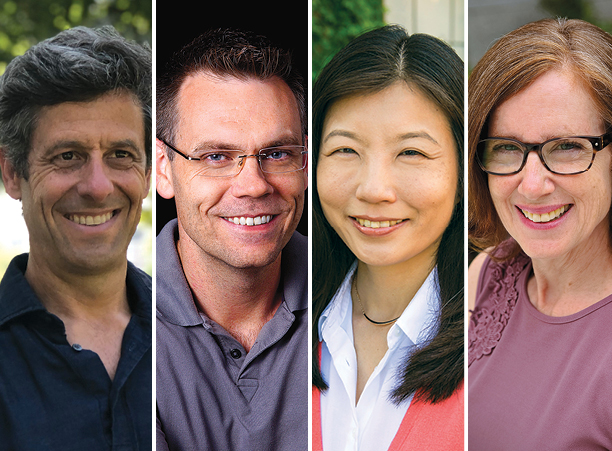
Four Holy Cross faculty members across three departments have been promoted to the rank of professor this fall, in recognition of their scholarship, teaching, mentorship and service to the College.
Four Holy Cross faculty members across three departments have been promoted to the rank of professor this fall, in recognition of their scholarship, teaching, mentorship and service to the College.
People and institutions from every corner of the country — and beyond — are embracing the call to become an anti-racist society and Holy Cross is no exception.
Like much at the heart of Holy Cross, the College’s landmark Become More campaign began in 2013 with deep reflection and contemplation:
“What does it mean to think critically, act ethically and have hearts of compassion today?”
“What does discerning leadership, which marks women and men for and with others, look like in the 21st century?”
“What must we do better to prepare students for their future lives after they have left Mount St. James?”
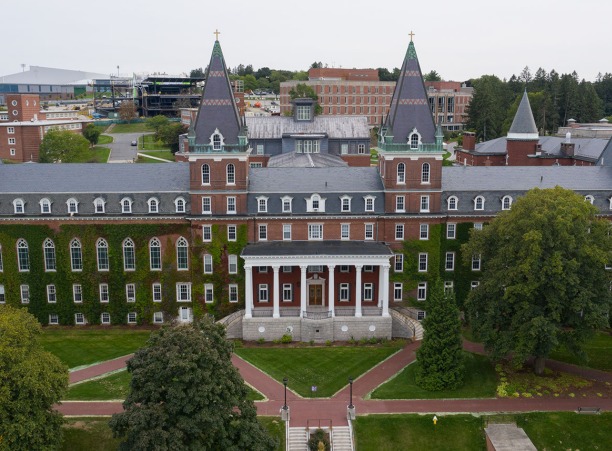
For the 11th consecutive year, the College of the Holy Cross has been recognized as one of the nation’s most environmentally responsible colleges, according to The Princeton Review, receiving a “Green Rating” score of 88 out of 99.
In its “Guide to Green Colleges: 2021,” the Princeton Review chose the schools based on a survey of administrators at 695 colleges in 2019-20 about their institutions’ commitments to the environment and sustainability, analyzing more than 25 survey data points.
“We strongly recommend the College of the Holy Cross to students who want to study and live at a green college,” said Rob Franek, The Princeton Review’s Editor-in-Chief. “Each and every one of the outstanding colleges in this edition of our guide offers both excellent academics and exemplary evidence of environmental commitment.”
In its profile of Holy Cross, The Princeton Review cited the College’s commitment to reach net-zero emissions by 2040, as well as the active student participation in projects that promote sustainability on campus, such as the student-led group Eco-Action.
At Holy Cross, sustainability is a collective responsibility, embraced at all levels of the institution — from the centralized approach provided by the newly-created Office of Sustainability to student-driven initiatives such as the Holy Cross Green Fund.
“Holy Cross receiving recognition for its environmental efforts for over a decade demonstrates just how committed this community is to a sustainable future,” said Cathy Liebowitz, Holy Cross’ newly appointed director of sustainability. “So many individuals from across campus come together in support of climate action. It’s inspiring to support this collective effort.”
The Supreme Court nomination and subsequent confirmation hearings of Amy Coney Barrett have shined a spotlight on her alleged commitment to the Christian religious group, People of Praise, and raised concerns for some over her impartiality if she is approved for the post.
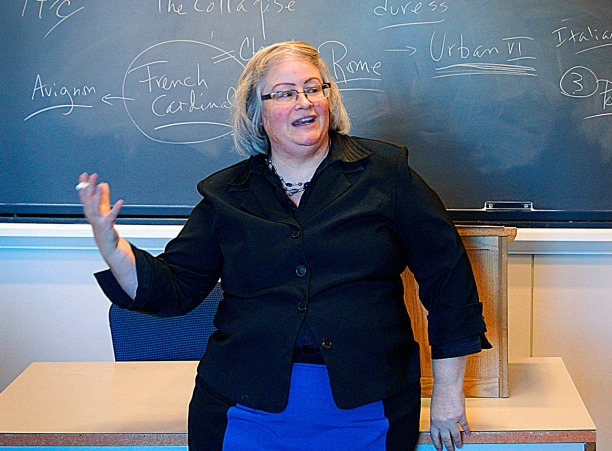
Similar questions of impartiality are why, throughout history, public office-holders have been asked to swear oaths before assuming important roles. In an article for The Conversation, Joanne Pierce, professor of religious studies at Holy Cross, breaks down the history behind oaths, as well as how they have become such an important tradition.
According to Pierce, who specializes in medieval Christian liturgy and ritual, from their beginnings in ancient Rome to present day, oaths have served as promises of integrity.
“The conscience of appointees, not the preservation of their personal reputations, has been the focus of these ‘oaths of office’ for almost 250 years,” says Pierce. “This is as true today as it was in 1787.”
To read the full article, go to TheConversation.com.
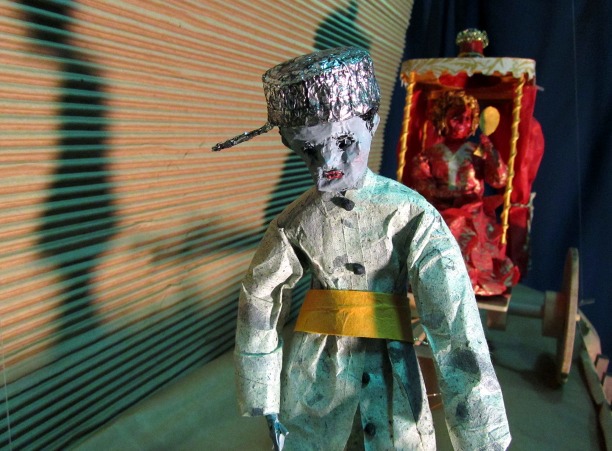
The Iris and B. Gerald Cantor Art Gallery at the College of the Holy Cross, will present the work of Boston-based artist B. Lynch in the exhibition “New Gilded Age” from Tues., Oct. 13 through Fri., Feb. 5. A dedicated exhibition website can be viewed at: https://newgildedage.holycross.edu.
Lynch, a former studio art faculty member and director of the Trustman Gallery at Simmons University, studied Japanese and East Asian culture and Japanese Theatre and Performance at the University of Kansas and in Japan as an undergraduate and graduate student, then later painting at the School of the Museum of Fine Arts, Boston, and holds an MFA from Lesley University School of Art and Design.
Lynch’s interest in theatrical presentation is a catalyst for her multidimensional and immersive world of characters, complete with props, scenes and story lines centered around the “Reds,” whose wealth and privilege allows them to live a life of ease, while the “Greys,” the less fortunate of society, are doomed to lives of toil. Lynch takes photos on her travels to incorporate into her videos. A fan of puppets and alternative theatrical ventures, she modeled her two new stages created especially for Holy Cross after an inspiring visit to Toy Theatres in Germany in 2018.
“New Gilded Age” presents a fantastical sci-fi world comprised of paintings, videos, dioramas and three-dimensional handmade puppets in various sizes, who inhabit sets that Lynch builds by hand. The various media build on and reference each other, with archetypal characters appearing in various guises and situations throughout. In their interactions, two groups interact with and impact each other. As the visitor explores the worlds of the Reds and Greys, she will contend with ideas of equity and status, while drawing parallels to, in Lynch’s words, “the corrosive effect of income disparity on our society and democracy.”
In its playful yet deeply satirical send-up of modern society, Lynch references a number of literary and scholarly inspirations for the “New Gilded Age,” including Voltaire, Thomas More, Mark Twain, Herman Melville and the more recent novel by Thomas Wolfe, “Bonfire of the Vanities.”
Meredith Fluke, director of the Cantor Art Gallery, says “We are excited to re-open the Cantor with ‘New Gilded Age.’ I am confident that the thematic valence of Lynch’s work will provide fodder for many conversations: about the forms and importance of satire and its critique of society; about pressing questions of income and class disparity and their toll on democracy; on the fascinating nexus of play, imagination, storytelling, performance and craft that B. Lynch creates through her work. The tension in Lynch’s exploration of serious themes through playful theatricality will bring a wonderful energy to the campus this fall.”
The Cantor Art Gallery will be transformed into a series of stages and sets for the installation of “New Gilded Age,” with videos and sound increasing the immersive quality of the work. The Gallery will also host a series of videos and programming on its website, in order to provide online access to the work.
Due to the ongoing COVID-19 pandemic, in-gallery visits from off-campus visitors will take place by appointment only. Hours are Tuesday through Friday noon – 5 p.m., with limited Saturday availability. To book an entry time, email prosenbl@holycross.edu or call 508-793-3356. Masks and social distancing practices are required. Public programming events will be made available online, publicized on the Gallery’s website and through social media.
EVENT:
Virtual Artist’s Talk by B. Lynch
Monday, October 19, 4 p.m. via Zoom
Pre-registration at https://www.holycross.edu/cantor/lynch
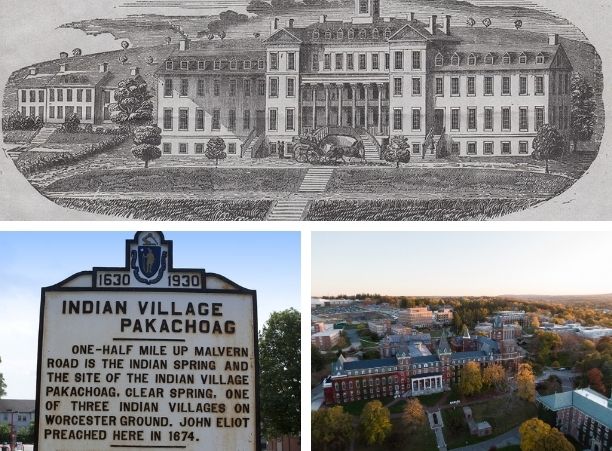
It is a well-known story that Holy Cross was formally established by the Jesuits in 1843, on land that college founder Bishop Benedict J. Fenwick, S.J. purchased for $1,500. The fact that the land was originally home to the Nipmuc, a Native American tribe found in Massachusetts and adjacent portions of Connecticut and Rhode Island, is lesser-known.
This academic year, the College, its faculty and students are working to change that.
In his fall address, Rev. Philip L. Boroughs, S.J., president of the College, reflected on the heightened obligation to not only educate the community about the College’s complex institutional history, but also to memorialize it. Thus, in addition to creating a plaque referencing the Nipmuc tribal community who once lived here, Fr. Boroughs also announced that, starting with October 12, 2020, the College will observe the federal holiday of Columbus Day as Indigenous Peoples’ Day.
“Indigenous Peoples’ Day celebrates and honors Native American peoples, their histories, contributions and cultures,” said Fr. Boroughs. “It also serves as a reminder of the losses suffered by the Native American peoples and their cultures from diseases, warfare, massacres and forced assimilation at the hands of colonialism and westward expansion. At Holy Cross, in particular, being built upon Pakachoag Hill, we have a responsibility to recognize and understand our own history and to honor those from the Nipmuc nation who are native to this land.”
This is a topic that Professor Thomas Doughton, a senior lecturer in interdisciplinary studies at Holy Cross, and one of the preeminent historians of the Nipmuc people in the region, has had on his mind for a while now. “Today’s students are so hungry to learn more about past and present Indian-U.S. relations, here in Worcester, but also at the national level,” said Doughton. “It’s important to give them an opportunity to deepen their understanding of these important issues.”
Thus, he teamed up with colleagues Sarah Luria, professor of English and director of the Environmental Studies Program; Sarah Klotz, assistant professor of English; environmental studies major Madison Chouinard ‘22; and environmental historian Colin Novick from the Greater Worcester Land Trust, to develop the 1620/2020 Speaker Series.
Open to area educators, historians and the general public, the series will explore past and contemporary Indian/New England/U.S. relations in conjunction with the 400th anniversary of the arrival of the Mayflower at Plymouth, Mass., and will culminate with the November 7 premiere of the College Hill/Pakachoag Film Project: “Pakachoag: Where the River Bends,” a film documenting historic sites around College Hill.
“The 1620/2020 Speaker Series can make a meaningful contribution to the College’s commitment to social justice in presenting the Native American heritage of The Hill,” said Doughton.
The series is co-sponsored by the McFarland Center for Religion, Ethics and Culture.
Worcester Magazine, Nov. 3: Holy Cross examines its foundations built on Native American settlement
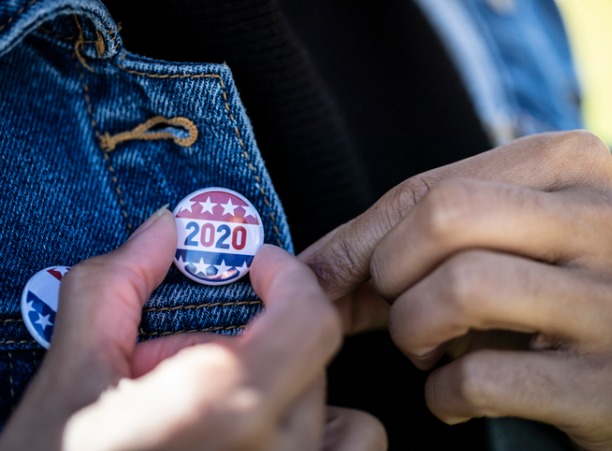
Should we be prepared for the possibility of a major dispute over the outcome of the 2020 presidential election this November? And what should we expect Congress’ role to be in resolving this dispute?
In a recent piece for The Conversation, Donald Brand, professor of political science at Holy Cross, looks at past elections that ended up in Congress and concludes that, generally, the framers sought to avoid congressional involvement in presidential elections.
According to Brand, the House of Representatives would serve as the backup plan if there’s no clear winner in the electoral college, but even so, “The best bet for American democracy, history shows, is a clear and decisive victory in the Electoral College, as the framers intended.”
To read the full article, go to TheConversation.com.
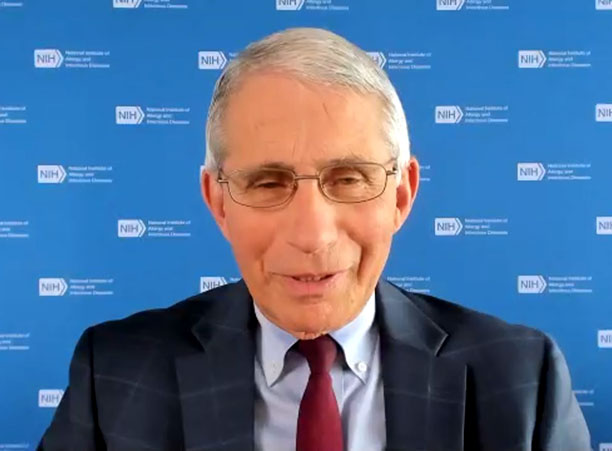
Dr. Anthony Fauci ’62
Dr. Anthony Fauci ’62, the nation’s most trusted expert leading the COVID-19 response, joined current Holy Cross students in a live webinar on October 6 to discuss the trajectory of the coronavirus pandemic and the best ways students can keep themselves and their communities safe.
Dr. Fauci took questions from a dozen students during the Q&A session, sponsored by the Rev. Michael C. MacFarland, S.J. Center for Religion, Ethics and Culture, on topics ranging from virus mutations to development of a vaccine to global cooperation during the pandemic.
“Pandemics are global,” Dr. Fauci noted in response to a question on international cooperation from Zicong Li ’21, a philosophy major. “There’s no such thing as a provincial pandemic. For those of us who have spent years studying Latin and Greek—I always pull out my Holy Cross card on people when I talk—‘pan’ means all. It’s a pandemic throughout the world, and countries need to cooperate.”
He reflected on the disparate rate at which COVID-19 is affecting people of color. “I think that this outbreak has shed a bright, painful light for me on something that I have known for years, particularly from the early years of HIV, and that is the somewhat shameful disparities in health among our minority population—brown and black people,” he said. “We’ve got to do something in society to get rid of that enormous disparity. The problem with that is it takes decades. You have to have a societal commitment that you’re going to change that around.”
Prompted by a question by Alfonso del Aguila ’21, a psychology major, Fauci also spoke on the most difficult decision he has had to make in his career, in a reference to his current role as a leading member of the coronavirus task force.
“When it became clear that we had community spread in the country… I recommended to the President that we shut the country down. That was a very difficult decision, because I knew it would have serious economic consequences, which it did,” Fauci said.
“But there was no way to stop the explosive spread that we knew would occur if we didn’t do that. And unfortunately, since we actually did not shut down completely—the way China did, the way Korea did, the way Taiwan did—we actually did see spread even though we shut down.”
Fauci believes he has continued to find success in his role, including times he has had to speak truth to power, by ensuring all his recommendations are based on science and not being afraid to tell people what they might not like to hear.
“You should never, ever veer away from being transparent, being consistent, and being truthful,” Fauci said. That includes being honest about what you don’t know. “I wake up every morning and I worry about the things that I don’t know… that’s what drives a good scientist and a good policy person.”
Fauci also had a word of advice for students, as he touched upon the high numbers of transmission currently among young people. “You have a moral obligation to wear a mask,” he noted. “You have a societal responsibility to protect yourself as well as the people around you.”
Fauci also said that he is “cautiously optimistic” that there will be a viable vaccine, likely by the end of the year. “The thing that we’ve got to make sure we appreciate is that this is going to end. One of the things we have to be careful about is despair,” he said. “We’re going to get a vaccine, we’re going to get it in a reasonable amount of time. Don’t give up hope.”
Fauci credits his passion for service to his upbringing and his Jesuit and liberal arts education, including an unusual premed course of study at Holy Cross that combined medicine with the study of ancient Greek. “I always felt that I was more interested in human nature than I was in human psychology. That really started from the time I was a child… I wasn’t quite sure what it meant until it became really explicit with a Jesuit education, both at Regis [High School] and at Holy Cross.”
A classics major with a premedical concentration (now health professions advising) at Holy Cross, Dr. Fauci has often credited his professional success to the Jesuit intellectual rigor that was a core part of his education at the College, which also instilled in him a lifelong commitment to social justice.
A top-cited scholar, Presidential Medal of Freedom recipient and Holy Cross alumnus, Dr. Fauci is director of the National Institute of Allergy and Infectious Diseases at the National Institutes of Health and a member of the White House Coronavirus Task Force. He has received over 45 honorary doctoral degrees, including one from Holy Cross, and was recently recognized as the Federal Employee of the Year.
Access the complete recording of the live webinar with Dr. Fauci here.
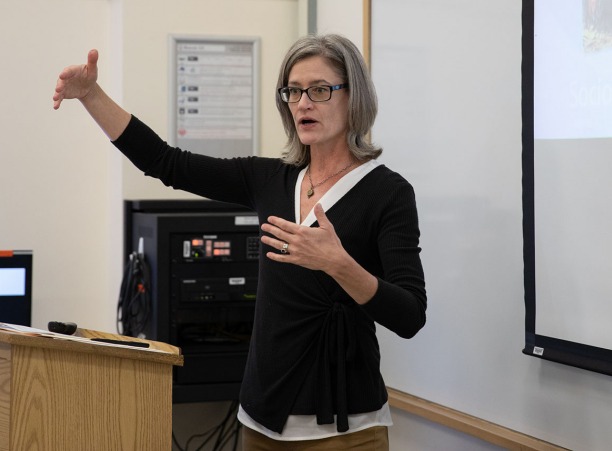
Jennie Germann Molz, professor in the sociology and anthropology department at the College of the Holy Cross, recently spoke to The Washington Post about the emerging trend of “roadschooling” or “worldschooling,” an issue she’s been researching extensively for her upcoming book, “The World Is Our Classroom: Extreme Parenting and the Rise of Worldschooling.”
The coronavirus “has been an inflection point in a lot of ways,” says Germann Molz. “With schools going virtual there has been a resurgence of interest in homeschooling in general, and then people realize, ‘Gosh, we don’t have to be home to do it.'”
And while “worldschooling” was considered extreme back in 2014 when Germann Molz and her family decided to spend a year traveling to all seven continents, today it’s becoming more mainstream among parents who are considering “taking a risky leap of faith to live a more fulfilling lifestyle than the one that’s served up by a consumerist suburban society.”
Germann Molz specializes in critical studies of travel and tourism, mobile technologies and social media, and global citizenship.
To read the full article, go to WashingtonPost.com.
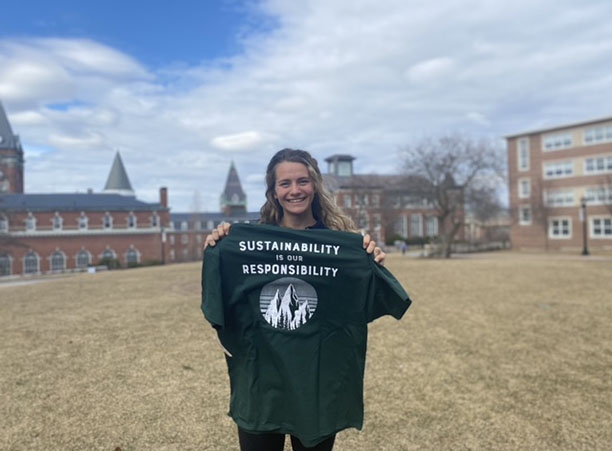
Renée LeBlanc ’21, co-chair of EcoAction, on the Hoval last year.
When the College’s student-led Eco-Action group was canvassing for student votes for the Holy Cross Green Fund last year, Kimberly Fetherston ’22 went to the place she knew she’d get results. “That was my first campaign,” she remembers. “I immediately went to talk to people on the Hoval. I walked around for hours, explaining the importance of the Fund, talking about what it would do for the College, and asking people: ‘Have you voted for the Green Fund yet?'”
That grassroots effort was undeniably effective, with 78% of students ultimately voting to implement the Green Fund, which is now used for student-run projects to promote sustainability on campus. A similar advocacy effort by the group last year resulted in the successful addition of a Director of Sustainability position at the College. But as a new semester begins, Eco-Action, like many groups and organizations, is rethinking their communications to fit the new reality of a world in the midst of a pandemic. “This is one of our biggest issues this semester—to not be able to just bother people on the Hoval,” Fetherston, co-chair of Eco-Action and an English major with an environmental studies minor, says. “But we’re making use of social media and every tool we have, and we’re finding ways to get out there and grow our online presence, followers and the kind of content we offer.”
As their communications efforts shift from stickers and brochures to social media posts and virtual advocacy, Eco-Action isn’t dialing back their mission during the remote semester. “Our mission continues to be educating students, faculty and staff about sustainability issues globally,” says Renée LeBlanc ’21, co-chair of Eco-Action and an environmental studies and political science double major. “We want to really direct our mission toward environmental justice this year and create more ways to empower people to address environmental inequalities in their area.”
“When we have the opportunity, we are taking it,” explains LeBlanc. “We can’t have a farmers’ market on campus this semester, but we are doing EcoTeams, an interactive, small group-based challenge to complete tasks over time—for example, calling a local congressperson about an environmental issue and sending in a screenshot of the call—and giving the winning team at the end of the semester a gift basket. We’re focused right now on voter registration to ensure students know about which issues are environmental votes. And we’re putting together resources so people who want to learn more can watch documentaries or read recommended books to continue their education on sustainability topics.” Ultimately, the students hope to partner with professors to incorporate some of these resources into classes in the College’s environmental studies department.
The group also plans to hold environmental justice webinars, in collaboration with the environmental studies department, which will allow students access to experts and leaders in sustainability. Here, the student co-chairs see a silver lining—while the group has always brought in speakers, the remote nature of this semester’s speaker forums opens new and exciting possibilities for the speaker pool. And as LeBlanc notes: “The nice part is that it’s better for the environment for them to not travel, so it works out!”
Despite their current lack of access to students on the Hoval, LeBlanc and Fetherston are focusing on the benefits to the semester’s remote environment. In addition to being able to more actively engage students’ local towns and communities to take more of a stand on environmental issues, this semester can be an opportunity to be sustainability ambassadors to family and friends. “When you’re home, you have more of an opportunity to interact with your family and you can take time to apply what you’ve learned from Eco-Action,” says LeBlanc. “Take a look around and see where there’s an opportunity for improvement: what type of energy is your family really using, and how much? We can encourage people to pay better attention to what’s coming in and out of their home every single day.”
Some of Eco-Action’s recommendations for small ways in which students can start living more sustainably include:
1) Focus on water usage to maximize the impact of the water you’re using—only run the washing machine or dishwasher with full loads, use cold water over hot water whenever possible (it uses less energy) and air-dry your clothing. Shower to a two-song playlist.
2) Use natural light as a simple way to save on energy—sit next to a window to read or study on a nice day with natural light (bonus: it will be easier on your eyes!).
3) Considering purchasing from sustainable companies when shopping online. (Don’t know where to start? Read this interview with Ellis Jones, assistant professor of sociology.) Eat and shop local. When you’re food shopping, pay attention to what kind of food you are buying—for example, transitioning to oat or soy milk from cow’s milk cuts down on emissions.
For more tips like these and for information on how to join Eco-Action, follow their Instagram at @hcecoaction or email Eco-action@holycross.edu.
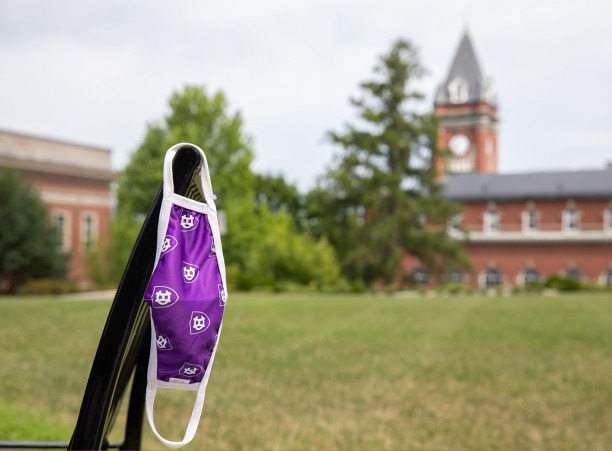
In the midst of the disruption brought on by the COVID-19 pandemic this past spring, while many of his peers were still grappling with the challenges of a sudden shift to remote learning, John Larsen ’22 had something else on his mind. He felt strongly that, during this challenging and pivotal time in our history, it was important to preserve the memories of those in the Holy Cross community who lived through this pandemic.
So he teamed up with Lorelle Semley, professor of history and director of the Center for Interdisciplinary Studies, and Cynthia Hooper, associate professor of history and director of the Russian and Eastern European Studies program, in applying for an $18,000 grant from the McFarland Center for Religion, Ethics, and Culture to recruit student research associates to work on this project for the duration of the summer.
Dubbed “COVID Chronicles,” the project was structured to have two major goals: to design a website, intended to collect testimonies, photos or mementos of this time from diverse members of the Holy Cross community, and to complete individual research projects around larger COVID-related themes, each involving the compilation of interviews and collection of primary sources.
“The ‘COVID Chronicles’ project demonstrates a crucial example of student initiative and perspective in the form of a graduate-level research opportunity,” said Semley. “It’s so important to create and highlight these types of research opportunities that derive from students’ own interests and also serve the larger community in a time that is so shaped by use of technology and social media.”
Indeed, the student response was overwhelmingly positive, with 26 applications for the 12 approved research associate positions. According to Professor Hooper, the project felt important to students because they were “very aware that we are living through a transformational moment – a period of weeks or months or years that will become the focus of scholarly analysis in the future, and a time people will be curious about for generations to come. We are all, right here right now, living through history.”
The student research project topics were equally varied and complex, including: the experiences of Chinese international students, the role of women, the consequences of the Spanish Flu in Worcester almost exactly a century ago, the effects of the current pandemic on today’s Worcester community, the consequences of the pandemic era for young people and the changing roles of art and technology in this new age, and more.
Titled “Alone Together: Technology’s Impact on Social Isolation,” Larsen’s research project examined the relationship between isolation, technology and connectivity during the COVID-19 pandemic. As part of his research, Larsen incorporated his own contemporary historical research with oral history interviews he coordinated and conducted.
“In just a short number of days, our world became so small, so quickly,” said Larsen, a history and Asian Studies double major. “During this time, people lost their typical patterns and quickly adapted to a world where social media replaced authentic social interaction. This adaptation period was challenging for many, and I believed it was important for me to provide a space for people who felt particularly lonely and isolated during this pandemic.”
A history and art history double major, Jinze Mi ’23 focused on the experiences of Chinese international students during the pandemic. He interviewed Chinese students in the U.S., mainland China, Hong Kong and Taiwan in the hope that he could “shed a light on family relationships, information flows via mass media and reconfiguration of national pride during this unique time of public health crisis.”
Elizabeth Griffin ’21 delved into researching the impact of the pandemic on artists and performing arts organizations around the country and explored what the future of performance might look like post-COVID. “The arts industry has lost roughly $10 billion since March, and most performances have been canceled until 2021, so I was prepared for some pretty grim outlooks – that this could be the end of performance,” said Griffin, a history and music double major. “But many I talked to were hopeful that a cataclysmic event like the pandemic could finally thrust classical music into the 21st century and make it more accessible and socially conscious.”
The COVID-19 crisis and its impact on politics, economics and everyday life is not going away as we head into the fall. According to Semley and Hooper, we will still be in the midst of an epoch-defining historical moment over the course of the coming year, as communities of all sizes try to rebuild and renegotiate the organization of family, work and education.
The two professors hope to continue this project during 2021 and the upcoming academic year. They envision this project as a way of creating community and learning from the experiences of others. The next step is to recruit students to manage the “COVID Chronicles” website and develop strategies to engage website visitors and gather content submissions.
“In the end, the ‘COVID Chronicles’ project, as a whole, has been of enormous value both in terms of its mission to preserve history and, I think, also in terms of its practice of creating community,” said Hooper. “But maybe the most important aspect of this project is that it has encouraged our students not only to think about the impact the pandemic has had on their own lives, but also to appreciate and give voice to the different ways the pandemic has touched people other than themselves.”
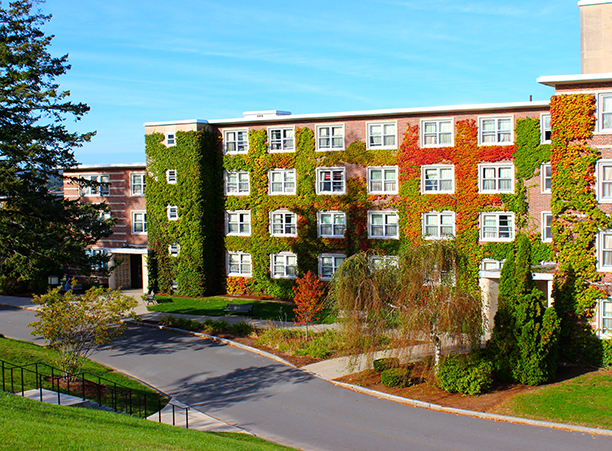
Philip L. Boroughs, S.J., president of the College, announced in his fall address that Brooks-Mulledy Hall will now be known as Brooks Hall.
“In the face of ongoing racial violence and the momentum of the Black Lives Matter movement, statues have toppled and names have been dropped by various colleges and universities, and we have turned again to the issue of the Mulledy name,” Fr. Boroughs said. “I have decided, and our board of trustees, the Jesuit community on campus and our provincial have supported, that we remove the Mulledy name from the residence hall and change the name of Brooks-Mulledy Hall to simply Brooks Hall.”
In his address, Fr. Boroughs explained the history behind the College’s first president, Rev. Thomas F. Mulledy, S.J.: “In 1838, Fr. Mulledy, while serving as provincial of the Maryland province, authorized the sale of 272 enslaved persons owned by the Jesuits to pay off debts at Georgetown University. In the controversy that followed within the Jesuit community, he resigned his position and spent the next five years in a form of exile in Europe.” Mulledy later returned to the U.S. to found the College of the Holy Cross.
In 1966, the College named its newest residence hall after Fr. Mulledy, a decision it re-examined in 2015-2016 when Fr. Boroughs instituted the Mulledy/Healy Legacy Committee to examine the appropriateness of the names on two residence halls in light of connections to slavery. In 1853, Patrick F. Healy, S.J., a Jesuit scholastic at Holy Cross, received $2,300 from the sale of his father’s estate in Georgia, which included 49 enslaved persons. Because Healy — the son of a white Irish immigrant farmer and his common-law wife, a mixed-race slave named Eliza Clark — could not keep the money due to his vow of poverty, he received permission from his superiors to donate it to the College, which was rebuilding from a devastating fire the previous year.
After months of meetings and sessions with campus constituencies, the Mulledy/Healy Committee decided not to remove the Healy name, but couldn’t find consensus regarding the Mulledy name. Fr. Boroughs proposed renaming the building as Brooks-Mulledy Hall, to indicate the transformative work of Rev. John Brooks, S.J. ’49, the 29th president of the College, in recruiting several Black men to the College in the early 1970s in order to diversify campus.
“The story of Fr. Mulledy, the source of the Healy gift to the College and the complexity of [his] family’s racial history should be memorialized, studied and taught on our campus, as should the fact that where our campus stands had at one time had been part of the lands of the Native American Nipmuc tribe,” Fr. Boroughs said. “Currently, we are in the process of having plaques fabricated for Brooks Hall and Fenwick Hall that detail this history, as well as a campus plaque referencing the Nipmuc tribal community who once lived here.
“This is only one small step of many more we need to take to become more intentionally anti-racist,” he continued. “As an institution and community, we must continue to research the history of the College and understand that history in connection with the legacy of slavery and persistent social inequities.”
Over the summer, the College announced an evolving anti-racism action plan and the Board of Trustees created a permanent Diversity, Equity and Inclusion Committee of the Board to oversee that work.
In addition to the steps laid over in the summer, Fr. Boroughs announced in late September that the College would observe the federal holiday of Columbus Day as Indigenous Peoples’ Day, and also recognize Juneteenth as an official holiday. These actions, the president said, “serve as a reminder of the enduring struggle for equality and respect by people of color as well as an opportunity to consider the work that we must continue to do together to make our community and our country a place where all people are respected and treated fairly.”
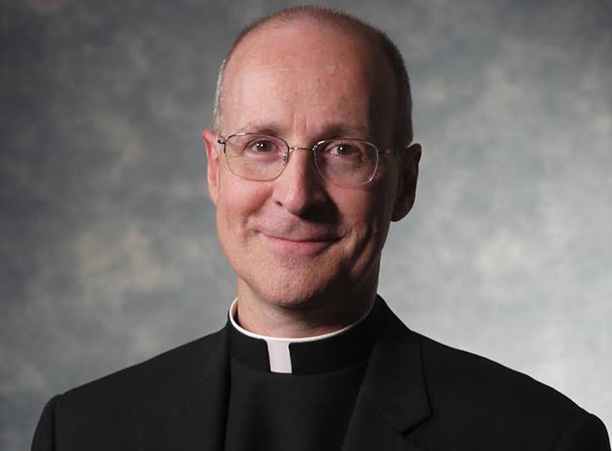
Rev. James Martin, S.J.
Renowned Jesuit priest Rev. James Martin, S.J. joined the Holy Cross community on September 28 for a live webinar, “Ignatian Tools During a Time of Crisis,” which included a talk followed by a Q&A session. The event, hosted by the Holy Cross Alumni Association, was open to alumni, students, parents, faculty and staff, who also had the opportunity to submit questions to Fr. Martin ahead of the event.
Initially planned as an in-person event for the 2020-2021 academic year that would have accommodated approximately 200 people, the move to a virtual format ultimately enabled a wider audience to hear from Fr. Martin. The event had over 1,400 participants, with over 100 questions submitted by registrants.
Rev. Philip L. Boroughs, S.J., president of the College, kicked off the hour-long session by introducing Fr. Martin as “an outspoken advocate for dialogue across differences and a strong promoter of Ignatian spirituality and the great tradition of the Society of Jesus. If you read Jim’s works carefully, you know well that he sees in Jesus’ ministry to us the essence of what it means to embody compassion and mercy.”
Fr. Martin began his remarks by sharing his appreciation for Holy Cross, noting, “I am a New England province Jesuit originally, and so Holy Cross played a big part in my Jesuit life, even though I’m not an alum.” He noted that he has long had a “fondness” for Holy Cross and enjoys meeting alumni from the College.
In the first half of the webinar, Fr. Martin shared his thoughts on how to use the tools handed down from St. Ignatius to help us navigate life in a time of crisis. Using the current pandemic as a framework for the discussion, Fr. Martin detailed three Ignatian tools that can be used on a daily basis during this challenging time: discernment of spirits, examination of conscience and Ignatius contemplation. He emphasized the need to focus on feelings of gratitude in what may otherwise seem like a time of despair. “In difficult times, we tend to focus just on the problems,” said Fr. Martin. “That can work against us, though. As much as we are trying to figure things out, we can overlook the graces and the blessings that God has given us.”
For the moderated Q&A session, Michael Shanahan ’78, president of the Holy Cross Alumni Association, posed questions to Fr. Martin that had been submitted ahead of the webinar by members of the Holy Cross community. The questions focused on a range of subjects, from politics to the church to spirituality tools he uses in his own life. When asked how to ensure that the presence of the Jesuits is felt years into the future, Fr. Martin projected a positive outlook, using the College as his example, remarking, “Let’s look at campus ministry at College of the Holy Cross and all the wonderful work that they do… It’s not all Jesuits. It’s not all men. It’s people who are animated by Jesuit spirituality and by the Ignatian charism. So I do think that Jesuits are essential at a Jesuit university… but the gifts of Ignatian spirituality are for everyone.”
Fr. Martin is a daily spiritual resource for thousands through social and news media outlets. After entering the Society of Jesus in 1988 following a career in corporate finance, he was ordained to the Roman Catholic priesthood in 1999. He is the editor-at-large of the Jesuit magazine America, a consultant to the Holy See’s Dicastery for Communication, and the author of many books, including The New York Times bestsellers “The Jesuit Guide to (Almost) Everything” and “Jesus: A Pilgrimage.” His book “Learning to Pray: A Guide for Everyone” will be published in February.
Watch the entire recording of the Holy Cross Alumni Association’s webinar with Fr. Martin, “Ignatian Tools During a Time of Crisis” on the Holy Cross YouTube channel.
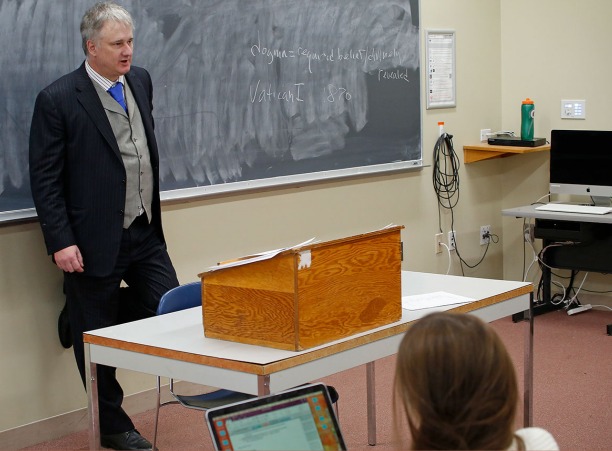
When Judge Amy Coney Barrett was nominated as President Donald Trump’s pick to replace late Supreme Court Justice Ruth Bader Ginsburg, media focus immediately turned to her reported membership in “People of Praise,” a nondenominational Christian charismatic community formed in South Bend, Ind. in 1971.
Writing for The Conversation, Mathew Schmalz, professor of religious studies at Holy Cross, explains the history behind the Catholic charismatic faith and also the controversy around some of its practices, which differ from mainstream Catholic worship.
“Commentators disagree about whether Barrett’s membership in a charismatic religious community should be an issue in any potential nomination hearings,” says Schmalz. “But charismatic or Pentecostal groups and churches represent the fastest-growing segment of Christianity throughout the world. For this reason, Amy Coney Barrett’s beliefs may be shared by many contemporary Christians.”
Schmalz, an expert in global Catholicism and Catholic history, has previously received Fulbright and American Institute of Indian Studies dissertation grants for the study of charismatic Catholicism in India.
To read the full article, go to TheConversation.com.

Prior Center for Performing Arts
Last week, a small group gathered for the topping out ceremony to watch the final beam be placed atop the Prior Center for Performing Arts. This milestone marks significant progress on a structure that will be the heart of the arts at Holy Cross for years to come.
“We would not be here today if it were not for the remarkable generosity of Neil Prior, class of ’56, and so many alumni, parents and friends whose vision and investment allowed us to commence construction on this facility that is critically important to the future of this college,” said Rev. Philip L. Boroughs, S.J., president of the College, who proceeded to thank Dimeo Construction, architect Charles Renfro and his associates at Diller Scofidio + Renfro, the Holy Cross facilities team and the construction crew who work at the site each day. “You are helping to create an important addition to our campus that will have a profound impact on the education experience of the students here at Holy Cross.”
Although the gathering was small due to the ongoing pandemic, the milestone was a reminder of some of the persisting values of the Holy Cross community—creativity, innovation and togetherness. “Our entire College family is here with us in spirit,” said Fr. Boroughs. “We’re cognizant that we remain united even when we are apart.”
Fr. Boroughs led those in attendance in a prayer as the final beam was lifted into place at the top of the building. Other highlights of the ceremony included statistics from Dimeo on the staggering amount of work that has gone into the building so far—over 15,000 cubic yards of earth moved and over 3,600 tons of concrete put in place without a single accident—as well as remarks from Stephen Rutledge, chief operating officer of Dimeo, and Margaret Freije, provost and dean of the College.
“We are confident that, as we top off today, this will be a center for the entire community, where each member is encouraged to be entrepreneurial, to be open to new ideas and new ways of engaging the word, to grow in ways that we can’t even imagine now,” said Provost Freije. “And we look forward with great enthusiasm to the day when we can occupy this space and, with renewed fervor, expand our commitment to the arts and to the excellence of a Holy Cross education.”
Once complete, the center will include dedicated spaces for the fine and performing arts as well as spaces and technology to support creative interactions between the arts and other disciplines. Included in the design are a 400-seat proscenium-style concert hall and theatre, a 200-seat fully flexible experimental theatre space, support and multi-use spaces to encourage collaboration among the arts (such as “the Beehive,” a flexible space with a café that will support creative collaboration among students from all academic disciplines) and a shared multimedia teaching space. The new building will also house Cantor Art Gallery, which will be moved from its current location in O’Kane Hall, and will offer several outdoor amenities, including a small amphitheatre and gardens for meditation and outdoor creative work.
The center will serve as home to Holy Cross’ distinguished faculty in the performing arts. Their creative works have been presented to worldwide acclaim and have been celebrated with recognition such as a Guggenheim Fellowship, a MacArthur Genius Award, three Grammy awards, numerous international prizes for composition and performance and multiple grants from federal and regional organizations.
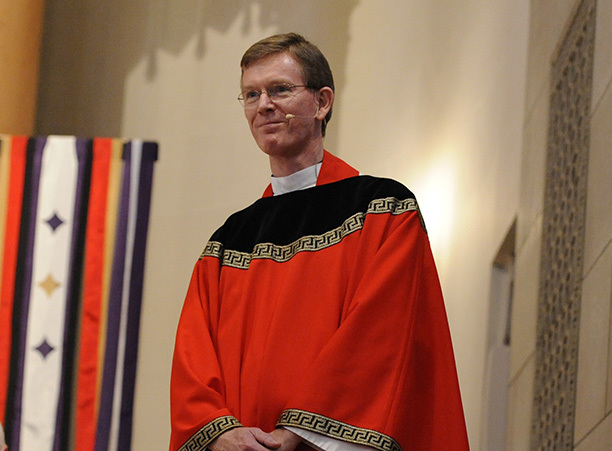
The Rev. Philip L. Boroughs, S.J., president of the College of the Holy Cross, announced Tuesday that this academic year will be his last, ending a nine-year tenure marked by the largest fundraising campaign in school history, new buildings, and expanded academic and cocurricular programming.
Fr. Boroughs, 71, is the 32nd president of the Jesuit liberal arts college, the oldest Catholic college in New England. In a live video address to campus on Tuesday, he said he will stay on until June 30, 2021, and then take a one-year sabbatical before receiving a new assignment from the Jesuit Order. A national search for Fr. Boroughs’ replacement will begin shortly.
“I feel that new energy and some different skills are needed to address the realities of the coming years,” Fr. Boroughs said in a message to campus and alumni. “This time feels like a natural inflection and transition point for the institution: our seven-year campaign just ended most successfully and we have just begun a strategic planning process that will set goals for the College for the next three to five years. As I know from my own experience, it is important that a new president be part of that process, as it will give shape to his or her energies and commitments throughout their term of office.”
Rick Patterson, Chairman of the Board of Trustees, said, “Father Boroughs has been an inspirational, inclusive leader of our beloved College and a tireless champion for all that our Holy Cross family values. The transformation that he drove atop Mount St. James, as well as the construction of the stunning Contemplative Center in West Boylston, will enhance the spiritual, intellectual and physical well being of countless generations of Holy Cross students.”
Fr. Boroughs assumed office in Jan. 2012. Since then, Holy Cross has successfully completed a $420 million capital campaign through the generosity of alumni who continue to place the College in the top 10 in the nation in alumni giving participation. The College also instituted new academic initiatives, including the J.D. Power Center for Liberal Arts in the World, Arts Transcending Borders, and the Scholarship in Action program, which funds faculty research in Worcester. During Fr. Boroughs’ tenure, Holy Cross’ Division 1 athletics program has consistently performed in the top 10 in the nation with a graduation success rate of at least 97%.
Fr. Boroughs also led efforts to make Holy Cross a more diverse, inclusive campus. During his tenure, the College created the Office of International Students and joined the American Talent Initiative, which seeks to expand access for low-income and first-generation students. Holy Cross opened a new office of Diversity, Equity and Inclusion, and created a new position, Associate Provost for Diversity, Equity and Inclusion, to lead efforts in that area. A new office of Title IX initiatives and equal opportunity was also created during this time.
Under Fr. Boroughs’ leadership, the College has begun or completed transformational capital projects, with a priority on furthering an education which integrates mind, body, spirit and community. In 2016, the College opened the Joyce Contemplative Center, a new 33,800-square foot complex in West Boylston, Mass., which has allowed for expanded and additional retreat programming for students, alumni, faculty and staff. In 2018, the College unveiled a dramatically expanded Luth Athletic Complex, which greatly enhanced facilities available to Holy Cross athletics teams. In the next year, the College is on track to open two new buildings on campus: a dramatic, state of the art Performing Arts Center; and the Joanne Luth Recreation and Wellness Center to serve students, faculty and staff and promote healthy opportunities for recreation and exercise.
Immediately before coming to Holy Cross, Fr. Boroughs served as Georgetown University’s first vice president for mission and ministry from 2003 to 2011. He currently serves as a member of the Board of Directors of the Association of Jesuit Colleges and Universities; the Board of Trustees of St. Joseph’s University; the Board of the Higher Education Consortium of Central Massachusetts; and the Council of Presidents of the Patriot League, for which he served as chair from 2015-2017. He also served a three-year term on the Board of Directors of the American Council on Education and has served on the Board of the University of San Francisco.
Fr. Boroughs earned his B.A. from Gonzaga University in Spokane, Wash., in 1973, and received a Master of Divinity from the Jesuit School of Theology (Chicago) in 1978. He holds a Licentiate of Sacred Theology from the Jesuit School of Theology in Berkeley (1987) and received a Ph.D. in Christian spirituality from the Graduate Theological Union (Berkeley, Calif.) in 1989.
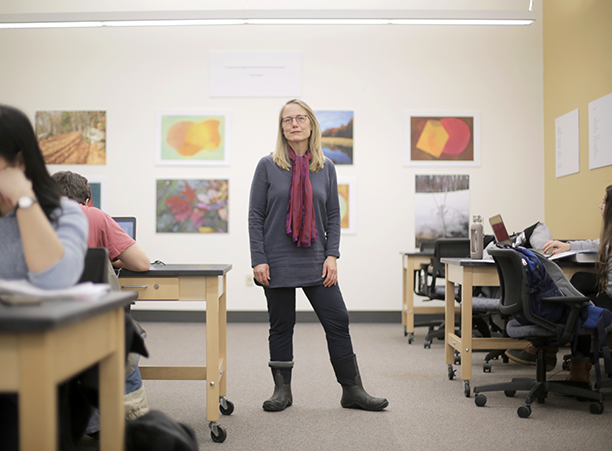
As the pandemic continues to grow nationwide, another wave seems to also be surging: embracing kindness.
Leila Philip, professor of English at Holy Cross and a contributing columnist for the Boston Globe’s Opinion section, recently penned a piece for the paper in which she reflects on her neighbor’s involvement with RVs4MDs, a volunteer group matching RV owners with healthcare workers in need of temporary housing.
Originally started as a grassroots movement through Facebook, RVs4MDs has quickly morphed into a nonprofit organization garnering support on a national level, with people across the country coming together to protect the families of healthcare workers from exposure to the coronavirus.
“Ordinary Americans like my neighbor and the many volunteers at RVs4MDs show how we can prevail — when we remember our American tradition of lending a hand, the transformative power of kindness,” said Philip.
To read the full article, go to BostonGlobe.com.
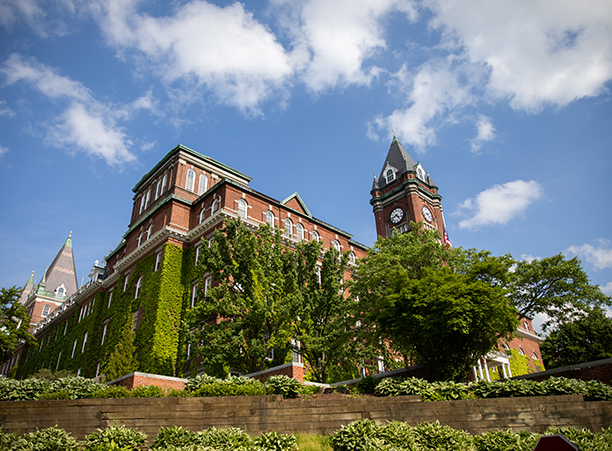
The College of the Holy Cross has once again been recognized as one of the top colleges in the nation by Washington Monthly in the magazine’s “2020 College Guide and Rankings.” The annual ranking reflects the College’s “contribution to the public good” in terms of supporting and promoting social mobility, student research and public service.
Holy Cross was ranked No. 11 on the magazine’s list of “Best Bang for the Buck Northeast Colleges,” which recognizes four-year institutions that “help nonwealthy students obtain marketable degrees at affordable prices.”
Additionally, the College was also ranked No. 18 for liberal arts colleges, from a total list of 218 liberal arts institutions across the country.
Washington Monthly prides itself on taking a different approach to rankings, by ranking colleges on how well they serve the country as a whole—through recruiting and graduating nonwealthy students, encouraging student activism, and producing research and technologies that create high-paying jobs and address threats like climate change.
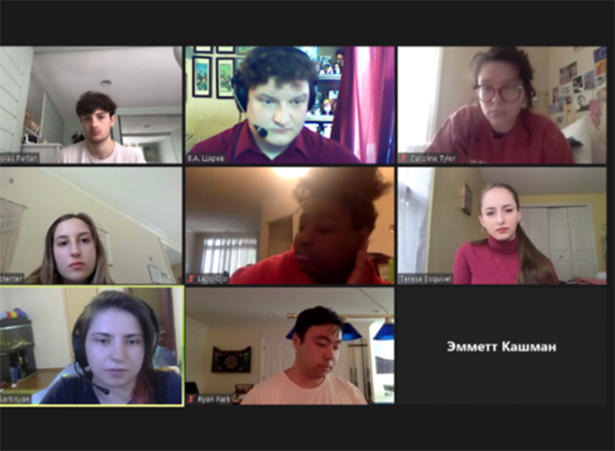
Photo courtesy of the Russian State University for the Humanities.
When the 2020 Moscow Maymester was cancelled due to the coronavirus pandemic, the 12 students who were scheduled to attend found themselves suddenly without their highly anticipated study abroad plans. But Olga Partan, associate professor of Russian and co-director and faculty advisor for the 10-year-old program, rallied to find a new opportunity for an immersive language experience for her students.
“The Maymester program is a critical element of our Russian studies program—students love the experience and it significantly enhances their language skills,” Partan explains.
Working closely with Valentina Trufanova, the head of the Center of Russian as a Second Language at the Russian State University for the Humanities (RSUH) in Moscow, as well as Holy Cross and RSUH administrators, Partan tackled the logistics involved in designing and creating the program alongside Loren Cass, dean of experiential learning and student success, and Brit Smith, director of study abroad. Despite the challenges posed by the pandemic, the program was able to launch only a week later than the Maymester had originally been planned to start.
During the intensive program, students at four different language levels worked online five days a week for six weeks, with second-year Russian students taking four hours of online sessions per day with RSUH instructors, and students at other levels following individualized plans. Two students outside of the College—one from Vassar and one from Brandeis—were also accepted into Holy Cross’ program. All of the students were taught by world-leading specialists in teaching Russian as a second language.
Teresa Esquivel ’23, a Russian and international studies major, found the remote instruction to be extremely effective. “I was pleasantly surprised by the skillful integration of electronic media into presentations and our interactive lessons. I felt as close to a ‘regular’ student as possible during my courses, and found every one of my professors to be an exceptional, approachable educator. I can say without hesitation that my grasp of the Russian language has grown deeper than I ever could have imagined in so few weeks of study.”
Nicholas Partan ’22, a political science major and Russian minor, appreciated the variety of instruction. “Before beginning, the director of the program in Russia spoke individually to all of the students in my class to better understand what level we were at going into the program, in order to better suit the course material to our needs. During class, we were taught every hour by a different instructor, which helped to keep us engaged and allowed us to hear a broad range of native Russian speakers throughout the day.”
Students received significant individual attention during the summer session, made marked progress in their Russian proficiency and will receive a full course credits toward their Russian minor or major.
“Most importantly,” says Professor Partan, “This program has opened a window to Russian culture and society for our students who were unable to travel to Russia. Students had several virtual tours in Moscow and other Russian cities, were singing popular Russian songs, were working on their phonetics and pronunciation as well as reading and discussing a variety of Russian texts. The students really enjoyed close online interaction with native Russian instructors who are living in Russia.”