In Memoriam: William Meinhofer, Founding Director of Community-Based Learning

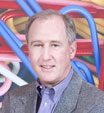
Dr. William Meinhofer, founding director of the Donelan Office of Community-Based Learning at the College of the Holy Cross, passed away on Jan. 3 in Boston. He had been undergoing treatment for cancer. He was 60.

Dr. Meinhofer was recruited to the faculty of Holy Cross in 2001, following a nationwide search for a director with the special blend of skills it would take to establish a new program in community-based learning at Holy Cross. His hard work and good humor quickly won him many friends and the program he created has set high standards for peer schools to aspire to. Through his work with numerous community agencies, Dr. Meinhofer also significantly improved relations between the College and the city of Worcester.

“We are deeply saddened by the loss of Bill Meinhofer, as much for who he was as for what he did. He was a great friend to many, always caring, upbeat and generous. He deserves all the credit for building our very successful community-based learning program from a handful of courses to about 90 courses involving some 850 students each year. He also made major contributions to many of our other community involvements. There is no way to express adequately how much Bill Meinhofer meant to Holy Cross,” said Rev. Michael C. McFarland, S.J., president.

From his desk at Holy Cross, Dr. Meinhofer worked with faculty, students, and community and public service organizations in Worcester to facilitate community-based learning courses across the College curriculum. Since he first began promoting community-based courses on the campus, more than 20 percent of the faculty have taught courses in his program, and almost 25 percent of Holy Cross students are involved in community projects through these courses each year.

Among the local organizations participating in the College’s Community-Based Learning courses are: AIDS Project Worcester, Big Brothers Big Sisters of Central Massachusetts, Boys & Girls Club of Worcester, Massachusetts Audubon Society, and the Henry Lee Willis Community Center.

“Bill was the heart of Holy Cross’ relationships with the community,” said Richard Matlak, director of the Center for Interdisciplinary and Special Studies, which houses the Donelan Office of Community-Based Learning.

Dr. Meinhofer taught several courses himself, among them: Introduction to Community Organizing; Latinos in the United States; and Special Projects in Community and Urban Studies.

He was a 1994 graduate of the University of Massachusetts at Boston and received his Ph.D. in sociology from Boston College in 2001.

Dr. Meinhofer was a member of the Boards of Directors of Big Brothers Big Sisters of Central Massachusetts, the Worcester Working Coalition for Latino Students, and the Henry Lee Willis Community Center. He was also founding chairperson of the Community Engagement Committee of the Colleges of Worcester Consortium.

From 6 to 9 p.m. on Jan. 5, visitation will be held at the P.E. Murray Funeral Home, 2000 Centre Street, West Roxbury, Mass. 02132. At 10 a.m. on Jan. 6, a service will be held at the funeral home, to be followed by interment at St. Joseph’s Cemetery, West Roxbury.

A memorial service will be held on campus. Details are forthcoming.

Posted in News | Comments Off on In Memoriam: William Meinhofer, Founding Director of Community-Based Learning

CFO of Staples to Talk About Journey from English Classes to Head of International Company

When John J. Mahoney graduated from Holy Cross in 1973 with his English major, he hadn’t a clue about what was next.

“The early ’70s was a pretty interesting time in American history,” he says. “My friends and I graduated with no idea of what we were going to do. I wanted to try a couple of different things, and even thought about being a ski bum while I figured it out.”

So?

“Well, that idea didn’t appeal to my parents.”

For someone who didn’t have a particularly strong interest in leaping into the business world, Mahoney’s position today as vice chairman and CFO of the world’s largest office-products company might raise eyebrows.

It has been an exciting journey, Mahoney says. And reflecting on his career today, he believes his liberal arts education was a major asset and continues to supply resources and skills he needs to excel at his job.

Mahoney, an executive at Staples since 1996 and prior to that a partner at Ernst & Young, will discuss his career Jan. 25 at 7 p.m. in Hogan Suites B and C, fourth floor of the Hogan Campus Center. His talk, free and open to the public, is part of the Ciocca Entrepreneurial Business Seminars, sponsored by the Holy Cross prebusiness program.

In advance of his visit back to alma mater, he spoke about the value of a liberal arts education in the business world — and the responsibilities and challenges of his work at Staples.

What does a liberal arts education bring to business today, especially in this global economy?

First of all, because the world changes at such a rapid pace today, a liberal arts college like Holy Cross offers the best preparation for a career in business. A liberal arts education teaches you how to think and adapt and look ahead. It teaches you to read, write, communicate verbally, and really understand different patterns — whether they’re in math, science, history or psychology.

You come from a Holy Cross family.

My father graduated in 1944; my son Michael in 2000. Michael worked at EMC for two years, went to Harvard Business School, and is now at Rockport Co., which is a division of Reebok International.

Staples’ most recent annual report has extensive information about “Staples Soul”; about building diversity and your commitment to ethical business practices. Can you talk about that?

This has been a very interesting time for Staples. When the company launched 20 years ago, we were a relatively small entrepreneurial venture — just trying to survive. It seemed like all of sudden, we grew to a size that surprised even us. When that happened, NGOs came to us, pointing out the impact we were having on paper production around the world.

It was a shock to us; and we spent a great deal of time looking at the issues. It was the start of us recognizing the importance of sustainable practices. It began with the environment, and then grew into an examination of our practices from a people perspective and a community perspective.

And that’s where your commitment to diversity comes in?

Yes, our goal is to have a great workforce and make the company a place people are proud to work for; to have stores that people in the community want to shop in. We want a workforce that reflects the diversity of the markets in which we operate.

By inventing the office superstore concept back in 1986, Staples began life with an entrepreneurial spirit. Has that spirit continued?

Definitely. And that’s an inspiring part of our work. Our teams are constantly developing innovative products. They work hard to understand the problems and challenges facing small businesses. Solving these problems with product development is really fun — and keeps that entrepreneurial spirit alive. We had great success — and great fun with — the Department of Unexpected Gifts this holiday season. It was a terrific promotion.

Staples serves consumers and businesses ranging from home-based businesses to Fortune 500 companies in 21 countries throughout North and South America, Europe and Asia. Part of your job responsibility involves global strategic planning and business development.

We’re moving strategically and carefully in overseas markets. There’s still a great deal of growth potential in the U.S. What is exciting right now is that we’re one of the top five e-commerce sites in the world. We’ve gone from $0 to $4.5 billion in just six years. That’s been an incredible experience.

Posted in News | Comments Off on CFO of Staples to Talk About Journey from English Classes to Head of International Company

Holy Cross Professors Author Books in Wide Array of Fields

WORCESTER, Mass. – From the history of Charleston to the philosophy of viewing art to the practice of Catholicism, faculty members at the College of the Holy Cross have authored numerous books in a range of subjects recently. Many of the books have received praise from experts in their respective fields.

Among them:

Avery-Peck, Alan J. (ed.). The Review of Rabbinic Judaism: Ancient, Medieval, Modern, Vol. 9. Leiden & Boston: Brill, 2006.

This journal presents research on fundamental problems in the study of the authoritative texts, beliefs and practices, events and ideas, of the Judaic religious world from the Hellenistic period to the present. Pseudepigrapha, the editing of the Babylonian Talmud, life in Late Roman Palestine, Pharisaic law, vegetarian ideology in Judaism, and the Church Fathers’ use of Rabbinic Midrashic techniques. Avery-Peck is professor and chair of the religious studies department.

Avery-Peck, Alan J. & Jacob Neusner (eds.). The Mishnah in Contemporary Perspective. Part Two. Leiden & Boston: Brill, 2006.

This second of a two-part project on the Mishnah in contemporary study, displays a broad selection of approaches to the study of the Mishnah in the contemporary academy. Topics in this volume include the problem of Mishnaic historiography, the construction of households in the Mishnah, archaeology and the Mishnah’s legal tradition, and the Poetics of the Mishnaic literature. Avery-Peck is professor and chair of the religious studies department.

Avery-Peck, Alan J., Jacob Neusner and William Green (eds.). The Encyclopaedia of Judaism Second Edition, enlarged and expanded. Leiden and Boston: Brill, 2005.

In four volumes and 2948 pages, this encyclopedia covers the religion of Judaism beginning in ancient Israelite times and extending to our own day. Containing 150 major articles written by scholars in North America, Europe, and Israel, it treats Jewish religion, history, literature, beliefs, observances, practices, and the place of Jews and Judaism in diverse societies and cultures. This second edition doubles the size of the original publication, so as to cover all aspects of Jewish history and practice as well as to provide accounts of the character of contemporary Jewish communities around the world. Avery-Peck is professor and chair of the religious studies department.

Bizzell, Patricia L. (ed.). Rhetorical Agendas: Political, Ethical, Spiritual. Mahwah: Lawrence Erlbaum Associates, Publishers Inc., 2006.

Rhetorical Agendas comprises the proceedings of the 2004 biennial international conference of the Rhetoric Society of America. In addition to keynote addresses by Lester Faigley, Gerard Hauser, Peter Mack, and Jacqueline Jones Royster, 36 additional papers from the conference are grouped under these headings: History, Theory, Pedagogy, Publics, and Gender. Bizzell is a professor in the English department.

Cass, Loren R. The Failures of American and European Climate Policy: International Norms, Domestic Politics, and Unachievable Commitments. State University of New York Press, 2006.

Cass, associate professor of political science, argues that international norms and normative debates provide the key to understanding the evolution of both domestic and international responses to the threat of global climate change. The focus of analysis is German, British, European Union, and American climate policy between 1985 and 2005. He examines why some nations, but not others, have made climate commitments and succeeded or failed to meet these commitments.

Clark, S.J., William A. A Voice of Their Own: The Authority of the Local Parish. Collegeville, MN: Liturgical Press, 2005.

In light of three parish studies, Fr. Clark, assistant professor of religious studies, examines community, intimacy, and authority, and claims that a fundamental aspect of ecclesial authority resides in the local community.

Clooney, S.J., Francis (ed.). Jesuit Postmodern: Scholarship, Vocation, and Identity in the 21st Century. Lexington Books, 2006.

Nine American Jesuit scholars teaching at colleges and universities — including Holy Cross alumnus Fr. Bruce T. Morrill, S.J., ’81 and professor Rev. William E. Stempsey, S.J., M.D., professor and chair of the College’s philosophy department — reflect on their academic work, explaining why they engage in this endeavor and how it coheres with their self-understanding as Jesuits. In accounts that weave together scholarly lives and personal stories, the contributors explore the irreducible diversity of their experiences and criticize the dominant modern synthesis that shaped Jesuit institutions of higher education from the 1960s to the 1990s. Through unconventional ways of discussing Jesuits, scholarship and religious intellectual inquiry, this book challenges scholars to speak more critically and imaginatively on these subjects.

Cording, Robert K. Common Life. Cavankerry Press, 2006.

Cording, professor of English, looks at the various meanings of common, especially its senses of familiar and widely known; belong or relating to the community at large; and its twinned notions of simple and rudimentary and vulgar and profane. The book’s perspective is religious, and is grounded in the epigraph from the Psalms: “Be still before the Lord and wait patiently for him.” The “waiting” that is required has to do with three things: first, our desire, as Charles Wright puts it, “to believe in belief” rather than believe; secondly, the need for a setting aside of the self, an abandonment of “every attempt to make something of oneself, even … a righteous person” in the words of Dietrich Bonhoeffer; and thirdly, the “waiting” must be as Eliot wrote in the Four Quartets a waiting “without hope for hope would be hope of the wrong thing.” If we learn to wait in these ways, the final section of the book suggests that we have the chance of opening ourselves to all that is graceful within life’s common bounds.

Dustin, Christopher A., and Joanna E. Ziegler. Practicing Mortality: Art Philosophy, and Contemplative Seeing. Palgrave/Macmillan, 2005.

Dustin, associate professor and chair of the philosophy department, and Ziegler, professor of visual arts, are authors of Practicing Mortality, a collaborative endeavor to deepen readers’ understanding of “contemplative seeing” through the works of Plato, Thoreau, Heidegger and more. The authors explore what it means to “see” reality and contemplate how viewing reality philosophically and artfully is a form of spirituality. In this way, the authors propose a way of seeing that unites both critical scrutiny and spiritual involvement, as opposed to simple passive reception.

Kom, Ambroise. Jalons pour un dictionnaire des oeuvres littéraires de langue française des pays du Maghreb. L’Harmattan, 2006.

Last volume of a trilogy that includes the Dictionnaire des oeuvres litteraires de langue francaise en Afrique au Sud du Sahara, Volume 1 (1983) and Volume 2 (1996). The goal of this project is to develop a useful instrument to appreciate francophone literary production of the African continent as a whole. Kom is a professor in the modern languages and literatures department.

Kom, Ambroise. Mongo Beti Parle. Homispheres, 2006. (Originally published in 2002, this is an enlarged edition.)

Mongo Beti (1932-2001) is one of the most original francophone African writers. Novelist, essayist, human rights and political activist, he spent more than 40 years of his life in exile. Mongo Beti parle is his last words, the result of interviews recorded two years before his death. Kom is a professor in the modern languages and literatures department. Kom is a professor in the modern languages and literatures department.

Lapomarda, S.J., Vincent A. The Jesuits and the Third Reich. Lewiston: The Edwin Mellen Press, 2005.

In The Jesuits and the Third Reich, Second Edition, Fr. Lapomarda, associate professor in the history department, describes Nazi persecutions of the Jesuit order during the Third Reich and the fates of many Jesuits in Germany, Austria, Czechoslovakia, Poland, the Baltic States, Russia, Rumania, Hungary, Yugoslavia, Italy, the Low Countries and France. He also focuses on Jesuit efforts in defense of human rights — particularly those of Jews — and provides a corrective to such views of the Roman Catholic Church of the Nazi period as that popularized by Rolf Hochhuth in The Deputy. According to America magazine, “Readers of Father Lapomarda’s excellent book, rich in notes and bibliography, can understand better the dimensions of a drama that struck one small, if representative, group of servants of the church before and during World War II.”

Luria, Sarah. Capital Speculations: Writing and Building Washington, D.C. Lebanon, N.H.: University of New England Press, 2006.

Luria, associate professor of English, pursues the vital political connection between architecture and literature in the formation in 1791 of America’s grand new capital city. City planners believed that designing Washington, D.C. as a physical model of the Constitution and its balance of powers would help citizens bond with the newly created nation. Once established, Luria argues, the capital became a stage for the visions of subsequent reformers. Abraham Lincoln, Walt Whitman, Frederick Douglass, and Henry Adams, all lived in the capital, and, as Luria shows, shaped its space in significant ways in an attempt to realize their written visions of how the nation should change. Clarifying the dynamic relations among discourse, economics, politics, and the built environment, Luria demonstrates how keenly architectural history is interwoven into American literary and political life.

Morrill, S.J., Bruce T., Susan Rodgers, and Joanna E. Ziegler (eds.). Practicing Catholic: Ritual, Body, and Contestation in Catholic Faith. New York: Palgrave Macmillan, 2006.

This collected papers volume, based on a 2002 national conference held at Holy Cross’ Center for Religion, Ethics, and Culture, interprets world Catholicism as a deeply embodied and performed faith. Chapters range in subject from medieval rituals to contemporary faith practices in Massachusetts; scholars include art historians, liturgical theologians, performance artists, historians, and anthropologists. Rodgers is professor of anthropology, and Ziegler, an art historian and medievalist, is professor of visual arts.

Murphy, Frederick J. An Introduction to Jesus and the Gospels. Nashville: Abingdon Press, 2006.

Murphy, professor of religious studies, introduces readers to the four Gospels by discussing the variety of ways in which the Gospels are studied, describing their historical, cultural, and literary contexts, and analyzing each biblical gospel in depth. In addition, the book goes beyond biblical sources by surveying gospels outside the Bible. All gospels were written a generation or more after the death of Jesus, so this book also explains how historians attempt to study the historical Jesus. Finally, there is a chapter on why Matthew, Mark, Luke, and John were chosen for inclusion in the Bible, to the exclusion of others.

Raguin, Virginia C. (ed.). Catholic Collecting, Catholic Reflection 1538-1850. Washington, D.C.: The Catholic University of America Press, 2006.

In 224 profusely illustrated pages this book reflects an exhibition in Holy Cross’ Cantor Art Gallery of religious art borrowed from Jesuit institutions in England and the United States. These objects include chalices, vestments, sculpture, manuscripts, and stained glass preserved by Catholics after England became Protestant. Raguin, professor of visual arts, and seven other scholars profile aspects of piety, politics, and art, including the early missionary work of the Society of Jesus in England and the Maryland Colony. The collected essays also treat the 19th-century rehabilitation of the art of the Middle Ages and the restoration of legal rights for Catholics who were pioneers in the collecting of medieval art and early patrons of the Gothic Revival.

Raguin, Virginia C., and Sarah Stanbury (eds.). Women’s’ Space: Patronage, Place, and Gender in the Medieval Church. Albany: State University of New York Press, 2005.

Raguin, professor of visual arts, and Stanbury, associate professor of English, have collaborated with six other scholars to produce a cross-disciplinary study of gendered spaces in the Middle Ages. Raguin and Stanbury both give different perceptions on architectural space and donor representations for the widely-read text The Book of Margery Kempe. Other essays explore theater, burial customs, the power of donations, clerical exclusion of women from sacred spaces and women’s strategies for inclusion, and gendered representation in binary coding of right for male and left for female.

Reynolds, Paige. Pearson Introduction to Literature. Boston: Pearson Editorial Board, 2005.

Reynolds, associate professor of English, is a member of the editorial board for The Pearson Custom Library: Introduction to Literature. The Custom Library combines the flexibility of a customizable database anthology with the breadth of an Introduction to Literature anthology. It offers more than 700 literature selections by more than 375 authors, with a wide range of supporting apparatus, such as glossaries, MLA guidelines, and introductions to literary genres and theory. Instructors simply select the materials they want for their own literary anthology, and obtain for their classes a hardcopy anthology of their own design. Other members of the editorial board include: Kathleen Shine Cain, Kathleen Fitzpatrick, Janice Neuleib Stanley Orr, and Stephen Ruffuss.

Rodgers, Susan. Print, Poetics and Politics: A Sumatran Epic in Colonial Indies and New Order Indonesia. Leinden the Netherlands: KITLV Press, 2005.

Rodgers, professor of anthropology, offers the first English translation of a major Sumatran chanted epic, the story of Datuk Tuongku Aji Malim Leman. The epic was written down by a politically savvy newspaper freelancer from the Angkola Batak society, a mostly Muslim group. He published his folkloric epic in 1941, on the eve of the Japanese occupation of the Dutch East Indies. Rodgers’ book, based on research supported by a 2000-2001 National Endowment for the Humanities fellowship, presents a political anthropology reading of this remarkable printed epic.

Roorbach, Bill. Temple Stream: A Rural Odyssey. The Dial Press, 2006.

Roorbach, Jenks Chair in Contemporary American Letters in the English department, chronicles his determination to follow a stream that runs by his home in Maine to its elusive source. While on his many walks, Roorbach discovers a world of nature along the stream, and he records the incidents, thoughts and memories that he encounters there in this collection of essays. At times, his wife or their newborn baby accompanies him on these humorous and poignant outings, but more often just his two dogs are at his side as he experiences the flowers, trees, wildlife — and even the garbage — along Temple Stream. The Hartford Courant raves: “ Roorbach is a brilliant guide to the natural world.”

Ross, Claudia N., and Jing-heng Sheng Ma. Modern Mandarin Chinese Grammar. Routledge Press, 2006.

Modern Mandarin Chinese Grammar is an innovative reference guide to Mandarin Chinese, combining traditional and function-based grammar in a single volume. The Grammar is divided into two parts. Part A covers traditional grammatical categories such as phrase order, nouns, verbs and specifiers. Part B is organized around language functions and situations. The two parts of the Grammar are closely linked by extensive cross-references, providing a grammatical and functional perspective on many patterns. Ross is a professor in the modern languages and literatures department.

Ross, Claudia N., Baozhang He & Jing-heng Sheng Ma, Workbook for Modern Mandarin Chinese Grammar. Routledge Press, 2006.

The Modern Mandarin Chinese Grammar Workbook
is an innovative book of exercises and language tasks for all learners of Mandarin Chinese. Divided into two sections, the workbook initially provides exercises based on essential grammatical structures, and moves on to practice everyday functions such as making introductions, apologizing and expressing needs. Ross is a professor in the modern languages and literatures department. He is visiting assistant professor in the modern languages and literatures department.

Stempsey, S.J., William E. Elisha Bartlett’s Philosophy of Medicine. Dordrecht, Netherlands: Springer, 2005.

This volume by Fr. Stempsey, associate professor of philosophy, is the first systematic American work on the philosophy of medicine, An Essay on the Philosophy of Medical Science (Philadelphia, 1844), by Elisha Bartlett (1804-1855). The book is divided into two parts: Part I consists of a critical introduction that gives a biographical sketch of Elisha Bartlett and situates his empiricist philosophy of medicine within the philosophical debates of the various theoretical schools of medical practice of early 19th-century America. Short summaries of Bartlett’s other writings and important addresses are presented, and many of the reviews of Bartlett’s work that appeared in the medical journals of his time are discussed. Also, the influence of the Paris clinical school on Bartlett’s philosophy is shown. Part II contains the Essay, and includes a previously unpublished manuscript of Bartlett’s philosophy of therapeutics, which develops some of the ideas of the Essay and adds another facet to Bartlett’s philosophy of medicine. In conclusion, some critical notes on Bartlett’s works are incorporated. A bibliography includes Bartlett’s published work, published reviews of his work, unpublished manuscripts and correspondence, and secondary literature on Bartlett and the philosophy of 19th-century medicine, and the book’s index provides scholars access to the major ideas in Bartlett’s work.

Stueber, Karsten R. Rediscovering Empathy: Agency, Folk Psychology, and the Human Sciences. MIT Press, 2006.

In this timely and wide-ranging study, Stueber, associate professor of philosophy, argues that empathy is epistemically central for our folk psychological understanding of other agents — that it is something we cannot do without in order to gain understanding of other minds. Empathy, regarded at the beginning of the 20th century as the fundamental method of gaining knowledge of other minds, has suffered a century of philosophical neglect. Stueber addresses the “plausible” philosophical misgivings about empathy that have been responsible for its failure to gain widespread philosophical acceptance. Setting his argument in the context of contemporary philosophy of mind and the interdisciplinary debate about the nature of our everyday mindreading abilities, Stueber counters objections raised by some in the philosophy of social science and argues that it is time to rehabilitate the empathy thesis. He argues persuasively that empathy should be regarded as the central default mode for understanding other agents, even if empathy’s scope is limited.

Waldoff, Jessica P. Recognition in Mozart’s Operas. Oxford: Oxford University Press, 2006.

Recognition in Mozart’s Operas, by Waldoff, associate professor and chair of the music department, is a thoughtful and insightful discourse that uses both literary and musicological methods to illuminate some of the composer’s best-loved operas. Through close readings of Mozart’s operas, including Don Giovanni and Cosi fan Tutte, Waldoff taps the unexplored themes of knowledge and discovery that figure prominently in many of these works. She argues that rather than offering the happy endings or tragic climaxes of traditional operas, many of Mozart’s works feature scenes of recognition — moments in which a protagonist has an important revelation that changes the course of the drama. Drawing on Aristotle’s Poetics, the works of contemporary critics such as Terence Cave, and her own reflections, the author provides a critical account of Mozart’s recognition scenes.

West, Michael R. The Education of Booker T. Washington: American Democracy and the Idea of Race Relations. New York: Columbia University Press, 2006.

West, associate professor of history, offers a major reinterpretation of one of the most complex and controversial figures in American history. Lauded by some as a black George Washington, derided by others as a Benedict Arnold, Washington has long held an ambiguous position in the pantheon of black leadership. In this biography, West reveals the personal and political dimensions of his subject’s journey “up from slavery.” He explains why Washington’s ideas resonated so strongly in the post-Reconstruction era and considers their often negative influence in the continuing struggle for equality in the United States. His work also establishes a foundation for understanding the ideological origins of the civil rights movement.

Yuhl, Stephanie E. A Golden Haze of Memory: The Making of Historic Charleston. The University of North Carolina Press, 2005.

In A Golden Haze of Memory, Yuhl, associate professor of history, critically examines the city of Charleston, S.C., between 1920 and 1940. It was during this time that city leaders worked to promote Charleston’s cultural heritage and national value. Through a network of elite white artists, literary figures and cultural groups, the city marketed its architecture, art, literature and African American folk culture — and downplayed its Confederate associations. Yuhl believes that this “sanitized” version of southern history was a translation of the memories of privileged whites into a collective identity for the city that ultimately protected social hierarchies and preserved their power. Yuhl’s book has received two national awards this past year: the 2006 Historic Preservation Book Prize (sponsored by Mary Washington University) and the 2006 Willie Lee Rose Prize for best book in Southern history written by a woman from the Southern Association of Women’s Historians.

Posted in News, Press Release | Comments Off on Holy Cross Professors Author Books in Wide Array of Fields

Men’s and Women’s Basketball Games to Be Available Via Web Streaming

WORCESTER, Mass. – Holy Cross basketball fans across the country will be able to catch the Crusaders in action online this year. A total of 24 men’s and women’s basketball games this season will be available through live Web streaming on www.PatriotLeague.com.

In partnership with College Sports Television Online, the Partiot League is offering more than 100 men’s and women’s basketball games as part of the new Patriot League All-Access package. The first games will be streamed on Jan. 6, when the Crusader men’s and women’s basketball teams take on Lafayette.

Holy Cross is a founding member of the Patriot League, an NCAA Division I league that stresses academics as well as athletic achievement. CSTV Networks, Inc., part of CBS Corporation, is the leading digital and cable programming company dedicated to college sports.

Related Information:

View the list of games scheduled to be available

Posted in News, Press Release | Comments Off on Men’s and Women’s Basketball Games to Be Available Via Web Streaming

Snapshots of the Season

Posted in Photo Galleries | Comments Off on Snapshots of the Season

Holy Cross’ Cantor Art Gallery Presents ‘Layers: Collecting Cuban-American Art’

WORCESTER, Mass. – The Iris & B. Gerald Cantor Art Gallery at the College of the Holy Cross presents Layers: Collecting Cuban-American Art from Jan. 11 to Feb. 13, 2007. The exhibition, co-sponsored by the Holy Cross Latin American and Latino Studies Concentration, illustrates how Cuban American artists have negotiated their identities.

Layers: Collecting Cuban American Art is comprised of selections from three contemporary art collections, two private and one university collection. More than 40 works in painting, sculpture, photography and video by well-known and emerging artists will be featured in the exhibition, including works by María Brito, Emilio Falero, Alberto Rey, Paul Sierra, Maria Magdalena Campos-Pons, Maria Martinez-Cañas, Ana Mendieta and others.

A series of events in conjunction with the exhibit will be held at the Cantor Art Gallery on Jan. 24:

• 4-5 p.m. Gallery talk, “Identity in Art,” by Jorge J.E. Gracia, Samual P. Capen Chair and distinguished professor in the department of philosophy at State University of New York at Buffalo.
• 5:30-6p.m. Curator’s overview with Lynette Bosch, professor of art history at SUNY, Genesco.
• 6 p.m. Exhibition reception.

Exhibition organizer Bosch says in her introduction to the catalog, “This exhibition brings attention to the practice of collecting art as a means of discovering identity. The paintings, sculptures, photographs, prints, and video included in it indicate some of the range of style and visual presentation found in Cuban-American art.”

The exhibition not only brings together important examples of work by a group of leading contemporary artists but it also examines how both individuals and institutions can develop collections that provide both personal pleasure and scholarly benefit. The lenders to the exhibition include: Bosch, who has been actively supporting research and exhibitions on contemporary Cuban-American artists since the early 1990s; and Gracia, who like Bosch, has collected work by a large number of Cuban-American artists both for personal pleasure and as a adjunct to his philosophical and scholarly interests.

The third collection represents selections from the Lehigh University Art Galleries collection of Latin American photography and video. Ricardo Viera, director of the Lehigh Art Galleries, began actively collecting Cuban-American photography-based art in the mid-1970s. Since that time, under Viera’s leadership, the Lehigh University Art Galleries has become one of the leading collections of Latin American, Caribbean, and Latino art.

Layers: Collecting Cuban-American Art was organized in conjunction with the National Endowment for the Humanities and presented as part of the seminar, “Negotiating Identities in Art, Literature and Philosophy: Cuban Americans and American Culture,” held this past summer at SUNY Buffalo, and co-directed by Bosch, Gracia and Isabel Alvarez-Borland, professor of modern languages and literatures at Holy Cross. The seminar focused on cultural identity in art, literature and philosophy for Cuban-Americans. The exhibition was sponsored by the University of Buffalo at SUNY Art Gallery.

In his forward to the catalog, Gracia explains that the idea to gather together a group of scholars to explore the questions of personal and ethnic identity was the rationale behind the NEH seminar. The seminar assembled 15 faculty members from colleges and universities across the nation who came together to explore the ways in which social groups, and in particular Cuban-Americans, have worked out their various identities. The exhibition also illustrates how Cuban-American collectors of art have negotiated their own identities as collectors.

Gallery Information

The hours for the Cantor Art Gallery are Monday – Friday, 10 a.m. – 5 p.m., Saturdays, 2 – 5 p.m. Located in O’Kane Hall, First Floor, College of the Holy Cross, 1 College Street, Worcester, Mass, 01610. Admission to the gallery is free. Public parking is located on Linden Lane, gate 2, off College Street.

As announced last month, the Iris and B. Gerald Cantor Foundation made an unprecedented $1 million commitment to the art gallery at Holy Cross. The College will raise an additional $600,000 in matching funds in connection with this gift. The Cantor Foundation gift will be the largest ever received by the College’s art gallery which was established by and named for the Cantors in 1983.

For more information, call the Cantor Art Gallery at 508-793-3356 or visit the Gallery’s Web site.

Posted in News, Press Release | Comments Off on Holy Cross’ Cantor Art Gallery Presents ‘Layers: Collecting Cuban-American Art’

A Look Back at the News That Defined Holy Cross in 2006

A chronological look back at major accomplishments and other news of the past year:

• WCHC 88.1 FM, the College’s student-run radio station, started live Web streaming of its broadcast content, 24 hours a day, seven days a week.

• Curated by Virginia Raguin, visual arts professor at Holy Cross, the Cantor Art Gallery presented Catholic Collecting, Catholic Reflection 1538-1850. The exhibit, which drew media coverage from across the region, contained more than 60 objects, most from Jesuit institutions across the United States and in England, and centuries-old and extremely rare stained glass, liturgical vestments, paintings, books, sculpture and other works of art important to Catholic culture and worship.

• Holy Cross received a record 6,700 applications for admission to the Class of 2010 — a 41 percent increase from the previous year.

• City officials joined Rev. Michael C. McFarland, S.J., president, to announce Holy Cross’ partnership with the City of Worcester’s “No Place for Hate” campaign in March. Initiated by Kolt Bloxson ’06, the anti-bias initiative promotes individual and collective responsibility for building campus community.

• Renee Laverdiere ’07 won a Goldwater Scholarship, one of only 323 undergraduates nationally to receive the award from the Barry M. Goldwater Scholarship and Excellence in Education Foundation.

• The Holy Cross hockey team finished its most successful season ever with a 27-10-2 record and their first win in the NCAA Tournament.

• Justin Parrella ’06, who received a degree in chemistry and physics, was one of only 1,000 students nationwide to receive the prestigious Graduate Research Fellowship from the National Science Foundation to study atmospheric science at Harvard University’s Division of Engineering and Applied Science.

• The College celebrated its 30th anniversary partnership with Abby’s House, a non-profit shelter for women and children, with a fundraising concert by the Holy Cross Chapel Choir titled “An Afternoon of Song.” The event raised $1,000 for the agency.

• The Holy Cross women’s lacrosse team concluded the 2006 season — its most successful in school history — with a 14-7 mark.

• Kathleen Derrig ’06 received a Fulbright grant to work and study in Germany. She is a teaching assistant of English in what is a German equivalent of a high school.

• Several seniors during spring 2006 received teaching assistantships. Kathleen Seltzer ’06 received an assistantship to teach English at a secondary school in the Versailles region of France. Moira O’Neil ’06 received an assistantship to teach English at a secondary school in La Reunion, a small island off the East Coast of Madagascar in the Indian Ocean.

• Following Stephen C. Ainlay’s appointment as president of Union College, Timothy R. Austin, Ph.D., was named the new vice president for academic affairs and dean of Holy Cross.

• The Holy Cross College Choir traveled to Italy in May for a concert tour.

• Three paintings on display through the end of the year at the Worcester Art Museum celebrate the founders of the Society of Jesus (Jesuits) and the continuing presence of Jesuits in the city of Worcester, especially at Holy Cross.

• The College announced that it had concluded the most successful campaign in its history, raising a total of $216.3 million — surpassing its original goal of $175 million.

• Holy Cross partnered with the Redfeather Theatre Company in mounting a Shakespeare festival during the summer. Shakespeare’s As You Like It at Green Hill Memorial Grove Amphitheatre at Green Hill Park was directed by Edward Isser, associate professor and chair of the theatre department at Holy Cross.

• The first home games for the Holy Cross men’s and women’s soccer teams took place on the new Linda Johnson Smith Stadium. The stadium features a top-quality grass surface, permanently-installed aluminum stands with seating capacity for 1,320, and lights for night games.

• On the fifth anniversary of Sept. 11, the College invited the campus community to remember the day in a variety of ways.

• Stephanie E. Yuhl, associate professor of history, was awarded two prizes for her book A Golden Haze of Memory: The Making of Historic Charleston (University of North Carolina Press, 2005): the 2006 Historic Preservation Book Prize and the 2006 Willie Lee Rose Prize from the Southern Association of Women’s Historians.

• Wangari M. Maathai, founder of the Green Belt Movement in Kenya and winner of the 2004 Nobel Peace Prize, drew from 30 years of grassroots empowerment work to share her inspirational message to a crowd of more than 500.

• An estimated 250 students registered or applied for an absentee ballot in order to cast their vote in this year’s midterm elections as a direct result of an on-campus Voter Registration Drive.

• The Iris and B. Gerald Cantor Foundation made an unprecedented $1 million commitment to the art gallery at the College.

• Faculty, staff, and students at Holy Cross have shown their holiday spirit with generous donations of time and other resources to many charities and other causes.

Related information:
Holy Cross in the News

Posted in News | Comments Off on A Look Back at the News That Defined Holy Cross in 2006

Quartet San Francisco Earns Two Grammy Nominations in Classical Music Categories

WORCESTER, Mass. – Quartet San Francisco received two Grammy nominations for Látigo, their recording of tango and Latin arrangements, in the categories of Best Classical Crossover Album and Best Engineered Classical Album. Joel Cohen (cello), a founding member of the quartet, teaches in the music department at the College of the Holy Cross.

Released earlier this year, Látigo is the quartet’s second full-length album, following their 2002 self-titled debut recording. Látigo, Spanish for “whip,” refers to a performance technique used in tango — a quick slide or glissando of a left-hand finger on a stringed instrument for the purpose of simulating the sound of a whip.

Other quartet members include Jeremy Cohen (violin), Emily Onderdonk (viola), and Kayo Miki (violinist). Percussionist John Santos made contributions of rhythm and color to the Látigo sessions.

Founded in 2001, Quartet San Francisco focuses mainly on tango, but has regularly performed a wide range of material, including Beethoven, Brubeck, Mozart and Mingus.

Cohen received his bachelor’s of music from the University of Western Ontario. He has performed as co-principal cellist in the Oakland Symphony Orchestra, and as principal cellist in the Vienna Chamber Orchestra, as well as with the Vienna Radio Symphony (ORF/RSO) and as principal cellist with the Wiener Kammeroper (Vienna Chamber Opera). While living in Vienna he performed extensively throughout Europe and Asia, and regularly toured with the Johann Strauss Festival Orchestra of Vienna.

He has also performed in the Boston area with the Boston Symphony Orchestra, Handel and Haydn Society, the Boston Pops Esplanade Orchestra, the Boston Virtuosi and the Boston Landmarks Orchestra.

Cohen has been a member of the Holy Cross music department since 1997. He is also on the faculty at the Lexington Music School, in addition to maintaining a private studio. Since 2001 he has been involved with the New Directions Cello Festival, an annual event exploring non-classical cello styles through concerts and workshops. He also performs in the Boston area with Improvelocity, a group which explores musical collaboration through spontaneous chamber music, creating works in various styles including jazz, fusion, soundscapes and world music.

Posted in News, Press Release | Comments Off on Quartet San Francisco Earns Two Grammy Nominations in Classical Music Categories

Hanify-Howland Presents 41st Annual Public Lecture

Legal scholar and policy expert Ruth Wedgwood delivered the 41st annual Hanify-Howland Memorial Lecture on Nov. 30 at 8 p.m. in the Hogan Campus Center Ballroom at the College of the Holy Cross.

An audience of students, faculty, and other members of the campus community attended the timely lecture, “Fighting Terrorism Within the Law.”

At a reception for members of the Hanify-Howland Committee and other invited guests, Ward Thomas, associate professor of political science, was named the new faculty advisor to the Committee, succeeding David Schaefer, professor of political science, who served for many years.

The committee’s new Web site also launched this fall. Along with a chronology of previous lectures, the site invites suggestions for future speakers. The committee aims to bring speakers to campus who “will foster student debate and discussion of current issues, as well as inspire members of our community to commit their lives to public service.” The 12-student committee was founded in 1965 in honor of Judge Edward Hanify, Class of 1904, and Mr. Weston Howland.

At her November lecture, Wedgwood talked about the problems of the “failure of deterrence” — both in criminal law and international strategy — in dealing with non-state actors such as al Qaeda and the difficulties of anticipation and interception, rather than waiting for events to unfold, in the required factual showings for use of force and application of criminal law. She also addressed the attempted moral distinction between action and passivity — the assumption of some that it is morally preferable to refrain from action, where the foundation is uncertain, even at the cost of failing to protect against malevolent ends by other actors — measuring this against the new view about an affirmative “responsibility to protect.”

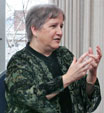
Wedgwood is the Edward B. Burling Professor of International Law and Diplomacy, and Director of the Program in International Law and Organization at the School for Advanced International Studies, Johns Hopkins University, in Washington, D.C. She also serves on the Pentagon’s Defense Policy Board, the Secretary of State’s Advisory Committee on International Law and the CIA’s Historical Review Panel. She is the American member of the United Nations Human Rights Committee. Wedgwood has commented frequently on issues of terrorism and the law on National Public Radio, “The NewsHour with Jim Lehrer,” and BBC, among other media outlets. She has testified before the Senate on issues of war crimes, Presidential war powers and trying Saddam Hussein.

Related Information:

* Ruth Wedgwood to Deliver 41st Annual Hanify-Howland Lecture at Holy Cross

Posted in News | Comments Off on Hanify-Howland Presents 41st Annual Public Lecture

Baroque Art Meets the 21st Century

Pressed by curators unfamiliar with her work to describe her art quickly but accurately, Cristi Rinklin calls it “techno Baroque surrealism.”

It’s an apt description. The Baroque period is an art style of the 17th century in which artists sought movement, contrast, emotional intensity, and variety in their works. Rinklin, assistant professor of visual arts, is inspired by Baroque art, but her work — which will be on view in three different New England venues in January — is informed by 21st century concepts.

“I want my paintings to give the viewer the feeling that they are being transported to a place that could not possibly exist in reality, but through the painting it could,” she explains. “I’m very interested in this idea of abstraction and this idea of space that is very heightened and fantastical, but that also has this sense of believability. You know this space can’t exist, but you could buy into this factor that it could.”

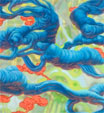
Rinklin’s paintings are colorful and layered with many images. They awake the senses. They give the sensation that one is stepping into a different world. They address technological and scientific changes in the new century by merging the dreamlike 17th-century Baroque art forms into works of art that represent the way people view the present-day world.

“I’m a contemporary artist, but I’m very interested in the Baroque era where the art pulled the viewer in in a psychological way. What’s interesting to me as a 21st century artist looking at the Baroque period — its paintings, architecture, ornament and sculpture — is infusing my work with this style. In the 21st century, artists are becoming more and more interdisciplinary, drawing on science, technology, and medicine.”

Appropriately enough, Rinklin, who has been at Holy Cross since 2002, uses the computer to manipulate imagery in her artwork. She credits Margaret Nelson, academic computing support specialist at the College, for assisting her in software experimentation and the use of large format archival ink jet printers.

“I’m a painter, but I’m also linked to the process of installation and I’m also working with digital imagery,” she says. “I find it interesting how this period is having an impact on contemporary art. On a personal level, these spaces are about saturation and seduction. My work is very intense — there’s nothing minimal about it.”

No doubt. The site-specific installation Nuvolomondo, running through May (extended from its previous January closing), is splashed across the walls and windows of the Tufts University Art Gallery’s Harry Remis Sculpture Court. The installation’s title (a neologism meaning “cloudworld” in Italian) and concept are derived from her stay in Rome as a visiting artist and scholar in residence at the American Academy. Her visit inspired her to create this contemporary interpretation of Baroque ornament, architectural details and stained glass panels.

While her other shows may not physically engulf the viewer the way Nuvolomondo does, the vibrant colors, layered sources, and abstract imagery absorb the senses just the same.

Running through the end of January, Heidi Hove Pedersen + Cristi Rinklin at the RHYS gallery in Boston, allows viewers to witness her work in a more compact form with a similar eye-popping impact.

“During the Baroque period, a lot of the painters like Caravaggio addressed space as something that extended out to the viewer. Baroque painting allowed space to move forward, moving it up without geometry but using clouds, form and bodies,” she says.

Lincoln’s DeCordova Museum and Sculpture Park will be the site of an exhibition featuring works by artists whose imagery is informed by contemporary issues. Titled Big Bang! Abstract Painting for the 21st Century, Rinklin, whose work will also be displayed, is partly responsible for its materialization.

“It’s really great to be a part of this show because this exhibition tackles the ideas of what abstraction means in the 21st century,” she says.

Rinklin’s work has not gone unnoticed by the media. In an art review, the Boston Globe says Nuvolomondo “glows and rollicks; it washes over the viewer the way clean ocean waves roll onto the beach.” Her Phantasmagoria painting show last year at Boston’s Green Street Gallery was named one of the region’s best gallery shows of 2005 by the Boston Globe. The show “sprang rambunctiously across centuries and through visual ideas. Baroque danced with digital imagery; Rorschach blots, cartoon through bubbles and architectural ornamentation all joined the game. The paintings were gleefully ambitious and easy on the eye.”

Rinklin moved from Minneapolis, where she earned her MFA from the University of Minnesota with an emphasis in painting and drawing, to Boston about five years ago. In addition to her teaching at Holy Cross, she’s been working to get her name recognized. Her work has been exhibited at The Drawing Project at the Bernard Toale Gallery, Boston, the ABWO Gallery, Rome, and the New York Center for Art and Media Studies, among others.

Posted in News | Comments Off on Baroque Art Meets the 21st Century

Holy Cross Music Professor Nominated for Two Grammy Awards

WORCESTER, Mass. – Osvaldo Golijov, associate professor of music at the College of the Holy Cross has been nominated for two Grammy awards for his opera Ainadamar (Fountain of Tears).

The Argentine-born Golijov was nominated in the categories of Best Opera Recording and Best Classical Contemporary Composition. “Ainadamar” means “fountain of tears” in Arabic, and is the place where, in 1936, Spanish poet Federico García Lorca was murdered by Fascist soldiers during the early stages of the Spanish Civil War. The opera is centered around Lorca’s death, and the mourning of Margarita Xirgu, interpreted by acclaimed soprano Dawn Upshaw.

The two nominations add to Golijov’s three previous Grammy award nominations. In 2003, he received nominations in the categories of Best Chamber Music Performance and Best Classical Contemporary Composition for his chamber music release Yiddishbuk. Last year, he was nominated in the category of Best Classical Contemporary Composition for a song cycle titled Ayre.

The 49th Grammy Awards are to be handed out Feb. 11. The nominations were announced yesterday.

Golijov is working on the score of director Francis Ford Coppola’s upcoming film Youth Without Youth.

In January and February, Lincoln Center presented a Festival called “The Passion of Osvaldo Golijov,” featuring multiple performances of his major works, chamber music, late nights of Tango and Klezmer, and a night at the Film Society.

Golijov earned his Ph.D. at the University of Pennsylvania. He has been a member of the Holy Cross music department since 1991.

Posted in News, Press Release | Comments Off on Holy Cross Music Professor Nominated for Two Grammy Awards

Holy Cross Community Donates Time, Money, Clothing During Holiday Season

WORCESTER, Mass. – Faculty, staff, and students at Holy Cross are getting into the spirit of Christmas with generous donations of time and other resources to many charities and other causes.

Among these efforts:

• Organized by the Office of Human Resources, the annual United Way fund drive, supported by faculty and staff, exceeded its goal of raising $46,000. The money will be used to support programs in the greater Worcester area that encourage positive youth development, help people most in need and ensure children’s readiness for school.

• A fundraiser sponsored by Women in Wine, titled “Share Your Strength for Abby’s House,” last month raised more than $17,000 for the local shelter for low-income women and children. The event, which included food, wine, music, a live auction and a performance by the Holy Cross Ballroom Dance Team, was held pro bono in the Hogan Ballroom. Earlier this year, Holy Cross raised $1,000 by holding a benefit concert in support of Abby’s House.

• Donations accepted at a concert by folk artist Dar Williams in the Hogan Ballroom last month raised $260 for Abby’s House. The concert was sponsored by Women’s Forum, Allies, Abigail, Pax Christie, Women and Gender Studies and the Campus Activities Board.

• Organized by Human Resources, the Thanksgiving food drive, which benefits members of the Holy Cross community on medical or family leave, faculty and staff were able to send fruit baskets, food baskets, or floral arrangements to 11 families.

• Money raised in the annual AIDS Compassion & Awareness Charity Banquet earlier this month, sponsored by the Bishop Healy Multicultural Society, will go to AIDS Project Worcester and the Pendulum Project, a non-profit humanitarian organization that helps families and communities care for, support, and protect orphans and vulnerable children in parts of the world that are severely impacted by AIDS.

• As this year’s Class Holiday Charity project, the Class of 2010 Class Council participated in Operation Christmas Child through Samaritan’s Purse, where gift-filled shoeboxes are shipped to needy children across the world. Approximately 200 students, faculty and staff helped and the officers sent 110 shoeboxes filled with stationary, shoes, toys, toiletries, sweets, and games, among other items.

“As the most diverse class ever on Mt. St. James, we wanted to extend the mission of ‘men and women for others’ across the world,” says Gbenimah Slopadoe, vice president, Class of 2010. “What better way to do it than packing a lot of love in a box for a child at Christmas?”

• Toys for Tots donations were collected at the annual Holy Cross Dining Holiday Luncheon on Dec. 7.

• Sponsored by Human Resources, the Candy Cane tree allows participants in early December to select candy canes from a Christmas tree and buy a gift for a patient at St. Mary’s Health Care Center, or for a needy child in the Main South neighborhood of Worcester, through the Worcester Coalition.

• The Chaplains’ Office and Alpha Sigma Nu (the Jesuit Honor Society) collaborated in collecting toys at worship services on campus in Advent. The toys will be donated to churches in Worcester for distribution to children at Christmas.

• Since 1987, the Physical Plant/Building Services department donates used furniture from office and residence hall upgrades, and conducts a winter clothing drive among staff, faculty and students to benefit the following Worcester organizations: Henry Lee Willis Community Center, PIP Shelter in Worcester; Central Mass. Housing Alliance; Abby’s House; and Central Mass Shelter for Homeless Veterans, among others. “It’s grown to be unbelievably huge,” says Jack McCann, assistant director of Physical Plant/Building Services, who estimates that more than 100 coats alone were donated this year. “It’s amazing how much is dropped off.”

• The Loyola House Council and Resident Assistant Staff teamed up for their own clothing drive benefiting charity. The clothing will be delivered to various organizations, including Catholic Charities and PIP shelter.

• The Information Technology Services department recently offered volunteer staff assistance to the computer lab at the Nativity School, founded and sponsored by Holy Cross and the New England Province of the Society of Jesus. ITS staff assisted in cleaning up viruses and troubleshooting other technical problems.

• Year-round, Dining Services donates surplus food to the Central Mass Shelter for Homeless Veterans, in Worcester.

• Money raised in a benefit concert held earlier this semester in the memory of Sheila Lynch ’05 was donated to Student Programs for Urban Development and the Appalachia Service Project, organizations that held special meaning for Lynch. The event was sponsored by Alumni Relations staff, the Chaplains’ Office and Campus Activities Board.

Posted in News, Press Release | Comments Off on Holy Cross Community Donates Time, Money, Clothing During Holiday Season

Classics Majors Embark on Groundbreaking Scholarly Research in Homeric Poetry

Four Holy Cross classics majors are tackling a project of epic proportions.

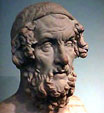
William Dolan ’10, Michael Kinney ’10, Katherine Schmieg ’09, and Patrick Walsh ’09 have been selected to serve a crucial role in the pioneering preservation of the world’s most important works of literature. They are working during the 2006-07 academic year with their professors on the Homer Multitext Project, a long-term analysis and electronic presentation of all the many variations of Homer’s epic poetry. As the newest Homer Multitext Fellows, their contributions will join those of classical scholars at the Center for Hellenic Studies, Furman University, the University of Houston, and several other colleges and universities.

The project is unusual in several respects, not the least of which is its electronic component. The epic poetry of Homer was originally passed on orally, taking on a slightly different form every time it was told. The work of these scholars involves examining all references and sources in all Homeric variations. When complete, every element connected to the original Homeric poetry will be available in a digital format so scholars and general readers alike will be able to experience much more than reading the plain text on a page.

“We’re putting all the components of Homeric epic as it survives today — in medieval manuscripts, shredded scrolls from the sands of Egypt, the remnants of ancient scholarship on Homer, even vase paintings from Athens — into a single framework, to let them ‘talk’ to each other directly,” explains Jack Mitchell, assistant professor of classics at Holy Cross and one of the editors of the Multitext Project. “This is why it’s called a ‘multitext’— we want as much variety as possible.”

The Holy Cross Fellows have a specific assignment involving the Iliad, working with assistant professor Mary Ebbott and associate professor D. Neel Smith. “What we are doing is using the apparati critici of the text — that is, the very small, dense and exhaustive system of abbreviated footnotes on the sources and variants of different words and phrases that appear in the different papyri and codices,” explains William Dolan. “We’ll use this information to reconstruct the four oldest codices and their texts of the Iliad.”

The Homer Multitext Fellows from Holy Cross have taken on this task, consisting of a minimum of five hours each week, in addition to a full course load. Also, because the fellows have each been assigned a partner, with whom they must work, they need to find overlapping time in their schedules in which to work.

This process will provide students with a unique experience, one that many graduate students in the classics may never encounter.

“We are finding out first-hand the results of oral transmission and the problems it poses for those of us further down the line,” says Patrick Walsh, explaining that as the epics were passed down orally, there were substantial changes depending on the opinions and attitudes of those who told the stories, as well as those who heard them. The work of these scholars will be to help others to understand these variations, as well as to create a source from which one may come to understand the original intentions of Homer in his epics and see how over the decades, others have interpreted and varied the epics.

Professor Ebbott has been involved with the Multitext Project from the very beginning; forming crucial relationships with classics departments at other universities.  Professor Smith’s contributions to the project include digitizing the work being done by the fellows and for the project in general. “He is an extraordinary polymath, at home with Homer and with the Internet,” said Professor Mitchell.

Holy Cross fellows will have completed their portion of the project concerning the Iliad by the end of the 2006-2007 academic year, according to Professor Mitchell. However, the project in its entirety will be in progress for the duration of the decade, expanding to include more Homeric epic material and information to illuminate the work.

By Jen Robert ’07

Related information:

# Center for Hellenic Studies – The Homer Multitext Project
# Classics Department

Posted in News | Comments Off on Classics Majors Embark on Groundbreaking Scholarly Research in Homeric Poetry

Holy Cross Administrators to Serve Midnight Breakfast to Students During Final Exam Period

WORCESTER, Mass. – Recognizing that students stay up late studying during finals period, administrators at the College of the Holy Cross — including President Michael C. McFarland, S.J. — volunteer each semester to serve the scholars breakfast late into the night.

The menu includes scrambled eggs, bacon, sausage links, assorted bagels, Belgian waffles and topping bar, assorted juices and nightly specials.

The events will kick off Dec. 10. Kimball Dining Hall will open at 11 p.m. and administrators, donning aprons, will serve until 1 a.m.

Sunday, Dec. 10
Michael Lochhead, Vice President for Administration and Finance
Michael C. McFarland, S.J., President
Jacqueline Peterson, Vice President of Student Affairs and Dean of Students
Paul Sheff, Vice President of Development and Alumni Relations

Midnight breakfast for the remaining nights will take place in Crossroads in the Hogan Campus Center from 11 p.m. to 1 a.m.

Monday, Dec. 11
Edwin Coolbaugh, Director of Residence Life
Curran Ford, Community Development Coordinator
Kristine Goodwin, Associate Dean for Student Life
Melissa Kneeland, Patrol Person, Public Safety
Becky Riopel, Director of Student Programs and Involvement
Devon Skerritt, Community Development Coordinator
Amy Weit-Lane, Associate Director of Residence Life

Tuesday, Dec. 12
Mark Freeman, Assistant Dean, Class of 2007
Esther Levine, Assistant Dean, Class of 2006
Earl Peace, Assistant Dean, Class of 2009
Vickie Swigert, Assistant Dean, Class of 2008

Wednesday, Dec. 13
Margaret Bramley, Associate Director of the Holy Cross Fund
Eric Butler, Research Analyst, Development
Tom Cadigan, Associate Director of the Fund for Athletic Fundraising
Margaret Devine, Development Writer
Kristin McCue, Assistant Director of Donor Relations
Erin Mooney, Assistant Director of the Holy Cross Fund
Frank Vellaccio, Senior Vice President

Posted in News, Press Release | Comments Off on Holy Cross Administrators to Serve Midnight Breakfast to Students During Final Exam Period

Organist Christie Continues Series of Concerts at Holy Cross Commemorating Death of Buxtehude

WORCESTER, Mass. – Organist James David Christie will perform the fourth of eight concerts commemorating the 300th anniversary of the death of the great 17th-century North German organist-composer Dietrich Buxtehude (1637-1707). As part of the Holy Cross Chapel Artists Series, “The Buxtehude Tercentenary at Holy Cross” is being performed on the late 17th-century North German inspired Taylor & Boody organ throughout the 2006-2007 concert season.

The concert, free and open to the public, will be on Dec. 10 at 3 p.m. in the College’s Saint Joseph Memorial Chapel. The chapel is handicapped accessible.

Christie is the distinguished artist in residence and College organist at Holy Cross. In addition, he serves as organist for the Boston Symphony Orchestra. He was the first American to ever win a first prize at the Bruges (Belgium) International Organ Competition and was the first person in the history of the competition to ever win both the Prize of the Jury and the Prize of the Audience. Professor Christie has served on more international organ competition juries than any American organist. He has toured the United States, Canada, Europe, Asia and Australia giving concerts, master classes and seminars at major music festivals. He has recorded for 12 different labels and is heard regularly on radio broadcasts in the United States, Canada and Europe.

The program follows:

Magnificat primi toni, BuxWV 203

Magnificat noni toni, BuxWV 205
[versus 1]
[versus 2] alla duodecima

Puer natus in Bethlehem, BuxWV 217
Der Tag, der ist so freudenreich, BuxWV 182
In dulci jubilo, BWV 197

Fuga in C, BuxWV 174

Nun komm der Heiden Heiland, BuxWV 211
Gelobet seist du, Jesu Christ, BuxWV 189
Gelobet seist du, Jesu Christ, BuxWV 188

Magnificat primi toni, BuxWV 204

Praeludium in C, BuxWV 137

Posted in News, Press Release | Comments Off on Organist Christie Continues Series of Concerts at Holy Cross Commemorating Death of Buxtehude

Holy Cross Chemistry Professor Receives Award to Conduct Research on Microfluidics

WORCESTER, Mass. – The Camille and Henry Drefyus Foundation has awarded Kimberley Frederick, associate professor of chemistry at the College of the Holy Cross, a $60,000 Henry Dreyfus Teacher-Scholar Award for her proposal titled “Studies of flow processes in microfluidic systems involving polyelectrolyte multilayers, thermoresponsive polymers and guanosine gels.”

Frederick will use the money to buy components to conduct research in microfluidics or “lab on a chip,” a relatively new technology that aims to do chemical reactions and analyses on single drops of solutions. By decreasing the size of the samples, it is possible to do multiple analyses more quickly and with less chemical waste. This has important applications in biomedical tests which can often take hours or days. Microfluidics is also being studied in environmental testing, pharmaceutical analysis and industrial quality control.

The goal of the project is to develop new technologies or methodologies which would be helpful to other researchers or companies as they work toward implementing “lab on a chip” chemical analysis methods. The money will also allow Frederick and her students to present their research at national scientific meetings.

The Henry Dreyfus Teacher-Scholar Awards Program is “intended to support and encourage young scholars who demonstrate excellence in both research and teaching” and emphasizes the nominee’s accomplishments in teaching and scholarly research with undergraduate students. The award was given to seven individuals this year.

Frederick, of Worcester, has been at Holy Cross since fall 2003. She has previously conducted research on electrosomotic flow and the development of new methods of detection using Raman spectroscopy in the field of forensics. She earned her bachelor’s in chemistry from Lawrence University and her Ph.D. from Purdue University.

Posted in News, Press Release | Comments Off on Holy Cross Chemistry Professor Receives Award to Conduct Research on Microfluidics

College Chaplains Plan Events to Celebrate Start of Advent

The College Chaplains and the College Choir of the College of the Holy Cross will sponsor the 28th annual Advent Festival of Lessons and Carols on Dec. 7 at 8 p.m. in St. Joseph Memorial Chapel, along with a number of other events to celebrate the start of Advent.

The festival will consist of nine Advent and Christmas scripture readings, beginning with Old Testament prophecies and concluding with the Gospels. The readings, proclaimed by various members of the College community, will be interspersed with carols performed by the College Choir including Morten Lauridsen’s “O Nata Lux” and Felix Mendelssohn’s “Sleepers, Wake.” All will be invited to join in familiar tunes such as “O Come, O Come, Emmanuel” and Adeste Fideles.”

The College Choir and the Office of the College Chaplains have presented the Advent Festival of Lessons and Carols since December 1978. The religious service is based on one celebrated each year at King’s College Chapel in Cambridge, England.

Other events include:

Advent Toy Collection: Alpha Sigma Nu, the Jesuit Honor Society, will collect Christmas toys for needy children in Worcester at all chapel services the weekend of December 2-3.  Bring a new, unwrapped, nonviolent toy to Mass at 4:30 p.m. Saturday (Mary Chapel), 11:30 a.m. Sunday (St. Joseph Chapel), 7 p.m. Sunday (Mary Chapel) or 10 p.m. Sunday (St. Joseph Chapel) or to the Inter-Denominational Service of Praise and Worship at 4:30 p.m. Sunday (McCooey Chapel).

Advent Reconciliation Service
: Celebrate God’s unconditional forgiveness in preparation for Christmas at this service of scripture, prayer, reflection and song on Dec. 4 at 8:30 p.m. in McCooey Chapel. Assistant Chaplain Meg Fox-Kelly will preside and preach. Fathers William Clark, James Corkery, Lawrence Daka, James Hayes, Anthony Kuzniewski, James Miracky, William O’Halloran, Joseph Pomeroy, Oliver Rafferty and Edward Vodoklys will be available for the Sacrament of Reconciliation.

Solemnity of the Immaculate Conception
: This Roman Catholic holyday of obligation, which is the patronal feast of the Catholic Church in the United States, falls nine months before the celebration of the birth of Mary, the mother of Jesus. It celebrates the belief that Mary was free from sin from the moment she was conceived. Masses for the holyday will be celebrated on Dec. 8 at 8 a.m. (Fr. Corkery, McCooey Chapel), 12:05 p.m. (Fr. Dunn, Mary Chapel) and 10 p.m. (Fr. McFarland, Mary Chapel), and on Dec. 7 at 10 p.m. (Fr. Bruce, Mary Chapel). The Mass on Thursday evening will be in American Sign Language with voice interpretation.

Community Advent/Holiday Mass: Join President Rev. McFarland C. McFarland, S.J., for the last weekend Mass of the fall semester on Dec. 10 at 8:30 p.m. in St. Joseph Chapel. A reception with refreshments will follow the Mass. There will be no 7 or 10 p.m. Mass this Sunday. The Saturday (4:30 p.m.) and Sunday (11:30 p.m.) Masses will be celebrated as usual.

Posted in News | Comments Off on College Chaplains Plan Events to Celebrate Start of Advent

Relax and Unwind With These Finaltastic Events

Check out the events taking place during finals period to keep you stress free and energized. Good luck on exams!

Dec. 5
Tree Lighting Ceremony
O’Kane Porch, 5 p.m.

Judging of the campus-wide hall decorating contest
Following tree lighting ceremony, 6 p.m.

10 Spot
Hogan Crossroads, 10 p.m.

Dec. 6
“Bored” games and activities table
Hogan First Floor Lobby, 3-5 p.m.

Men’s Basketball vs. Duke on the big screen
Crossroads, 7 p.m.

Dec. 7
“Bored” games and activities table
Hogan First Floor Lobby, 3-5 p.m.

Women’s Basketball vs. Maine
Hart Gym, 7 p.m.

Dec. 8
Managing stress and exam anxiety workshop
Counseling Center, Hogan 2, 2 p.m.

Dec. 9
The Edge: Dance Party
10 p.m. – 1:30 p.m.

Dec. 10
Community Mass, followed by reception on the Square in front of St. Joseph’s
St. Joseph Chapel, 8:30 p.m.

Dec. 11
Holiday Bazaar
Hogan 3, noon-4 p.m.

Managing stress and exam anxiety
Counseling Center, Hogan 2, 2 p.m.

Tea Time
Hogan First Floor Lobby, 3-5 p.m.

Mary Poppins and holiday goodies
Hogan First Floor Lobby, 7 p.m.

Dec. 12
Reiki, an ancient energy-based healing technique
Hogan 3, 1-4 p.m.

TV special: “The Life and Adventure of Santa Claus” and Christmas goodies
Hogan First Floor Lobby, 7 p.m.

Dec. 13
Managing stress and exam anxiety
Hogan 215, 2 p.m.

Holiday wrapping table
Hogan First Floor Lobby, 3-5 p.m.

TV Special: “Rudolph’s Shiny New Year” and Christmas goodies
Hogan First Floor Lobby, 7 p.m.

Dec. 14
Holiday wrapping table
Hogan First Floor Lobby, 3-5 p.m.

TV Special: “The Little Drummer Boy” and Christmas goodies
Hogan First Floor Lobby, 7 p.m.

The Polar Express
Hogan First Floor Lobby, 8 p.m.

The mind/body room is available to students to do yoga, meditate, study and listen to relaxation tapes during finals week from 8 a.m. to 6 p.m. Students should call Health Services (x2276) to secure the room.

Campion House is open from 9 a.m. to midnight, Monday-Friday and Sunday from 5 p.m.-10 p.m.

The let loose hour is from 9-10 p.m. in all residence halls.

In response to the need for increased access to networked workstations during the exam period, the Dinand Tech Lab (second floor) will be open as follows:

* Dec. 2, 3, 9, 10: 11 a.m. – midnight
* Dec. 4 – 8, 11-14: 8:30 a.m. – midnight

Related information:

# Extended Multimedia Resource Center Hours
# Holy Cross Administrators to Serve Midnight Breakfast to Students During Final Exam Period
# Extended Library Hours

Posted in News | Comments Off on Relax and Unwind With These Finaltastic Events

Annual Christmas Tree Lighting Ceremony on Dec. 5

WORCESTER, Mass. – The annual Christmas tree lighting ceremony, hosted by Rev. William O’Halloran, S.J., special assistant to the president, and the Purple Key Society, will be held Dec. 5 at 5 p.m. on O’Kane Porch at the College of the Holy Cross. The event is free and open to the public.

The evening will feature Christmas performances by the Holy Cross Chamber Singers, Marching Band and the Nativity School Boys Choir.

The event is sponsored by the Purple Key Society and the Office of Student Life.

Posted in News, Press Release | Comments Off on Annual Christmas Tree Lighting Ceremony on Dec. 5

Setting Sail

Junior Jane Sarno knew she wanted to spend a semester off campus, but she didn’t want to go the traditional route of studying in a romantic country. Instead, she wanted to navigate the ocean — literally.

On Nov. 25, Sarno set sail on a 3,000 nautical mile, six-week voyage from St. Croix Island, with possible port calls in Montserrat, Dominican Republic and Jamaica to a final destination of Key West, Fla., as part of the SEA Semester, a study abroad program through Sea Education Association in Woods Hole on Cape Cod.

“I have always loved sailing and the ocean and I came across this program through the Semester Away Program,” she says. She researched the program, under the auspices of Holy Cross’ Center for Interdisciplinary and Special Studies, and “knew it was something right up my alley.”

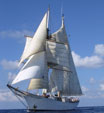
Sarno, a sociology major with a concentration in environmental studies, is joined with 17 students from other leading liberal arts colleges, including Bowdoin, Colby, Middlebury and Smith. They’re sailing in the school’s 134-foot tall brigantine vessel, the Corwith Cramer, one of the most sophisticated research equipped vessels under sail in the United States.

The Sea Semester Program consists of 12 weeks of study (eight weeks for the summer session) divided between a six-week shore component at Woods Hole and a six-week sea component in the Atlantic, Atlantic/Caribbean, or Pacific. Sarno, of Boston, selected the “Documenting Changes in the Caribbean” program, which began in early October.

During the shore component, Sarno developed a research project that will be tested and completed aboard the Cramer. In the next few weeks, she will be researching the zooplankton biomass and productivity levels around the Caribbean, especially around Montserrat. She will also be testing the waters to see if the distribution of zooplankton correlates to the varying nutrient levels of chlorophyll and iron.

“The shore component was amazing,” says Sarno, days before setting sail. “It was one of the best experiences of my life and we have not even left for sea yet. In Woods Hole, my classmates and I took three classes: maritime history and culture of the Caribbean, oceanography I, and marine environmental history. We have learned so much about the islands we will be visiting, done multiple research projects about environmental issues in the area, and we have learned the history of how sailors used to navigate the seas.”

Sarno, a self-described lifelong sailor who spends her summers at Martha’s Vineyard, is excited about providing weather observations to a national database; learning to chart the course of the vessel using pilot charts, nautical maps and celestial navigation; and serving as the Junior Watch Officer, taking full command of the vessel during a watch.

Besides studying oceanography and maritime studies, another benefit of the program is the augmentation of team-building skills.

“There’s an intellectual growth that occurs,” says Gary DeAngelis, associate director of the Center for Interdisciplinary and Special Studies, who worked with Sarno during her applications process. “The biggest thing that I notice when students come back is how much maturing has taken place because of their involvement in the program.”

Sarno agrees.

“The shore component was much more amazing than I thought it was going to be. It wasn’t just classes; it was a total community-building experience. The people in class are more than just crewmates to me now, have formed a bond that is absolutely unreal. We have become so close that we know how our group dynamic will be on the ship. It is our sense of community that we formed at Woods Hole that will get us through all the toils at sea.”

Related information:

# Listen to periodic podcasts of the trip on the SEA Semester Program Web site
# Sea Semester at Woods Hole

Posted in News | Comments Off on Setting Sail