SPUD Celebrates 50 Years of Students Serving Worcester

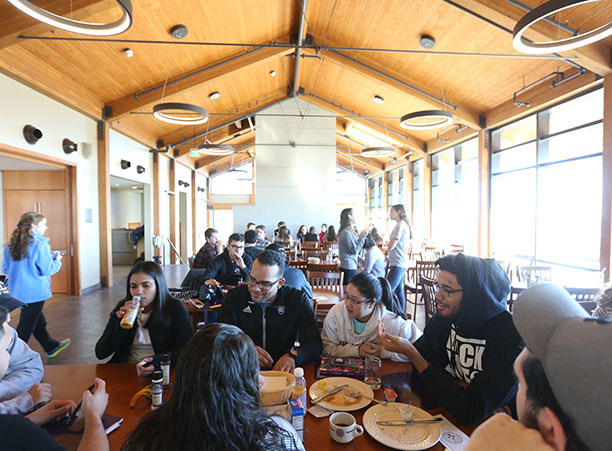
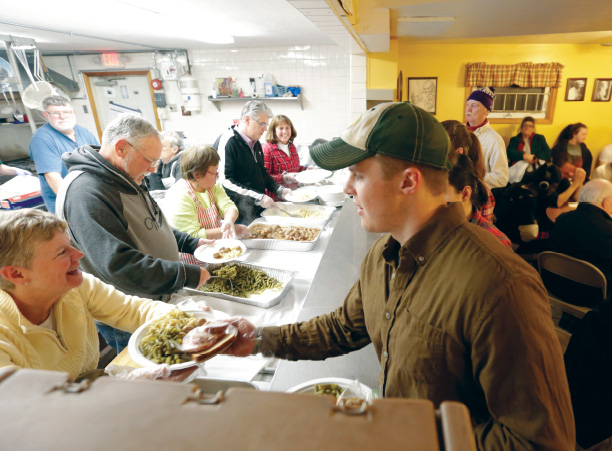
Students volunteering through SPUD.Dissatisfied with the status quo and seeking more agency in uncertain times, Holy Cross students decided to put their Jesuit education to use in 1968 by establishing a student-run service organization, one that has since exploded in scope throughout the city of Worcester and is now celebrating its 50th anniversary.

Student Programs for Urban Development, better known as SPUD, was founded out of a desire to connect with Worcester residents in light of the major events disrupting the American landscape in 1968: mounting resistance against the Vietnam War, increased participation among youth during the Civil Rights Movement and the assassinations of Dr. Martin Luther King Jr. and Robert Kennedy.

SPUD founder Patrick E. Clancy ’68 and other Holy Cross students recognized the need to serve their neighbors and set out to establish a student-led volunteer organization. To attract participants, Clancy created a brochure that listed six volunteer sites throughout the city and a quote by French poet Paul Claudel: “Youth was not made for pleasure, but for heroism.”

“I probably read that quote in a theology or philosophy class,” recalls Clancy, who used it as a call to action for students. “We were aspiring to heroic acts; that was sort of the spirit of the times.”

The SPUD spirit of dedication to others is reflected in the oft-repeated Jesuit ideal, “Men and women for and with others.” And, surprisingly, SPUD predates the adoption of this motto on campus.

“It’s noteworthy that students at Holy Cross were already living this out concretely before the Jesuits had fully articulated education for justice as the primary aim of Jesuit higher education,” says Martin Kelly, associate chaplain and current SPUD faculty adviser. “Students paved the way for building the volunteer capacity to significantly impact local neighborhoods and address the immediate needs of the underprivileged in Worcester.”

The first year SPUD was launched, there were six service locations staffed by 40 Holy Cross students and 60 students from other Worcester colleges and universities. Today, SPUD sends 530 student volunteers to more than 40 sites across Worcester and is run exclusively through Holy Cross.

Students have been visiting some of the sites — which have become program staples — for decades, such as the Big Brothers Big Sisters program, the Mustard Seed Catholic Worker and Abby’s House.

Posted in Holy Cross Magazine, News, Spring 2018 | Comments Off on SPUD Celebrates 50 Years of Students Serving Worcester

Malcom Miller ’15 Makes NBA Debut

Malcolm Miller '15 of the Toronto Raptors poses for a portrait during Media Day on Sept. 25, 2017, at the BioSteel Centre in Toronto, Ontario, CanadaAfter playing last season in Germany, Malcolm Miller ’15 overcame an ankle injury, signed with the Toronto Raptors and has become the first Holy Cross basketball player in 37 years to make his NBA debut.

Last fall, Miller was signed by Toronto to a two-way contract, which effectively allows teams to have 17-man rosters with two players in hybrid situations. Players on two-way contracts must have three or fewer years of experience and can float between the developmental G League and the NBA for up to 45 days. Toronto’s G League team, Raptors 905, is based in Mississauga, Ontario, Canada.

Miller began the season with Raptors 905, averaging 26.8 minutes and 12.3 points per contest in his first 27 games. He was traveling with the team in late December when he got the news he was getting called up to the pros.

“The next thing I know, they called,” the 6-foot-7 forward says of the Toronto front office. “I hopped on a plane and met the Raptors.”

Miller made his NBA debut Dec. 20 in Charlotte, North Carolina, and played five minutes with two assists, becoming the first Holy Cross product to appear in an NBA contest since Garrett “Garry” Witts ’81 of the Washington Bullets during the 1981-82 season.

“It is definitely an honor,” says Miller, who turned 25 on March 6, from his suburban Toronto apartment. “Not many people from the Patriot League or other mid-major programs are able to make it to that level. It was nice to get into the game. I had played against some of those guys in the G League before.”

Three days later, he played three minutes at home against the Philadelphia 76ers. Miller, who scored 1,013 points in his career at Holy Cross, then scored the first six points of his career as he made two shots from 3-point range on Jan. 11 against the Cleveland Cavaliers. Miller later made his first NBA career start against the Charlotte Hornets on March 4.

“The dream is always you want to be an NBA player. I was happy to get that done,” Miller says.

Raptors head coach Dwane Casey has been impressed by Miller, who played four years for the Crusaders.

“He is an NBA shooter,” Casey said before a game in Washington, D.C., against the Wizards. “He played in the Cleveland game and came in and knocked in a couple of buckets. I am very impressed with his shooting. He needs to get a lot stronger and take the hits and bumps of the NBA, but shooting will not be one of his problems.”

Miller was a standout at Gaithersburg High in Maryland, a suburb of the nation’s capital, but did not get a lot of attention from major Division I college programs. Milan Brown, former Crusaders head coach, went to Howard University in Washington, D.C., and learned about Miller from a friend, James Lee, who was officiating AAU games in the region.

“I had just gotten to Holy Cross, and James called me. He said [Miller] fits your academic profile,” says Brown, now an assistant coach at the College of Charleston in South Carolina. “I saw him play at a tourney in West Virginia.”

By the time Miller was a sophomore at Holy Cross, Brown says he knew Miller had the potential to go pro.

“The sky is the limit if you are willing to work,” Brown told him. “His junior year was very good. He had some tremendous highlight film plays.”

Miller ended his Holy Cross career with 532 rebounds, 164 assists and 143 blocked shots, the latter of which ranks third in all-time program history. He graduated in 2015 with a degree in philosophy and played for the Boston Celtics Summer League team. He later joined the Maine Red Claws, the Celtics’ G League squad, before going to Germany for the 2016-17 season. There he played with Alba Berlin, one of the top clubs in Germany, and also took part in EuroCup games.

“Going to Berlin was a great experience for me,” he says. “It helped me grow up as a person and a ballplayer. I broke my wrist and missed a few games. Germany was a pretty physical league. Many of the European leagues aren’t as athletic as the NBA.”

Brown, his former coach, says he sent Miller a text once he got called up to the NBA.

“I told you so,” Brown wrote, remembering their conversation when Miller was a sophomore on Mount St. James.

According to Brown, Miller replied, “You are right coach, you are right.”

Written by David Driver for the Spring 2018 issue of Holy Cross Magazine.


About Holy Cross Magazine

Holy Cross Magazine (HCM) is the quarterly alumni publication of the College of the Holy Cross. The award-winning publication is mailed to alumni and friends of the College and includes intriguing profiles, make-you-think features, alumni news, exclusive photos and more. Visit magazine.holycross.edu/about to contact HCM, submit alumni class notes, milestones, or letters to the editor.

Posted in Holy Cross Magazine, News, Philosophy, Spring 2018 | Comments Off on Malcom Miller ’15 Makes NBA Debut

Preserving a Legacy: Robert Beauchamp Collection Turns Cantor Gallery Into Unique Classroom and Teaching Tool

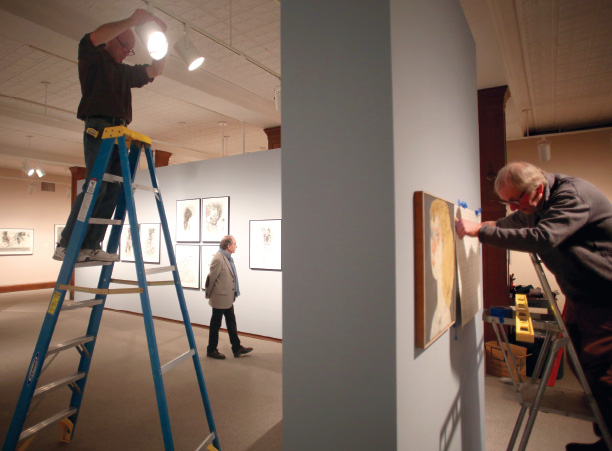
Members of the Holy Cross community assemble the exhibit “Robert Beauchamp: Four Decades of Works on Paper.”Roger Hankins makes his way to the studio on Bethuen Street in Manhattan’s West Village every six months or so. Behind the pale-yellow concrete exterior and brass and glass doors, dozens of painted canvases lie vertically on racks, some as large as five feet across. Hundreds more drawings and sketches, stored in flat file drawers and portfolios, fill the space, along with a worktable in the center of the room.

The canvases and papers are alive with shapes, people, animals and objects, all drawn with the sharp lines, flattened forms and distorted imagery typical of the expressionist art movement.

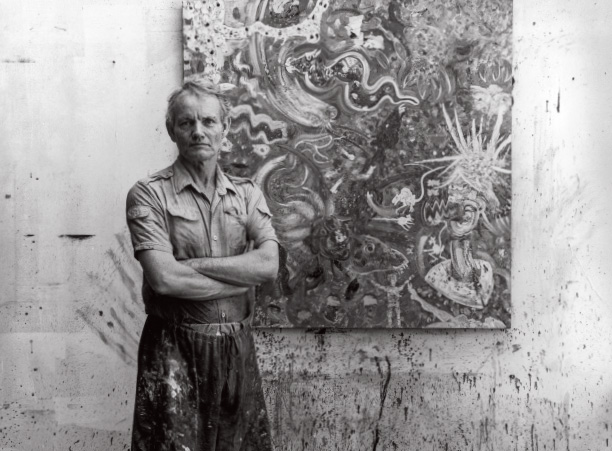
The artist is acclaimed expressionist Robert Beauchamp (pronounced “Bee-chum”), who was renowned for his paintings and drawings from the 1950s until his death in 1995.

Beauchamp lived and worked in this Manhattan studio, and also spent time in Wellfleet, Massachusetts. Major galleries in both locations and across the United States exhibited his work during his life, including the Museum of Modern Art and the Guggenheim in New York, as well as galleries in Provincetown, Massachusetts.

His widow, Nadine Valenti Beauchamp, also an artist, maintains this studio space for her own painting, as well as to store her husband’s legacy, a sizeable portion of which has become a permanent part of the fine art collection at Holy Cross.

Posted in English, Holy Cross Magazine, News, Spring 2018, Visual Arts | Comments Off on Preserving a Legacy: Robert Beauchamp Collection Turns Cantor Gallery Into Unique Classroom and Teaching Tool

Leading the Next Generation of Dreamers and Doers: Carolyn Casey ’87 Lights Leadership Spark Across Massachusetts

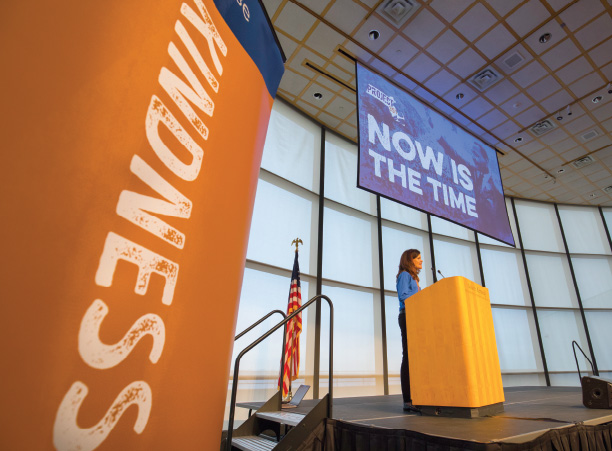
Carolyn Casey ’87 welcomes Project 351 ambassadors at the organization’s annual launch day.After eight years in a corporate job, Carolyn Casey ’87 needed some time. Time to observe. Time to reflect on social justice. Time to think about how best to serve. So she decided to drive cross-country, west to east, visiting civil rights monuments, doing volunteer work and gaining inspiration from those on the front lines.

Casey spent time on a Native American reservation in Arizona, visiting new mothers with her sister, Kathleen Casey, M.D., ’84; helped build a home with Habitat for Humanity in Mississippi; pulled 24-hour shifts in a domestic violence shelter and worked in a food bank in Alabama; and pitched in on a playground project in Georgia.

“It was a really beautiful experience of seeing our country and loving America with all its bumps and faults and challenges,” she recalls.

It was on that road trip that Casey had an idea: tapping the energy and potential of young people to promote service and unity in their communities and across Massachusetts. That idea became Project 351, a nonprofit that enlists one eighth-grader from each of the state’s 351 cities and towns for a year of leadership training and service.

Now in its eighth year, Project 351 has trained more than 3,000 eighth-graders — called “ambassadors” — who have tackled issues from hunger to hurricane relief and, in all likelihood, put them on a lifelong path of helping others.

Posted in English, Holy Cross Magazine, News, Spring 2018 | Comments Off on Leading the Next Generation of Dreamers and Doers: Carolyn Casey ’87 Lights Leadership Spark Across Massachusetts

Trial Teams Deliver Professional Competitive Advantage in All Fields

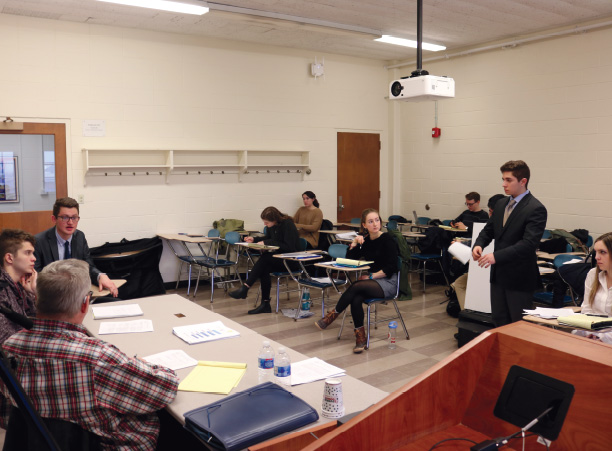
Mock Trial team members prepare for regional tournament.On July 16, 2017, Charley Waters saw everything. Waters witnessed Kerry Bell-Leon — the victim — argue with a known drug dealer at around 10:30 p.m., before entering the Jaywood Building through the back door. Later, Waters witnessed a person matching the description of the defendant access that same entrance. Later still, Waters watched an unidentified individual leave the building, then toss something into a dumpster behind the Jaywood, before running off. There, Detective Nichols located the pistol, which connects the defendant to the crime.

It’s an open-and-shut case for the prosecution, led by Mock Trial co-captains Ajit Bhullar ’18 and Jessica Russo ’19 — except the whole story is hearsay.

Founded in 1997, and endowed by a generous gift from Agnes N. Williams, Mock Trial is one of three competitive trial teams at the College, along with The Hon. Joseph F. Greene Jr. ’51, P81, 84 Moot Court Program (2003) — recently endowed by Michael Greene ’84, a member of the Board of Trustees, in honor of and named after his father, a retired New Jersey Superior Court Judge — and the Mediation team (2014). All three are now under the auspices of the J.D. Power Center for Liberal Arts in the World and provide students with opportunities to hone skills that deliver a professional edge regardless of whether participants pursue a law career, according to Mock Trial coach and attorney Ed McDermott ’79, P10, 13.

“Experiential learning in a courtroom setting provides our students yet another advantage over their peers elsewhere: practice in a professional setting in which they compete against the nation’s most elite schools and most talented students,” explains McDermott, who also coaches the Mediation team. “Our students leave the College ready for success in any industry, especially the many fulfilling and badly needed professions that require skills in writing, speech, persuasion and team effort.”

Attorney and Moot Court team coach John O’Donnell ’04 says students who participate in Moot competition are given a unique opportunity to enhance their communication, reasoning, organization and public speaking prowess.

“By studying both sides of a legal dispute, students are forced to consider the pros and cons of a specific argument,” he says. “And by presenting their arguments to a panel of judges who can ask questions and interact with the students, the students develop the critical skill of effective communication by answering questions directly and thoroughly in order to become more effective advocates.”

Through the reading of case law and development of arguments, Moot Court students learn to distill complex legal positions into simple arguments that can be understood in a 10-minute oral argument. Students work in pairs, and O’Donnell notes the program this year is fielding its largest turnout ever — 13 teams.

The inclusion of the popular Moot, Mock and Mediation programs under the J.D. Power Center could expand the teams’ appeal even further, McDermott says.

“Students that might otherwise say, ‘You know what, I got that email from the prelaw society about some info session for Mock. I’m not going to law school, so I’m not going to go.’ But now, as part of the J.D. Power Center for Liberal Arts in the World, they’ll look at it twice and say, ‘Maybe oratorical skills and critical analytical skills may be a good idea to look into,'” he notes.

Interested students are guided to the programs that best suit them. Mock participants, who must argue trial cases, might possess a disposition that differs from the those who thrive in Moot (for appellate cases) or Mediation (resolving disputes outside of court). The Moot and Mediation teams have each placed as high as 2nd in national tournaments as recently as 2016. Earlier this year, the American Moot Court Association ranked Holy Cross as the seventh strongest program in the nation. Mock teams finished first in 2003 at the American Mock Trial Association (AMTA) Regional Tournament and have competed at AMTA Nationals several times (2001, 2003, 2004, 2014-17).

“Hearsay,” states co-captain Bhullar during a Saturday practice in Stein Hall. “Detective Nichols was not at the scene of the murder, the attempted murder. Any information that you’ve accumulated at the scene of the crime could get the same objection.”

McDermott, playing judge for the afternoon practice, challenged the team to find work-arounds, which proved critical as the students built their case around the timeline the detective created, one now deemed potentially inadmissible. It was time to put practice into action, think on their feet and maneuver the facts at hand as best they could to keep their argument sound.

“Almost as soon as our students begin their academic careers at Holy Cross, especially in the Montserrat program, they hone their oral and written persuasion abilities by building on native talents and developing new ones,” McDermott explains. “Therefore, our students can pivot their arguments to adjust to any pace or style on the fly during trials. In short, polish, preparation and professionalism distinguish Holy Cross and set us apart from the crowd.”

Learn more about the J.D. Power Center for Liberal Arts in the World and its dynamic offerings below:

Written by Christopher Amenta ’06 for the Spring 2018 issue of Holy Cross Magazine.


About Holy Cross Magazine

Holy Cross Magazine (HCM) is the quarterly alumni publication of the College of the Holy Cross. The award-winning publication is mailed to alumni and friends of the College and includes intriguing profiles, make-you-think features, alumni news, exclusive photos and more. Visit magazine.holycross.edu/about to contact HCM, submit alumni class notes, milestones, or letters to the editor.

Related Information

Posted in Holy Cross Magazine, J.D. Power Center for Liberal Arts in the World, News, Prelaw Program, Spring 2018 | Comments Off on Trial Teams Deliver Professional Competitive Advantage in All Fields

Learning by Doing: Experiential Learning a Key Part of the Holy Cross Experience

Loren Cass, dean of experiential learning and student success speaks before a class of students.Loren Cass, Holy Cross dean of experiential learning and student success, has a goal for students: Get involved early.

In this newly established role, Cass oversees no shortage of opportunities for students. In addition to the J.D. Power Center for Liberal Arts in the World, Cass is responsible for helming everything from academic, career development and advising programs to study abroad, curricular and co-curricular programs, such as health professions, and more.

“We’re trying to connect students to the experiences that are going to be the most relevant to them,” he says. “Our goal is to try to get every student engaged, to try to get them to understand the full range of opportunities that are available, to coordinate better across our programs and to really meet our students where they are.”

Support from Bob and Mickey Atchinson P05, 07 and the Power family has helped create opportunities for every student on Mount St. James. Part of a recent $2 million gift from the Atchinson family will support a career exploration structure that provides resources and tools to aid students’ career discernment, first through senior year. Included in those tools are Gallup’s CliftonStrengths for Students, an assessment tool that helps students identify their strengths in order to best utilize their talents and explore careers based on their skill sets, and E-Portfolios, a digitized portfolio of student work and skills that can be presented to prospective employers.

The Power and Atchinson families have a long history of helping the College shape its vision of experiential learning and career preparation. The Atchinsons saw firsthand the benefits of internship experience through their son’s Holy Cross experience. In 2007, they established a fund to provide financial support for students who intern at nonprofit agencies. Similarly, the Power family created the J.D. Power Worcester Internship Fund to support students interning in the Greater Worcester area.

“Get out there. Try these things out,” Cass says of the College’s myriad experiential learning offerings. “See what you like; explore your passions and abilities. Hopefully, these experiences will allow our students to chart a path toward the lives of meaning and purpose that we desire for them. We’re really talking about cultural change: Experiential learning should be a part of every student experience at Holy Cross.”

Cass expects 100 percent participation in experiential learning programs, up from about 60 percent this year, which, if achieved, will push students into new challenges.

“There are going to be failures,” he says. “But we want to speed the process up. We want students experiencing more in their first year so they have more time and more information to pursue appropriate experiential learning opportunities in subsequent years.”

And, in Cass’ estimation, any setbacks are temporary and worth the potential upside. He’s seen students return to campus after an internship or a semester away completely transformed.

“Their outlook on life is different,” he says. “Their understanding of their education and how their education connects to what they want to do is different. It’s pretty amazing to see the changes in students when they engage in some of these opportunities; they have the potential to be life transforming.”

Learn more about the J.D. Power Center for Liberal Arts in the World and its dynamic offerings below:

Written by Christopher Amenta ’06 for the Spring 2018 issue of Holy Cross Magazine.


About Holy Cross Magazine

Holy Cross Magazine (HCM) is the quarterly alumni publication of the College of the Holy Cross. The award-winning publication is mailed to alumni and friends of the College and includes intriguing profiles, make-you-think features, alumni news, exclusive photos and more. Visit magazine.holycross.edu/about to contact HCM, submit alumni class notes, milestones, or letters to the editor.

Related Information

Posted in Health Professions Advising, Holy Cross Magazine, J.D. Power Center for Liberal Arts in the World, News, Spring 2018 | Comments Off on Learning by Doing: Experiential Learning a Key Part of the Holy Cross Experience

Backing the Underserved: Alumna Co-Founds Venture Capital Firm to Fund Women, Minority and Military Veterans

Mary Iafelice '11 addresses students at the Holy Cross Non-Profit Careers Conference in January.If anyone’s surprised that a philosophy degree could lead to a career in venture capital, it’s Mary Iafelice ’11.

“When I graduated from Holy Cross with my degree in philosophy, I thought I was going to stay in academia,” Iafelice confesses, “but then shortly after graduation, I eloped. Suddenly, I found myself living in North Carolina with my new husband — a Marine — and no job.”

It took Iafelice seven months to find part-time employment, a development that reset her expectations.

“It was a frustrating and humbling experience,” she says.

Things have changed considerably since then. Today, Iafelice is the co-founder of humble ventures, a venture capital firm that helps economically underserved entrepreneurs — women, minorities and military veterans — leverage internal and external partnerships to get their ideas to market. Since launching in July 2016, the company has helped 25 startups raise more than $4 million in venture capital funding and achieve almost $1 million in revenue. In early January, Iafelice was recognized as one of the 2018 Forbes ’30 Under 30′ in the Social Entrepreneurship category.

“Receiving that award was a shock,” she says, “but I’m so grateful. Being recognized for my work, into which I pour my heart and soul, was of course amazing, but the recognition has also opened up incredible opportunities for me and for the people I work with, which is the most important thing.

“My journey to this spot was a bit of a circuitous route,” Iafelice continues with a soft laugh. “I loved studying philosophy at Holy Cross — the faculty is incredible. Professor Lawrence and Professor Manoussakis were especially influential; they taught me how to think and gave me a true appreciation of the insights that deep analysis can provide. When you can spend three hours discussing one sentence, you realize it’s more about how you’re learning than what you’re learning.”

Iafelice says her stint as director of Student Programs for Urban Development (SPUD) also provided insights that inform her work to this day: “I saw that many of the problems plaguing underserved communities are the result of lack of economic opportunities.”

And when Iafelice entered the workforce, she realized much could be done. Her time as operations manager and then managing director with Bunker Labs — a national nonprofit committed to educating transitioning service members and veterans as they seek to launch their entrepreneurial ventures — cemented her resolve. Realizing that opportunities to “do well while doing good” were legion, Iafelice joined forces with Ajit Verghese, Harry Alford and Ray Crowell to form the venture capital firm humble ventures. “We realized that there were opportunities to take the programs we had created to a much bigger audience,” she says.

The firm’s aim is simple: to support entrepreneurs who are working to solve problems within their communities. “There are many leaders within local communities who have great ideas, but they’re often ignored by venture capitalists,” she says.

The humble ventures team is empathetic to their struggles, Iafelice continues, but that doesn’t mean they’re a soft touch. “We are looking for entrepreneurs who have the ability to be coachable — we don’t want big egos,” she notes. “We ask three tough questions of every startup: ‘Are you solving a problem that can be solved? Is the problem worth solving? Can your solution be monetized?'”

Humble ventures is one of a growing number of venture capital firms investing in underserved populations, Iafelice acknowledges, yet she maintains much work remains to be done. “Last year, 2 percent of all venture capital went to women and less than 1 percent went to founders of color,” she notes.

Iafelice remains committed to doing her part to move the needle. In January, she returned to Holy Cross to give a presentation at the Non-Profit Careers Conference, speaking on the “Business Side of Non-Profits.”

“I’m grateful to Professor Chu for inviting me to speak and share what I’ve learned,” Iafelice says. “I view my time at Holy Cross as one of the Top 5 achievements of my life, not only in what I learned, but also in the mindset that I shaped there. I’m very grateful for the opportunity to give back.”

FIVE QUESTIONS with MARY IAFELICE ’11

What’s the most important quality for an entrepreneur to possess?
Resilience. There are lots of ups and downs in the entrepreneurial journey, and usually more downs. It’s important to stay calm and maintain a steady mindset, even when the wheels are coming off the bus.

What’s the most common mistake you see entrepreneurs make?
They focus too much on their solution, rather than on the problem at hand. One of the biggest dangers for an entrepreneur is building a product that no one wants or needs. You’ve got to keep the end user in mind at all times.

How would you describe your approach to investing in philosophical terms?
I always ask myself two questions: Is this problem worth solving? Is this the right time and the right team to take the solution to market?

You’ve stated that you enjoy employing empathy to help underserved entrepreneurs. How would you respond to those who say that empathy and venture capitalism are antithetical?
I’d tell them they’re wrong. Empathy is at the core of my success. Without empathy — for entrepreneurs and for the populations they’re serving — I could easily become sidetracked by the challenges we encounter and the problems we’re working to solve.

What’s the most surprising startup idea you’ve seen?
One of our entrepreneurs is a woman in her 60s from Savannah, Georgia, so right away you see she’s not your typical entrepreneur — she’s a woman, she’s not a millennial and she’s not from a hot area of the country for startups. But she came up with a great idea for a business. It’s a telehealth company called Corstrata, and it provides wound care management to patients who can’t easily access wound care specialists. It’s a terrific idea, and it’s meeting a vital community need.

Written by Lori Ferguson for the Spring 2018 issue of Holy Cross Magazine.

About Holy Cross Magazine

Holy Cross Magazine (HCM) is the quarterly alumni publication of the College of the Holy Cross. The award-winning publication is mailed to alumni and friends of the College and includes intriguing profiles, make-you-think features, alumni news, exclusive photos and more. Visit magazine.holycross.edu/about to contact HCM, submit alumni class notes, milestones, or letters to the editor.

Posted in Ciocca Center for Business, Ethics, and Society, Holy Cross Magazine, News, Philosophy, Spring 2018 | Comments Off on Backing the Underserved: Alumna Co-Founds Venture Capital Firm to Fund Women, Minority and Military Veterans

Entrepreneurship: It’s Not Just for Business

Ja-Naé Duane oversees a brainstorming session.“Why are all the good ideas already taken?”

The rhetorical — and exasperated — question came from a senior during a three-minute brainstorm in which students in Holy Cross’ new Entrepreneurship course were asked to create a list of nagging everyday problems.

Broken up into smaller groups, the students dug into each other’s lists — which included everything from the difficulty of finding vegan food to the expensiveness of textbooks — doing quick Google searches to see whether another company had already run with the idea or building off each other to come up with something more unique.

“Find the connective tissue,” Ja-Naé Duane, entrepreneur-in-residence and the course’s lecturer, challenged the class. “What major themes or similar pain points do you see among your ideas?”

The collaborative exercise, a staple feature of this first-time course, aimed to parse out what larger topics students want to explore through entrepreneurial ventures that will serve as the semester’s culminating project. Exercises like these help the students connect areas that they are passionate about with the opportunity to turn it into a venture or even find a sustainable business model.

Overall, the course aims to give students a foundation to understand how and why businesses are started and the role that entrepreneurship and entrepreneurs play in today’s global economy. The course then dives deeper into the entrepreneurial mindset, challenging students to experience firsthand the steps involved in developing a successful business idea through the creation of their own.

Whether creating a product to help lacrosse players shoot more accurately or solving common issues faced while traveling, students learn to identify and anticipate the common challenges entrepreneurs experience and how to make decisions with incomplete information in environments characterized by rapid change and chronic resource scarcity.

Duane emphasizes that entrepreneurship, while complex, is a manageable process, and the lessons learned can be applied in virtually any organizational setting.

“A lot of the skills that students will learn throughout the semester are skills students will need within a larger corporation. The future of work and those skills are changing, so employees need to learn how to be flexible, to have lean thinking, and to know how to test their projects, hypotheses or campaigns so that they’re saving the company money, and they can be more efficient.”

Duane pushes students to start building these skills from day one.

“I run the class like I run a venture,” she says, giving students frequent opportunities for co-creation.

The course is also project-driven, allowing students to analyze successful and failed ventures from an academic perspective, while also participating in exercises, or “challenges,” that are more practical and application-based.

While there is no shortage of ideas in this course, Duane is more concerned with students walking away understanding entrepreneurship as a way of thinking and an attitude, dispelling the notion that entrepreneurship belongs exclusively to the business world.

“What political economist Schumpeter called ‘creative destruction’ is really the essence of entrepreneurship,” Duane says. “So, to me, to consider entrepreneurship just business is no longer valid.

“What isn’t clear to a lot of people is the connection between entrepreneurship and liberal arts,” she adds, explaining it came as no surprise that there was so much interest in the course, which drew students from a wide range of academic backgrounds.

“As someone with a fine arts background,” Duane shares, “it’s important to help students harness their creativity, the way they thoroughly think through the context of a problem and really look at all of the elements, not only just financial, but social, economic and the impact on the world. That 360-degree lens is the essence of any liberal arts education. This approach, reflected in entrepreneurship, helps students find where the connections are between their major, skills and the life that they want to lead.”

Posted in Ciocca Center for Business, Ethics, and Society, Holy Cross Magazine, News, Spring 2018 | Comments Off on Entrepreneurship: It’s Not Just for Business

English Professor Challenges Literary Norms in New Catholic Novel

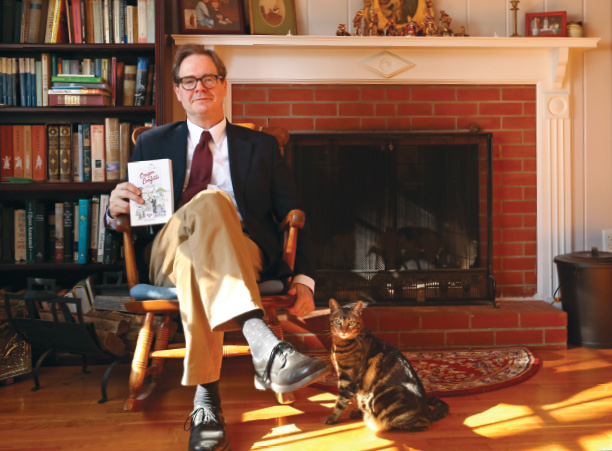
Lee Oser, professor of English, presents his newest novel "Oregon Confetti." “You write about what you know,” says Lee Oser, professor of English, about writing his newest novel, “Oregon Confetti” (Wiseblood Books, 2017). As a former musician in Portland, a professor of English and a committed Roman Catholic, Oser combines his knowledge of the Portland art scene, literary techniques and Catholic doctrine to reintroduce the Catholic novel to contemporary audiences.

“Oregon Confetti” challenges conceptions of success and happiness as “semi-honest” main character Devin Adams is confronted by his friend John Sun, a renowned artist, bearing a mysterious baby. The two embark on a life-or-death adventure to reveal the meaning of life, love and friendship in absurd and unexpected ways.

Making use of a combination of literary genres, “Oregon Confetti” is considered a satire, a detective novel and a Catholic novel simultaneously. The novel’s Catholic presence is often subtle and other times overt, as Oser incorporates a wise Jesuit professor who offers spiritual advice to the book’s protagonist throughout his journey — a nod to Oser’s connection with Jesuit institutions. He includes Catholic influences in the novel while, he says, “not sticking so neatly to clearly distinguished genres of writing.”

“I want to be held to the same standard from both Catholic and non-Catholic points of view,” he adds.

R. Clifton Spargo, author of “Beautiful Fools: The Last Affair of Zelda and Scott Fitzgerald,” calls the book “a post-secular fable for people who don’t want to be cynics any longer. In witty, energetic prose, Oser takes on easy American cultural pieties and pushes his characters (despite themselves) to believe in something ultimate that can’t be ironized out of existence.”

“What we’re talking about here is human dignity,” Oser explains in an interview with Crisis Magazine, “and that’s a Catholic conversation. I like it, I feel at home in it.”

“Oregon Confetti” has received acclaim from top Catholic literary outlets, including Crisis Magazine and Commonweal Magazine, which featured “Oregon Confetti” on their “Top Books of 2017.”

“Antic, absurdist, comic, and Catholic, this ribald novel grows out of the Evelyn Waugh and John Kennedy Toole tradition,” writes Commonweal Magazine. “But I also heard echoes of Auden. Like him, Oser finds theology in two unlikely genres: the picaresque and the detective novel.”

“Oregon Confetti” is Oser’s third novel. Other works include novels “The Oracles Fell Silent” and “Out of What Chaos” and three works of literary criticism.

Written by Maeve Sweeney ’18 for the Spring 2018 issue of Holy Cross Magazine.


About Holy Cross Magazine

Holy Cross Magazine (HCM) is the quarterly alumni publication of the College of the Holy Cross. The award-winning publication is mailed to alumni and friends of the College and includes intriguing profiles, make-you-think features, alumni news, exclusive photos and more. Visit magazine.holycross.edu/about to contact HCM, submit alumni class notes, milestones, or letters to the editor.

Posted in Catholic Studies, English, Holy Cross Magazine, News, Spring 2018 | Comments Off on English Professor Challenges Literary Norms in New Catholic Novel

Not ‘Til I’ve Had My Coffee: How Caffeine Culture is Affecting Kids

Alison Bryant Ludden, associate professor of psychology, speaks with students about her researchEveryone drinks coffee — what’s the big deal? When “everyone” includes adolescents, Alison Bryant Ludden, associate professor of psychology, says there’s reason for concern.

Her interest in studying caffeine use in adolescents was piqued while conducting field work in schools.

“One of the things I started to notice was that adolescents were talking about caffeine use in the same way they talk about other substances, like alcohol use, for example — as a way for connecting with peers, a way of self-medicating to help you relax or to help you chill out with your friends. But instead of alcohol,” she explains, “they were talking about caffeine.”

In the past 15 years, with the introduction of energy drinks and the rise of coffee shops, the consumption of caffeine has become more and more popular among adolescents. While the physiological effects of these beverages are worrisome (energy drinks and coffee beverages contain five, sometimes up to 10, times the amount of caffeine found in a can of Coke), Ludden’s focus is on understanding the behavioral choices made around the substance.

Through her focus group interviews and survey research with high school students, Ludden has seen that drinking caffeine is a way for kids to feel cool, connect with their friends and show their independence and social status.

“This expands the notion of caffeine as just being something that adolescents are drinking for the stimulant effects,” she says. “It has a bit of that edginess, of being something that not everyone has access to and of risk-taking if parents were to find out.”

Companies have picked up on this interest and are reinforcing it through advertising specifically targeting kids: Energy drinks like Monster or Rockstar sponsor sporting events that are popular among adolescents, while coffee companies use flavors such as Oreo, Reese’s or chocolate to make their products appealing to a younger clientele.

Ludden also heard students saying they “needed caffeine to get through the day” or “to function.” This language, she explains, is likely picked up at home or from the adults around them, and is particularly concerning.

“During times of change and stress, common in adolescence, kids are establishing patterns of adaptation,” Ludden says. “If they begin to rely upon caffeine as their way of getting through the day, those health behaviors become more established. We also have to worry about kids consuming more and more caffeine without realizing how much they’re consuming, and then forming addictions to caffeine, having withdrawal effects and needing caffeine. In both instances, addiction pathways are being activated.

“If you’re establishing a habit of self-medication and a habit of socializing using substances that are taboo, those patterns suggest that caffeine could be a gateway drug,” she continues. “There is correlational research to suggest that kids who use caffeine are more likely to use other substances. So why is this an issue with adolescents? Because behaviors you form in adolescence stick with you.”

Written by Evangelia Stefanakos ’14 for the Spring 2018 issue of Holy Cross Magazine.


About Holy Cross Magazine

Holy Cross Magazine (HCM) is the quarterly alumni publication of the College of the Holy Cross. The award-winning publication is mailed to alumni and friends of the College and includes intriguing profiles, make-you-think features, alumni news, exclusive photos and more. Visit magazine.holycross.edu/about to contact HCM, submit alumni class notes, milestones, or letters to the editor.

Posted in Holy Cross Magazine, News, Psychology, Spring 2018 | Comments Off on Not ‘Til I’ve Had My Coffee: How Caffeine Culture is Affecting Kids

For Today’s Catholics Hell Means ‘the Hopeless Anguish of God’s Absence,’ Says Holy Cross Professor

Joanne Pierce, professor of religious studies, pictured here during a lecture.

In an article for The Conversation, Joanne Pierce, professor of religious studies at Holy Cross, traces the conceptual evolution of hell through the Jewish and Greek cultures and their influence on the Christian description of hell or the afterlife, including examples from works such as Dante’s “Divine Comedy.”

Pierce ultimately cites the representation found in the “Catechism of the Catholic Church,” as the modern definition of hell, which “omits the gory details found in earlier attempts to describe the hellish experience, but restates that the chief pain of hell is eternal separation from God.”

To read the full article, go to The Conversation. The piece has also been republished by Newsweek and Religion News Service.

Posted in In The News, News, Religious Studies | Comments Off on For Today’s Catholics Hell Means ‘the Hopeless Anguish of God’s Absence,’ Says Holy Cross Professor

Religious Studies Professor and Papacy Expert Opines on Pope Francis’ Apology for Abuse in Chile

Last week, Pope Francis wrote to three clerical sexual abuse victims apologizing and asking for forgiveness for defending Chilean Bishop Juan Barros, accused of covering up their abuse by a former priest. In an article for The Conversation, Mathew Schmalz, associate professor of religious studies at the College of the Holy Cross, explains the extraordinary nature of Pope Francis’ timely public apology, framing it in the historical context of past popes.

In the piece, Schmalz also describes how “mercy and forgiveness have been the central themes of his pontificate” and closes the article by inviting Catholics to learn from the Pope’s example: “When Francis apologized to the people of Chile and to victims of sexual abuse, he also was teaching the rest of us how to admit our sins as a first step in making things right.”

To read the full article, go to The Conversation.

A sought-after expert on the papacy, Schmalz has published opinion pieces in Newsweek, Salon, The Washington Post, Fortune Magazine and Huffington Post. He also has provided expert commentary to CNN, USA Today, The New York Times, The Washington Post, ABC’s Good Morning America, NPR, CNBC, and U.S. News & World Report, among others.

Most recently, Schmalz was a panelist for a conference titled “Francis the Pilgrim: From Personal Devotion to Papal Diplomacy” and hosted by Holy Cross on April 11-12, 2018. The conference featured Pope Francis biographer Austen Ivereigh and Rev. Thomas J. Reese, S.J., senior analyst at Religion News Service, as keynote speakers.

For additional information on our faculty experts, please contact College Marketing and Communications at 508-793-2419.

Posted in In The News, Mathew Schmalz, News, Religious Studies | Comments Off on Religious Studies Professor and Papacy Expert Opines on Pope Francis’ Apology for Abuse in Chile

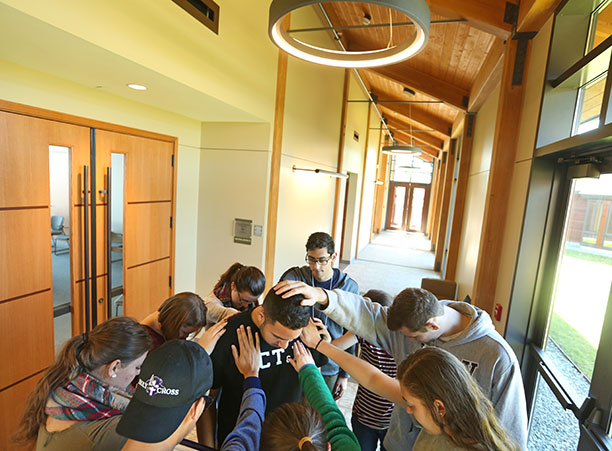
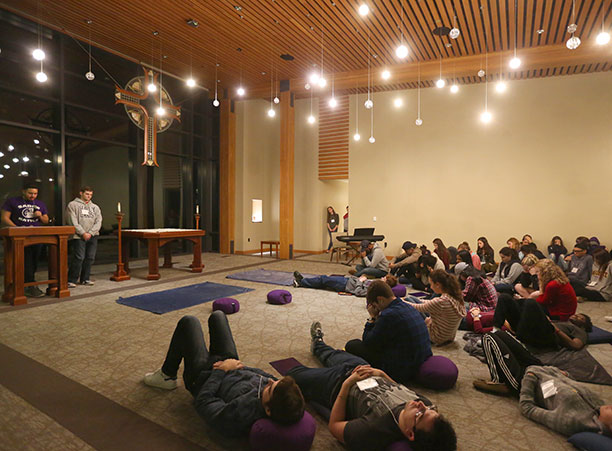
Contemplation in Action at the College of the Holy Cross — The Thomas P. Joyce ’59 Contemplative Center

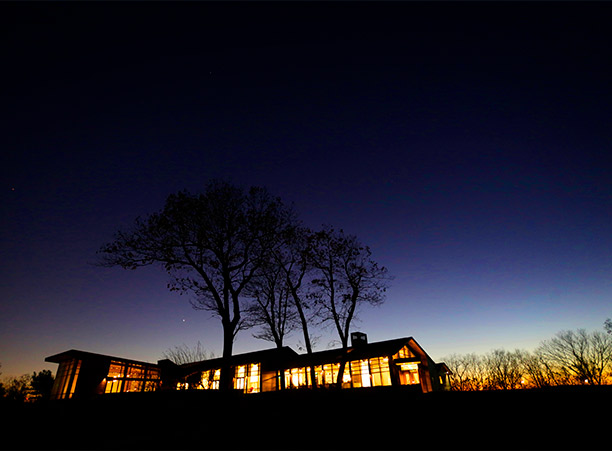
The Thomas P. Joyce ’59 Contemplative Center is a 33,800 square-foot complex featuring a chapel, meeting rooms, dining room, and bedrooms for 60 individuals in a lodge-like atmosphere removed from the regular bustle of campus life. Photo by: Tom Rettig

The Thomas P. Joyce ’59 Contemplative Center is a 33,800 square-foot complex featuring a chapel, meeting rooms, dining room, and bedrooms for 60 individuals in a lodge-like atmosphere removed from the regular bustle of campus life. Photo by: Tom Rettig

There are plenty of beautiful, serene places to pray on campus at the College of the Holy Cross. There are three chapels here, in addition to Campion House, the home of the Office of the College Chaplains, and any number of picturesque outdoor spaces atop Mount Saint James.

But the newest space is just a few miles away from campus, at the top of a hill in West Boylston with a view of nearby Wachusett Reservoir and quintessential New England foliage as far as the eye can see. The Thomas P. Joyce ’59 Contemplative Center is a 33,800 square-foot complex featuring a chapel, meeting rooms, dining room, and bedrooms for 60 individuals in a lodge-like atmosphere removed from the regular bustle of campus life. Holy Cross students, alumni, faculty and staff can be found here year-round, spread out across the vast 52-acre site, reading in the quiet nooks, writing in the sprawling woods, or speaking with spiritual advisors.

“The Contemplative Center is a concrete symbol of what our Jesuit and Catholic tradition invites the members of our community to do,” says Rev. William R. Campbell, S.J., the College’s Vice President for Mission. “To be reflective, to step away and to think deeply and engage the issues in a space that’s conducive and has taken on a sacred character.”

Since its opening in 2016, the Joyce Contemplative Center has become increasingly engrained in the Holy Cross experience. More than 700 students — roughly 25 percent of the student body — took part in a retreat or program at the Center during the 2016-17 academic year. A highlight is the Spiritual Exercises, a five-day silent retreat based on the Spiritual Exercises of St. Ignatius, which is offered four times a year. In May, students are invited to step away from the bustling campus for the “Eat, Pray, Study” retreat, where they can study for their upcoming finals in a quiet, serene atmosphere.

The Center is not just for students. Alumni visit for retreats, taking the opportunity to pray and reflect and reconnect with their fellow alumni and with God. Athletics teams and academic departments use the facility for team building that goes beyond X’s and O’s and the upcoming syllabus. The College’s Board of Trustees has also held a retreat here. Most weeks, the Chaplains’ Office is juggling three or four programs, says Marybeth Kearns-Barrett, the Director of the Office of College Chaplains.

But it isn’t for every event, Kearns-Barrett is quick to point out. This isn’t just a meeting space or a well-appointed retreat house. Every event here should have at its core a contemplative, Ignatian purpose.

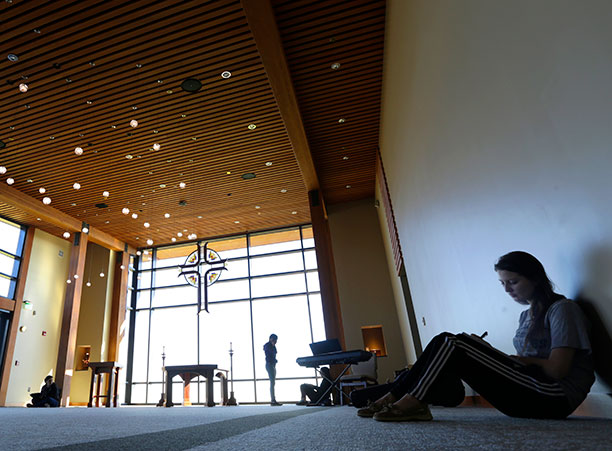
The architects of the Center, Lamoureux Pagano & Associates, Inc. of Worcester, were given the autobiography of St. Ignatius for inspiration, which is revealed in small touches throughout the property. Dozens of hanging pendant lights in the chapel mimic the night sky, which often held Ignatius’ gaze during his convalescence in Loyola, Spain.

The ceiling of the chapel is angled upward, just slightly, seeming to stretch upwards toward the sky. A stained-glass cross is suspended at the front, just before a glass wall that looks out over the surrounding beauty. It’s Kearns-Barrett’s favorite space on the property.

“That’s the place that reminds us of what this place is for, and why we’re there,” she says.

The Center builds on an already full mission and ministry program at Holy Cross. Of the 2017 graduating class, 68 percent participated in a College ministry program through the Office of College Chaplains, among the highest rates of participation of all Catholic colleges in the country. And in recent years, more than 150 faculty and administrators have participated in a 12-day pilgrimage to the sites associated with St. Ignatius, St. Francis Xavier, and other early Jesuits as well as the wider Catholic Church in Spain and Rome, after having engaged in discussion seminars on relevant readings prior to each trip.

Though the Center is removed from the main College, there are echoes of campus everywhere. Black and white photography on the walls depict slices of spirituality found back on campus, each one echoing aspects of the Exercises. The suspended stained-glass cross in the chapel was built according to the same design by the same liturgical artist who built the crosses in chapels on campus.

And while those echoes are present, being removed from campus allows students to disconnect from the day-to-day, says Fr. Campbell. Cell phones are left at home or dropped in a basket at the door. The outside world beyond view is left behind.

Last fall, Fr. Campbell observed two students from Cleveland and Chicago, who attended a silent retreat at the Center. Fully immersed in the Spiritual Exercises, the pair, both avid baseball fans, had no idea that their respective teams were set to meet in the World Series.

“It’s nice to see how seriously the students take the invitation to step away,” Campbell says, “and focus on prayer.”

This article originally ran in the April issue of Connections, an online publication of the Associations of Jesuit Colleges and Universities.

Related Information

Posted in News | Comments Off on Contemplation in Action at the College of the Holy Cross — The Thomas P. Joyce ’59 Contemplative Center

How Not Having It Figured Out Helped Me in the Long Run

Micaela English '08

Reader beware: This is not a traditional job story. There wasn’t one magical internship that paved the way for me. There was no shiny offer that I had entering my senior year. The lingering, complicated question of “What do you want to be when you grow up?”  was always a  challenge for me, as there was never an answer that immediately presented itself. In fact, I still ask myself this question monthly, weekly, daily. I still want to be so many things. I still want to learn so many things. I still want to contribute to so many things. At the end of the day,  I’m a creative thinker, and not having my future written in stone has actually helped my career.

So where does a degree from Holy Cross, and the alumni network fit into this backwards fairy tale? Holy Cross helped me feel confident that I didn’t need to fit into a box. Holy Cross made the real me bubble up to the top, and the network of women I have met in my alumni journey have emotionally carried me on their shoulders to help me shine brighter than I ever imagined.

Let me backtrack for a moment, to when I was a first-year moving into Mulledy at Holy Cross. I unpacked my trunks of eccentric clothes (luckily, there was no Instagram to document these “looks” in 2004), wore sky high heels to class (that prompted many falls in front of Dinand), and proclaimed that I wanted to be a lawyer when I graduated. Any student/faculty/human could have looked at me, my strengths, and interests and quickly realized that I probably was not going to be a lawyer. But at this point, I craved a clear understanding of who I was going to be. I felt this self-imposed tremendous pressure to have it “figured out.” After a summer internship at a law firm that made me feel like I was putting on a costume of who I was supposed to be everyday, I quickly realized that while the legal path was the right career for many of my fellow classmates, it wasn’t highlighting my inner strengths, and I was back to the career drawing board.

I had a very clear “aha!” moment my sophomore year on Mount St. James. I’ll never forget, my mom sent me this email: ” Hi Micaela, first of all, I hope you are doing your laundry. Second of all, you need to read this month’s Holy Cross Magazine, there’s a profile on an alum named Carolyn Risoli and she is the president of Marc by Marc Jacobs.”

My eyes lit up, my heart started booming — there was an alumna who was slaying the fashion scene in New York City. Instantly, I was inspired and wanted to learn everything about Carolyn Risoli. I Googled the heck out of you, Carolyn, in a socially acceptable stalker-ish way. I think I even memorized some of your quotes from that article my mom sent me, and might have used them to answer questions in upcoming interviews. “Why a liberal arts education?” I proudly recited your words,”I was taught to think, to speak and to write.”

With Carolyn’s career as my North Star, I started applying for summer internships that felt more like me during my time at Holy Cross. Also, as I got deeper into my philosophy major, with the help of my female mentor and professor May Sim, I became more open-minded and felt more comfort in the discomfort of not having it figured out. My one regret? I never reached out to Carolyn when I was a student at Holy Cross. I was intimidated and wasn’t sure what to say. I didn’t want to be one email in a sea of emails that she got from HC students just like me. Are you a student or alumnus that feels that way? Write the email.

When I finally did get the chance to meet the mentor who didn’t even know she was my mentor, I was wowed. Carolyn offered me career advice. I told her about my struggle to unplug in a digital world and in a digital field. We laughed and instantly bonded. And I have to say, that is the gift that keeps on giving to me professionally post-graduation from Holy Cross. The purple network of strong women that I have surrounded myself with. From my own friend group and peers (I text and email my Wheeler roommate, and St. Andrews abroad bestie, Courtney Hakanson, an unhealthy amount on job advice) to the insanely influential  brand consultant Erika Bearman who will take a call with me whenever I have a question to CNN social superstar Ashley Codianni who has kindly introduced me to her professional network. As women in business, we help each other out, offer advice, help with introductions, and most importantly, friendship.

So want to know where a dream of having a career like Carolyn Risoli got me? It didn’t quite land me a big job at a fashion house. But it did take me to some cool places. After jumping around to a few positions in publishing post-graduation, I found my home at Hearst. First on the print side of publishing and then moving over the Hearst Digital Media group, launching the digital footprint for the brand TOWN&COUNTRY. There I learned the inner workings of “the internet” and had a blast exploring the ever-changing landscape of social media, algorithms, engagement and growth.

That position eventually got me working in digital and social media on the brand side of things, first for the brand Anthropologie and now as a consultant for beauty and luxury brands (while still flexing my writing muscle as a freelance writer). As a Crusader with an untraditional career, I am so grateful to those that have helped me, feel so lucky that I didn’t have to fit into a box in order to feel gratified professionally, and can’t wait to provide mentorship for those students and alums that need hand holding throughout their process. We’re here for you. No matter your career path, a Crusader is a Crusader through and through.

Written by Micaela English ’08, a digital and social media strategist, and freelance writer based in New York City.

Carolyn Risoli ’86, who serves on the College’s Board of Trustees, the Board of the International Pre-schools in New York City, and on the Advisory Board for Comprehensive Development, Inc., will be honored at the New York Leadership Council Annual Dinner on May 14. 

Posted in News, Philosophy | Comments Off on How Not Having It Figured Out Helped Me in the Long Run

Photos: Holy Cross Students Share Their Passion for All Things Ancient Greek and Roman on Classics Day

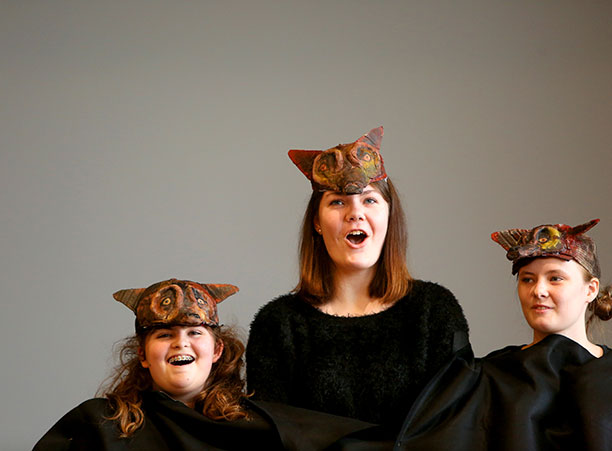
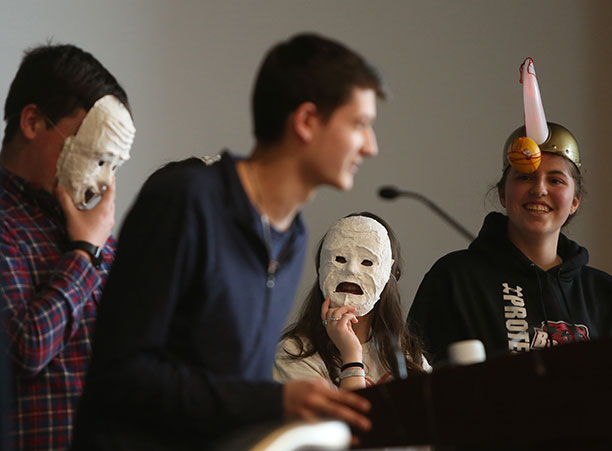
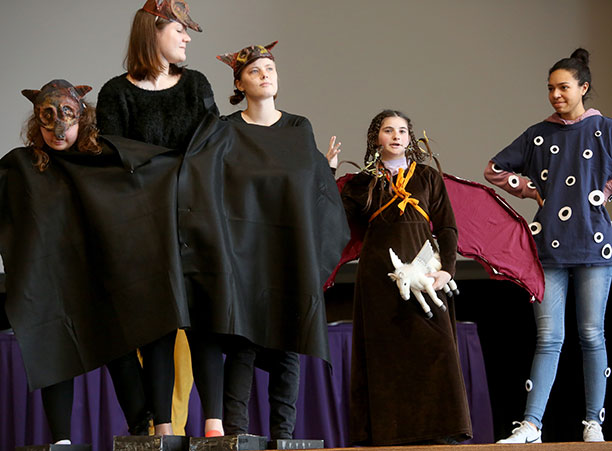
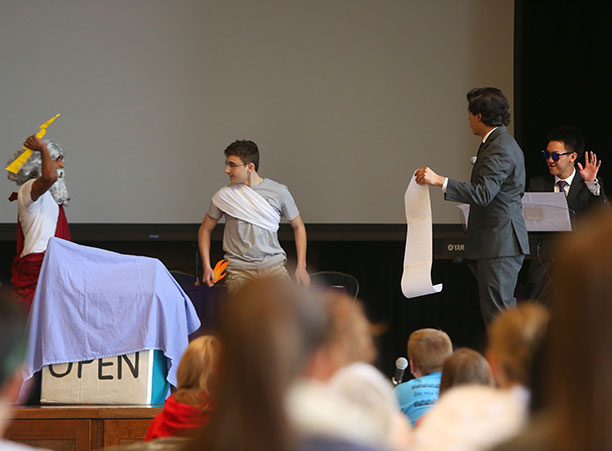
Three students from Ursuline Academy dress up as the mythical beast Cerberus.“Have any of you ever heard that Latin is a dead language?” Neel Smith, professor and chair of the classics department, asked the Hogan Ballroom filled with buzzing high school students from across New England. Hundreds of hands shot up in the air.

But the 46th annual Classics Day, a College of the Holy Cross tradition celebrating all aspects of ancient Greek and Roman culture, was more than lively.

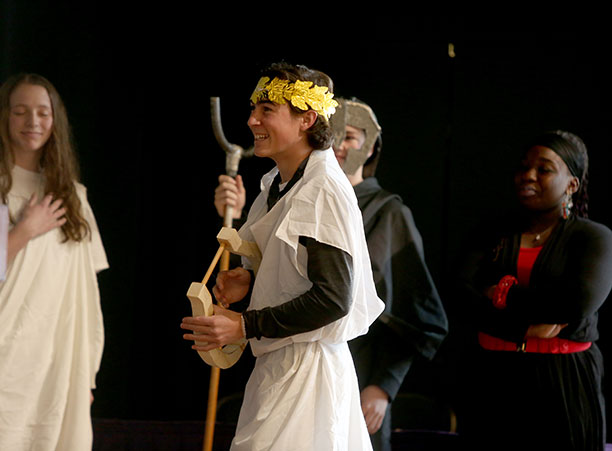
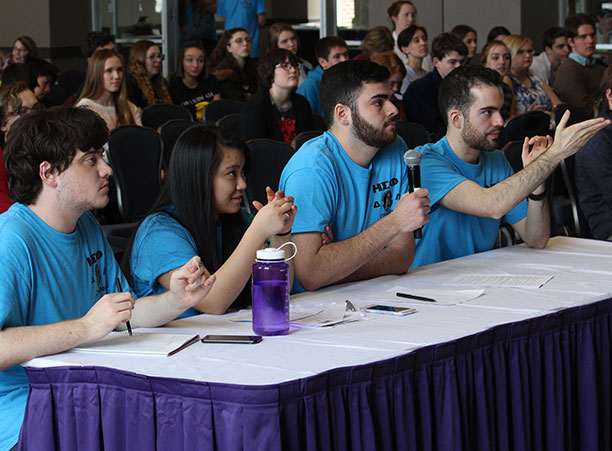
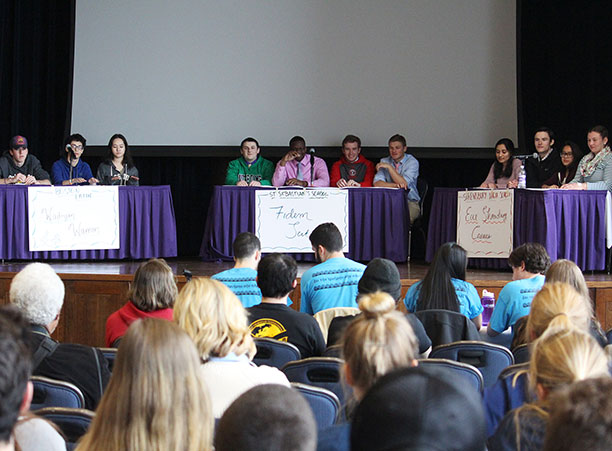
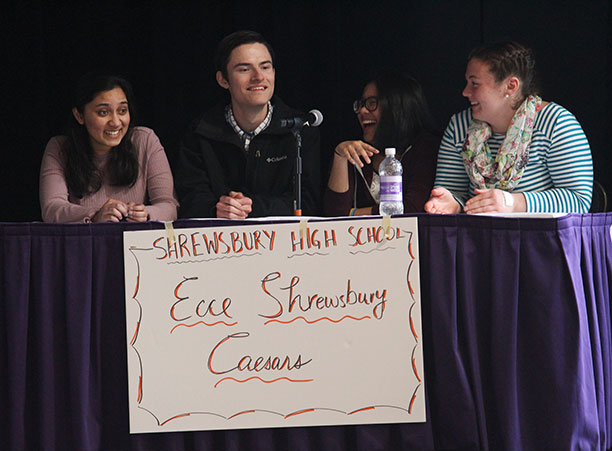
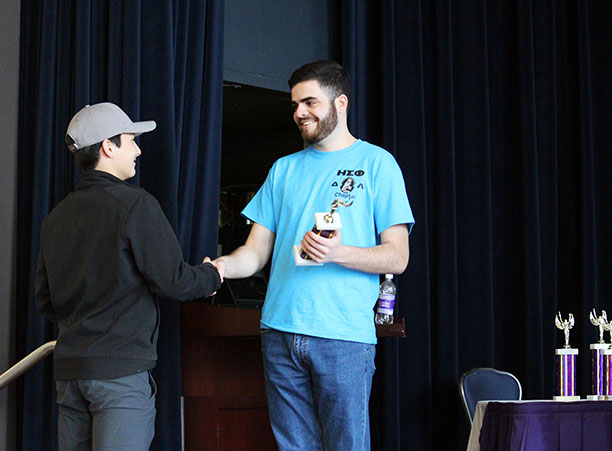
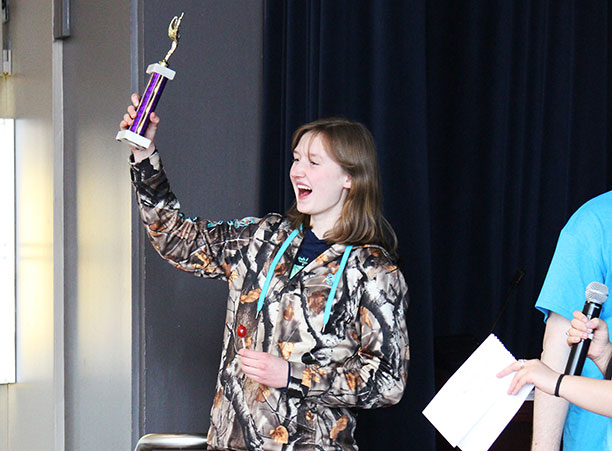
Put together by a committee of 20 Holy Cross classics students and the Delta Lambda chapter of Eta Sigma Phi, the Classics Honors Society, the all-day event featured Certamen (a quick-fire game of classics trivia); a widely popular costume contest; the third annual art contest; and a manuscripts challenge, where students were asked to translate and analyze ancient texts. A quick glance at the constantly cheering crowd was all it took to get a feel for the day — students in suits flipping through decks of flashcards, be-winged mythical creatures adjusting their accessories, and too many prop bow and arrows to count.

Classics Day also gives high school students a chance to discover that studying classics in college is a compelling option, especially at Holy Cross.

“When most people hear about classics, they ask, ‘Oh do you read Charles Dickens?'” says James Garry ’20, co-chair of this year’s event who explains that many aren’t sure what it means to study classics or what makes up the field. “It’s great to have an event that celebrates the classics and brings it into prominence.”

With one of the largest classics departments in the country, Holy Cross student classicists conduct leading research on ancient texts and culture, presenting their findings at conferences around the world. After graduation, students who majored in classics secure an array of opportunities, from attending law school to continuing research to studying medicine. In the past six years, eight classics majors have received Fulbright grants to teach and conduct research.

Michael Kelley ’18, who chaired the event last year, attended his first Classics Day as a senior in high school.

“I was still discerning where I wanted to go to college, and Classics Day acted as a visit to Holy Cross to see what it was all about, specifically the classics department. It meant a lot in terms of my decision to come here, but it also stimulated my interest in classics.”

Garry’s fellow co-chair, Hannah Nguyen ’19, considers herself lucky to be a part of the classics community at Holy Cross.

“Not only are we peers and classmates, we are close and supportive friends. I think that is very evident in the ways that we work together even beyond the classroom — studying together, working on research projects, putting together the classics journal ‘Parnassus,’ and of course, planning Classics Day.”

She hopes that Classics Day is a way for high school students to learn that it’s possible to study what you are passionate about and still have fun.

“Yes, I get to share with the high schoolers how much I enjoy the study of ancient languages, history and culture, but I also look at it as welcoming a whole new generation into a community that I am really proud to be a part of.”

Media Coverage

Worcester News Tonight: Classics Day at Holy Cross

Posted in Classics, Featured, News | Comments Off on Photos: Holy Cross Students Share Their Passion for All Things Ancient Greek and Roman on Classics Day

Honoring the Past: Students Seek Opportunities to Learn About the Holocaust

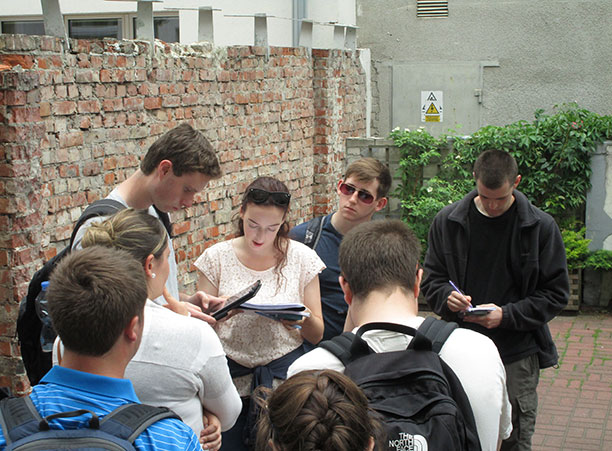
Students gather at the one of the few remaining sections of the Warsaw Ghetto Wall that was erected to seal off the Warsaw Ghetto, the largest ghetto in Poland, on a Maymester trip through central Europe. “Never forget” is a phrase that’s long been used to remind people, Jews and non-Jews alike, to remember the pain of the Holocaust, which is being commemorated — on campus and around the world — as A Day of Remembrance or “Yom Hashoah” until sundown on April 12.

Never forget also sums up the experience of Chris Fulco ’20, a physics major who is currently taking the course The Holocaust: Confronting Evil with Alan Avery-Peck, Kraft-Hiatt Professor in Judaic Studies at the College of the Holy Cross.

“I found it so interesting to learn that with ‘Halakha’ — religious law — Jews were able to keep practicing throughout the Holocaust even though they didn’t have any of their synagogues or religious books,” says Fulco. “Jews maintained their faith, even though they weren’t able to worship.”

The course is one in a selection of Judaism and Holocaust-related offerings at the College. With only a small population of Jewish students on campus, is there a real student interest in learning about the Holocaust and Judaism in general? Avery-Peck says absolutely.

He believes students on campus are interested in Judaism and the Holocaust because they’re invested in living lives that make the world a better place.

“When students think that the Holocaust happened barely a generation ago, in one of the most civilized countries in the world, they really wonder how this is possible and how this relates to us. It’s not a history that they think is irrelevant.”

Teaching on the Holocaust isn’t solely reserved for the religious studies department.

Daniel Bitran, professor of psychology, teaches an upper-level psychology class called Science, Medicine, and the Holocaust. He also leads a Maymester trip through central Europe with Thomas Doughton, senior lecturer in the Center for Interdisciplinary Studies, which explores history and memory in relation to the Holocaust.

“Initially, students are attracted to the Holocaust because they’ve had some exposure to Holocaust education at the high school level,” Bitran says. In his classes, he tries to get away from the sensationalist aspect of the subject matter and focus more on the deeply personal experience.

“We de-emphasize the numbers of people who were killed, we de-emphasize the atrocities that were committed. Instead, we emphasize the human story, individual stories, so that students come to know people for who they were. That allows them to identify with the subject in a much more personal manner.”

And then, Bitran says, the barriers fall.

“Students are no longer saying, ‘Well, this happened to Jews’ or ‘This happened to Jehovah’s Witnesses’ or other groups that were persecuted during the Holocaust, but they think, ‘It could happen to people like me.'”

Of course, students come to these courses with a consciousness of the involvement of Christianity, Avery-Peck adds.

“They know that anti-Semitism is a problem historically within the church, and that the relationship between Jews and Christians has not been an easy one,” he says. “They also know that for all that the Nazis themselves proclaimed to not be Christian and did not hold Christian values, they come out of a Christian heritage and a Christian nation. I tell students they can’t feel guilty for this by any means — it was not them. But they’re conscious of wanting to think about their own heritage and how they want to shape that heritage.”

Breaking Down Barriers

Bitran and Doughton, who teaches a Holocaust course in the history department, will once again team up to lead a Maymester trip through Lithuania, Poland, Czech Republic and Germany this May. On the trip, students will visit concentration camps such as Auschwitz and Treblinka and museums in Warsaw and Berlin, connecting deeply to aspects of the Holocaust memorialized throughout central Europe.

“Our goal there is to break down barriers,” says Bitran. “We look at individual stories — families that have survived or perished, getting to know the kinds of lives they lived before the war, characterizing the wide variety of Jewish life that took place in Europe.”

Corey LaForest-Roys ’18, a psychology major, found the trip helped him to view the whole notion of memorials more critically.

“I hadn’t really considered how things are memorialized and commemorated before. Just seeing different memorials, around campus and elsewhere, makes me think: Why was this built? Who was this built for? Who funded it?”

Natalie Czelusniak ’18, a mathematics major with a minor in statistics, says the Maymester is the most impactful course she has taken in her time at Holy Cross.

“Not only was it because of the extensive history I learned, but also because we were able to be present where the historical events physically occurred. I am Polish and I was so excited to visit the country where my family is from, which made learning the history of what actually took place in Poland that much harder to swallow.”

Outside of coursework and study abroad opportunities, students, faculty and staff can expand their Judaic knowledge through a series of anti-Semitism lectures on campus.

Last semester saw Seth Stephens-Davidowitz, former Google data scientist and author of “Everybody Lies: Big Date, New Data, and What the Internet Can Tell Us About Who We Really Are” (HarperCollins, 2017) presenting on Anti-Semitism on the Web.

Upcoming lectures include The Story of Hebrew on April 16 with Lewis Glinert, professor of Hebrew Studies at Dartmouth College and author of “The Story of Hebrew” (Princeton University Press, 2017); and Jews, Intersectionality and Contemporary Anti-Semitism on April 19 with Katya Gibel Mevorach, professor of anthropology and American studies at Grinnell College and author of “Black, Jewish and Interracial: It’s not the Color of Your Skin but the Race of Your Kin, and Other Myths of Identity” (Duke University Press, 1997).

Students like Mairead Forrest ’18, an English major with a minor in medieval and renaissance studies taking Avery-Peck’s Holocaust course, keep an open mind when learning the intricacies of a different religion.

“Every week we read a new book that proposes a new reason for the atrocities that occurred and each week we find ourselves saying, ‘Yes, that’s it. That’s why,’ only to have it turned on its head after reading the next book. There is no one ‘ah-ha!’ reason for the Holocaust.”

For Fulco, learning about the Holocaust has sparked an interest in furthering his knowledge on Judaism as a whole.

“It’s one of the oldest religions in the world, so there’s a lot to go off of. I’m a Catholic, so the Jewish religion is so interesting to me because it all connects so well.”

Posted in English, History, Mathematics and Computer Science, News, Physics, Psychology, Religious Studies | Comments Off on Honoring the Past: Students Seek Opportunities to Learn About the Holocaust

Holy Cross Cantor Art Gallery to Feature Work of Senior Visual Arts Majors in the Exhibition ‘Fine Art’, subtitled ‘Our Gift to You’

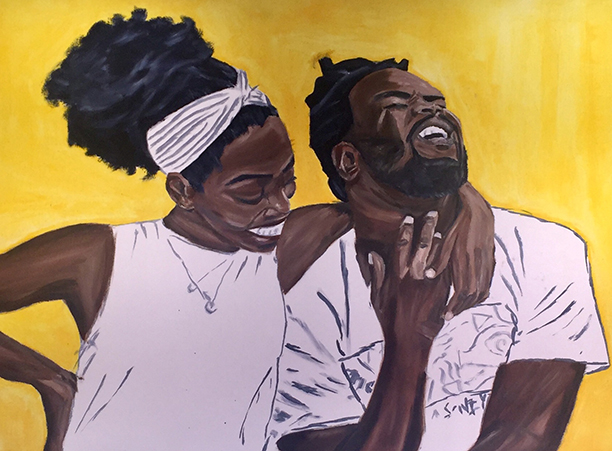
Demetrius Wilson '18 showcases his oil painting titled "Sweet Bliss."

The Iris and B. Gerald Cantor Art Gallery at the College of the Holy Cross will show the work of graduating senior visual arts studio majors in the exhibition “Fine Art,” which will be on view from Thursday, April 26 through graduation day, Friday, May 25. Student artists Alexandria Benoit, Matthew Brown, Erin Cunningham, Annalisa Dow, Ryan Hatfield, Joseph M. Metrano, Ann Mondi, Jake Nolan, Meg Snee, Autumn Taylor-Kelley, Megan Viera, Demetrius Wilson, Mengqi (Tavia) Wu will give presentations about their work in the gallery during the Academic Conference on Wednesday, April 25 beginning at noon through 2 p.m. The opening reception is scheduled for Thursday, April 26, 5:30–7 p.m.

Visual arts students who have participated in the year-long studio concentration seminar earn their place in the gallery by developing a cohesive body of work over the fall and spring semesters. In this capstone experience for the visual arts studio major, each student is given individual studio space and are encouraged to experiment with ideas and mediums, while cultivating an independent studio practice.

Amy Archambault Remby, lecturer and Millard Studio supervisor along with Rachelle Beaudoin, lecturer of digital arts media, co-taught the fall semester of the seminar, while Professor Cristi Rinklin was the instructor for the spring semester. Roger Hankins, director of the Cantor Art Gallery, serves as a professional mentor to the students throughout the process to help them conceptualize how their work will exist in a formal exhibition space.

Students engage in rigorous critiques with faculty and visiting artists with the goal of developing their work to its fullest potential. The senior exhibition experience provides students the opportunity to see their work transform through a professional presentation, in relation to the work of their peers, as well as through the reception of a public audience — a defining moment in which they transition from thinking of themselves as students to seeing themselves as working artists.

Each student’s work is informed by their unique perspective as individuals, as well as their academic studies and evolving abilities as craftsman.

Senior artist Alexandria Benoit will exhibit mixed media works on canvas influenced by the Pattern and Decoration Movement of the 1970s as expressed by artists such as Miriam Shapiro and others; Matthew Brown has crafted stop motion Claymation videos that expose issues related to hook up culture; large scale oil paintings by Erin Cunningham will offer scenes of glaciers entering the sea in Glacier Bay, Alaska; an installation of brightly colored fabric and painted organic shapes will cover an entire wall assembled by Annalisa Dow; Ryan Hatfield will show conceptual kinetic sculptures, small-scale sculptures created with chewing gum, and paintings; reverse paintings on Plexi-glass and plywood by Autumn Taylor Kelley will examine femininity, sexuality, and what it means to be a woman in modern day society; Joseph M. Metrano has created mixed media sculpture and photographs that provoke visceral responses to man’s domination and destruction of the natural world; Ann Mondi will show large scale mono-prints that seek to capture elusive and intangible memories; Jake Nolan will exhibit large scale paintings based on his experiences and reflections on the psychology of being; transforming personal pain through her sculptural and videoworks, Meg Snee will exhibit plaster casts of the human head; another printmaker, Megan Viera, will show mono-type and wood cut prints that explore the relationship between atmosphere and light; Demetrius Wilson offers glimpses of self through his oil painting portraiture; and Mengqi (Tavia) Wu uses the conceptual theme of telling secrets to engage the viewer in several visual and auditory experiences.

Visitors to the exhibition will be engaged both intellectually and visually as they view the work of this emerging group of young artists.


EVENTS

  • Academic Conference presentation by senior visual arts studio majors

Wednesday, April 26, noon–2 p.m.

  • Opening reception

Thursday, April 26, 5:30–7 p.m.

The gallery will be closed Saturday, May 19th.


Gallery Information

Founded in 1983 through the generosity of Iris & B. Gerald Cantor, the Cantor Art Gallery serves both as a venue for a changing series of historical and contemporary public exhibitions, as well as a vital resource for Holy Cross faculty and students, linking exhibitions to the broader liberal arts curriculum.

The hours for the Cantor Art Gallery are Monday–Friday, 10 a.m.–5 p.m. and Saturdays, noon–5 p.m. Located in O’Kane Hall, 1st Floor, College of the Holy Cross, 1 College Street, Worcester, Mass., 01610.  Visitors needing assistance with handicap accessibility should contact Public Safety at 508-793-2011. Admission to the gallery is free.

For additional information please call 508-793-3356 or visit the gallery’s website at: holycross.edu/cantorartgallery.

Posted in News, Press Release, Visual Arts | Comments Off on Holy Cross Cantor Art Gallery to Feature Work of Senior Visual Arts Majors in the Exhibition ‘Fine Art’, subtitled ‘Our Gift to You’

Worcester News Tonight Interviews Holy Cross Student as She Makes Final Preparations for Boston Marathon

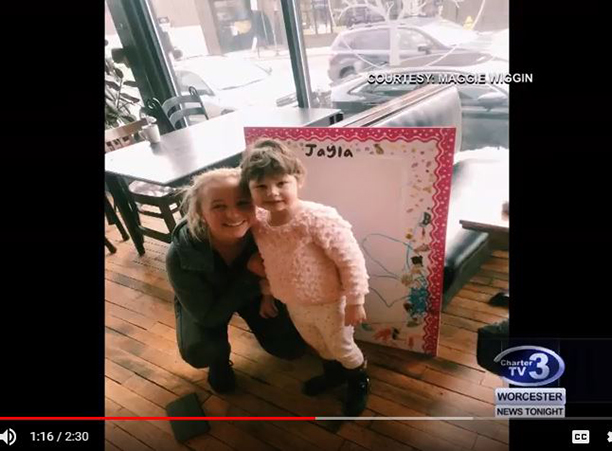
Maggie Wiggin '20 pictured here with Jayla,  a four-year-old Worcester native battling leukemia, currently being treated at the Dana Farber Cancer Institute.

Holy Cross sophomore Maggie Wiggin is preparing for her first Boston Marathon this year. Running to raise funds for the Dana Farber Cancer Institute, Wiggin has a special connection as the Institute helped her mom beat ovarian cancer. Wiggin was partnered with Jayla, a four-year-old Worcester native battling leukemia, currently being treated at the Institute. “She is going to be at mile 25, it’s just an amazing last mile and seeing them just helps you get to the finish line,” said Wiggin.

Wiggin will not only be representing the Dana Farber Cancer Institute, but also the College as a Holy Cross Crusader. “I’m really excited to represent Holy Cross, I’ve had a great two years here and I’m really looking forward to the Marathon,” Wiggin told Worcester News Tonight’s Brittany Schaefer.

To watch her full interview with Worcester News Tonight, click here.

Posted in Featured, In The News, News | Comments Off on Worcester News Tonight Interviews Holy Cross Student as She Makes Final Preparations for Boston Marathon

Holy Cross Professor on Why the Label ‘Cult’ Prevents Greater Understanding of New Religions

New religious movements have been a subject of fascination in American popular culture for decades, often portrayed in movies and TV shows as “cults,” which comes with its own implications of brainwashing and authoritarian practices.

In an article for The Conversation, Mathew Schmalz, associate professor of religious studies at Holy Cross, explains the connotations of the term and how he believes “that the label ‘cult’ gets in the way of understanding new or alternative religions.”

Schmalz identifies several problems with the term “cult,” namely its vague nature, a lack of concrete evidence for the effects of brainwashing on the brain, and the negative cultural sentiment associated with the word. Schmalz worries that “when people hear the word ‘cult,’ discussions end before any study has even begun.”

To read the full article, go to The Conversation. The piece has also been republished by Newsweek and Religion News Service.

Posted in In The News, Mathew Schmalz, News, Religious Studies | Comments Off on Holy Cross Professor on Why the Label ‘Cult’ Prevents Greater Understanding of New Religions

Latin American Film Class Travels to Buenos Aires to Explore Dark Period of Argentine History

In the span of about a decade, roughly 30,000 people in Argentina disappeared at the hands of the government. Called “los desaparecidos,” or “the disappeared,” many of these individuals were brought to the 500-plus clandestine detention centers established to detain and torture those thought to be a threat to the country’s dictatorship.

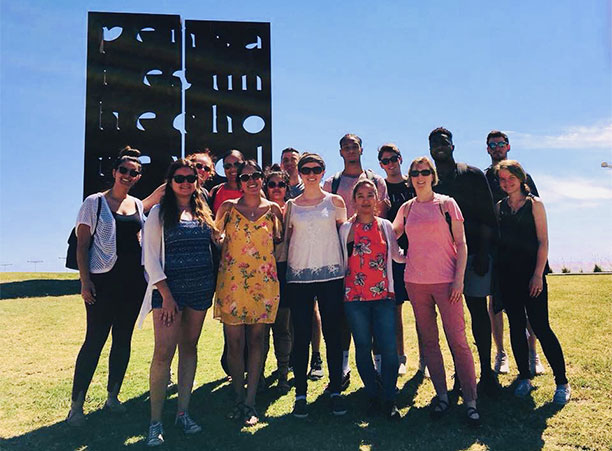
After spending the start of the spring semester studying this dark moment in Argentine history through film, Bridget Franco’s Latin American Film class traveled to Buenos Aires over spring break to explore how these events and los desaparecidos are remembered a mere 30 years later.

Posted in Latin American, Latinx, and Caribbean Studies, News, Photo Galleries, Spanish, World Languages, Literatures, and Cultures | Comments Off on Latin American Film Class Travels to Buenos Aires to Explore Dark Period of Argentine History