
 Former NFL quarterback Colin Kaepernick spent the 2017 and 2018 football seasons out of work. And even if he never takes another snap, he leaves quite a legacy.
Kaepernick’s influence was on display at January’s Black Student-Athlete Summit (BSAS) in Austin, Texas, where Marcellis Perkins ’19, a sociology major and member of the men’s basketball team, presented a paper, “Because He Is Seen but Not Heard: How Creating Spaces for Black Male Athletes Contributes to Holistic Development.” Perkins’ presentation won raves, making him an “instant rock star,” according to fellow Holy Cross student-athlete and BSAS attendee Martin Dorsey ’19.
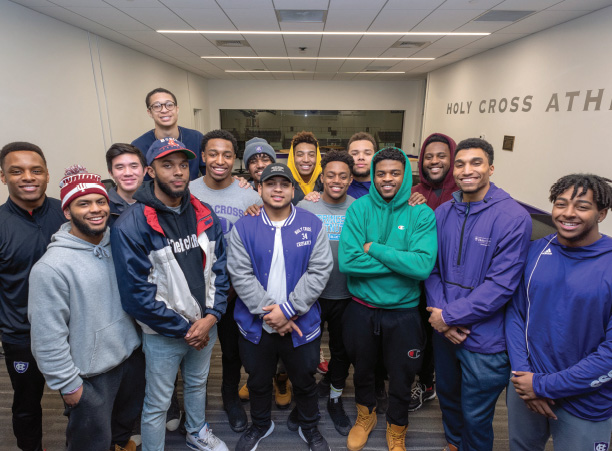
Perkins’ presentation was inspired by Men of Color Athletes (MOCA), a student group he helped found three years ago with Dorsey, a wide receiver, and Andre Chevalier ’19, a linebacker and the third Holy Cross student-athlete to attend BSAS. MOCA, in turn, was partly inspired by Kaepernick, whose activism in 2016 sparked nationwide debate and had a powerful influence on athletes of color.
A Shared Experience
MOCA was launched to give Holy Cross student-athletes of color a safe space in which to discuss a range of issues, from the national (Kaepernick’s outspokenness, followed by what many argue has been an unofficial league ban, keeping him unsigned) to the local (challenges faced by students of color at a predominantly white college) to the personal (topics such as dating, a subject that arises at meetings, Chevalier says).
The trio of co-founders are quick to give credit to fellow pioneers Armani Dawkins, former associate director of athletics for student-athlete development, and Steven Martinez ’16, former Crusaders defensive back.
The MOCA co-founders frequently cite empathy when explaining the need for the organization. “I love it here,” Dorsey says, but “we might be scared to speak our minds in classes, in a primarily white institution. We feel a little more comfortable at our Sunday night meetings. A lot of times, freshmen want to talk about the experience of being the only black face in a class. We tell them, yes, there are challenges, but it’s also an opportunity to offer insight and education to others.”
The meetings take place every other week in the Hart Center at the Luth Athletic Complex or the Hogan Campus Center, and they’re popular — a typical session may include 20 or more student-athletes of color, as well as administrators and professors. In contemporary America, where the line between sports, entertainment and politics is blurry, there’s never a shortage of topics.