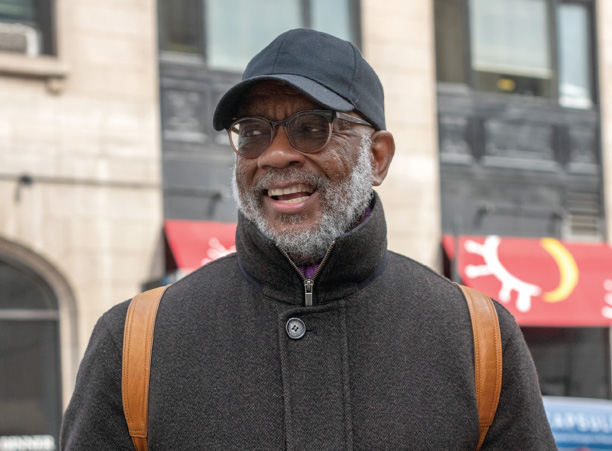
 Ron Lawson ’75 had worked for 14 years as a financial analyst and manager for some of the biggest firms on Wall Street. So when he was suddenly laid off in the early 1990s recession, he didn’t think much of it. “I figured with my professional and academic background, it would only take me two or three weeks to find another job,” he says.
Three weeks stretched into three months, and then four or five, with no new job materializing. Despite his high-powered lifestyle, Lawson hadn’t given much thought to savings — “everything I earned I wore on my back or on my feet,” he says — and suddenly he found himself unable to pay his rent.
At age 39, he was homeless. “I wound up on the floor of a friend of a friend who I barely knew,” he says, “and all I had to my name were three wardrobe boxes of clothes, a mattress and a sheet I used to pull over my head so that the roaches wouldn’t crawl on me.”
He spent the next six months without a home, without a job and feeling increasingly desperate. The only thing that kept him going was the kindness of friends, one of whom introduced him to a church in Brooklyn Heights led by civil rights icon Rev. Dr. Paul Smith.
“I’d go sit with him and we’d talk and pray, and he’d say, ‘Hard times don’t last always,'” Lawson remembers. Every time, Smith would give him an envelope with a couple of subway tokens and a few dollars that would help him get his next meal. Finally, a good friend asked if he’d be willing to help manage finances for Mayor David Dinkins’ re-election campaign, and suddenly Lawson went from homeless to managing the finances of an $11 million campaign.