
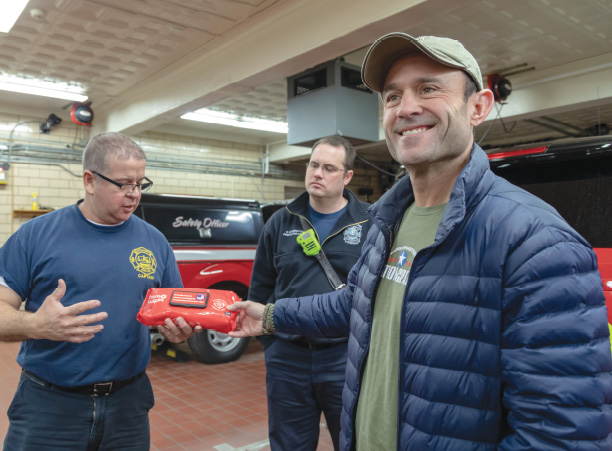
For Operation Gratitude CEO Kevin Schmiegel ’89, each morning breaks with a cup of coffee and some reading. “I start each day reading emails from service members who have received our care packages,” he says. “They express gratitude and astonishment to learn that people across America appreciate their service and understand their sacrifice — it’s incredibly powerful.”
The retired Marine lieutenant colonel understands the impact of appreciation expressed. He experienced it firsthand during his two decades of service in the United States Marine Corps and has encountered it many times since returning to civilian life. And it’s the reason he has chosen to spend his post active-duty life serving members of the military and first responders. “We have to say thank you to all who serve,” he notes, simply.
There’s no gap in Americans’ appreciation for the men and women who serve this country, he notes, but rather, “It’s a gap of understanding. There’s a civilian-service divide. People don’t have everyday interactions with those who serve, so they don’t understand what it entails.”
In response, Schmiegel has dedicated his life to changing that. After retiring from the Marines, he joined the U.S. Chamber of Commerce as chief of staff, traveling the world to meet with senior executives. It was fascinating work, but something was off. “I missed serving my country and serving others,” he says. “In my meetings, I repeatedly heard CEOs say that they liked hiring former service members.”
That observation led Schmiegel to leave his position and found Hiring Our Heroes, a program designed to help veterans and military spouses find meaningful employment. In no time, he realized he was onto something: “A young man came up to me at a hiring fair in Chicago and said, ‘You changed my life…I got a job.’ He didn’t realize it, but that day he changed my life, too.”
He equates problems facing active-duty military and veterans to a national security imperative. “For example, when I started Hiring Our Heroes, veteran unemployment was at 12.1 percent,” he says. “I saw that as a national security issue because if men and women who serve in the military don’t feel valued and don’t have a path to a career after service, it hurts our nation’s ability to recruit for our all-volunteer force.”
Over the next two years, Schmiegel and his team helped more than 120,000 veterans and military spouses find employment; today veteran unemployment stands at 4 percent.
In December 2017, he joined Operation Gratitude, a nonprofit that connects civilians and service members through gifts and handwritten letters. “Operation Gratitude offers me the opportunity to have a much broader impact on men and women in uniform, as well as on ordinary Americans who want to make a difference and give back,” he says.
Leading the organization, Schmiegel continues to focus on closing the civilian-service divide. “There’s a big disconnect between the general populace and service members because Americans don’t understand the jobs these people do or how to thank them for their efforts,” he says. “Gratitude is very important to those who serve, and it’s more than just saying ‘Thank you.’ Those who serve appreciate receiving snacks and hygiene items, but it’s the handmade-with-love items that mean the most. They’re not just a symbol of gratitude, they’re an actual expression of gratitude that volunteers make with their own hands, and they mean so much.”
Operation Gratitude has offered citizens a vehicle for saying thank you since its creation in 2003, delivering 2.3 million care packages and counting to servicemen and women. Schmiegel now wants to build on that foundation and serve other populations, as well. “For the first decade, the organization only served deployed service members, but now we’re serving our heroes at home as well, from veterans and military families to first responders, a cohort that is equally important to me,” he notes.
He’s also giving volunteers the chance to put a personal spin on their participation by allowing them to deliver care packages, rather than just assemble them, and expanding outreach through grassroots initiatives. Schmiegel encourages those looking to help narrow the civilian-service gap to find hands-on volunteer opportunities where people can interact with and get to know service members and first responders.
“When they have that opportunity to say ‘Thank you for your service’ and express gratitude face to face, they can take the next step and ask them questions about their service, the challenges they face every day and the sacrifices they and their families make,” he says. “That is the best way to create understanding and bridge the divide. We are all called to serve in different ways. And when you are called, you have a responsibility to answer.”