
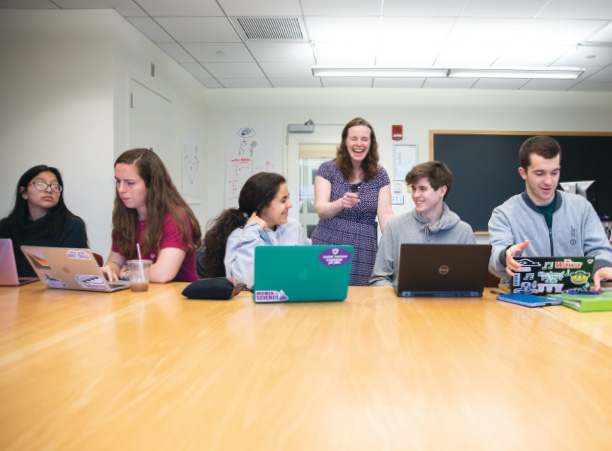
 There’s something poetic about the youngest members of the Holy Cross community spending an entire year learning about the oldest members of society. That’s the scientific quest students undertake in Biology of Aging: Understanding and Combating Aging, a Montserrat class in the Self cluster taught by Michelle Mondoux, associate professor of biology.
Mondoux breaks the yearlong course into two essential questions: How do we age (the fall) and what can we do about it (the spring)?
“We talk about what it means to age and then discuss how scientists think about that — and how scientists should think about that,” Mondoux says. “The first question on the first quiz is also the first question on the midterms and both final exams: What are the two factors that influence aging and diseases of age? And the answer is the same every time — genetics and the environment. That’s all there is.”
And while the course description reads like a 300-level biology class, Mondoux makes a persuasive case that it’s a perfect fit for students fresh to campus.
“We don’t have a textbook, and I use very little in terms of actual scientific texts because that’s not how students will encounter science in their future,” she says. “We work hard on reading something like a New York Times article about a recent discovery in aging and then ask critical questions: What did the scientists actually do? What was their experiment? What were their results? What are the things this article is not telling us? Did they test men and women? All of these different factors.”
Peter Oliver ’22 says the most interesting part of the course was that it wasn’t just memorizing and regurgitating facts. “Instead,” he notes, “we used information that we learned to apply to real-world situations. This was a really important step for me academically because it taught me how to apply things that I learn in the classroom to real life.”
Mondoux’s hope is that the course is a model for how to approach science — and, really, everything — in the media with a critical lens. “We ask: How do we approach a problem? And how do we think about the information we need to decide how we think about that problem? In that sense, I think it’s a really good fit for Montserrat.”
One of Mondoux’s favorite aspects of the course is that students can bring their own experiences and interests.
“I had a student who wrote a research paper about music therapy and Alzheimer’s,” she says. “Student-athletes may want to look at exercise and aging. One of my students is really interested in economics, so he’s researching whether or not biologically it would make sense to raise the Social Security age. People can take something meaningful to them and find there’s meaning in this course as well.”
The syllabus covers a range of topics, drawing heavily on Mondoux’s background as a molecular biologist.
“In the fall, we talk intensely about the cellular and molecular biology that you’re going to need to understand the things that come later. In the spring, we’re really thinking about how scientists study aging. And scientists study people who are really good at aging – very – which means centenarians, people who’ve made it to 100. Now you can study super centenarians: People who have made it to 110. There are 77 super centenarians in the world; that’s a small but pretty amazing number.”
Julia Zepernick ’22 thought the course was a great introduction to college classes, from class participation to writing assignments: “It acted as a ‘home base,’ providing stability during all the changes I encountered during my first year as a college student. Not only that, I really appreciated having the same professor all year. Professor Mondoux was someone I could turn to for both my academic and social needs.”
Given that first-year students are eons away from their elder years, what keeps them engaged?
“Students are always interested in aging because it’s an issue that’s affecting people they love, and at some point, they’re going to need to make decisions about their own health, about their parents’ health. And that’s going to be true as we get more and more into finding out about our own genetic information. And then the question is, do you have any ability to interpret that information? I think that’s going to be important in everyone’s health care.”
As Mondoux points out, “God willing, none of us are going to escape aging, right?”