Journalist Diane Brady chronicles the tumultuous era of the late 1960s and early ’70s at Holy Cross in the critically-acclaimed book “Fraternity” as she follows five African-American students who were recruited to the all-male, primarily white campus by then-theology professor Rev. John E. Brooks, S.J. ’49. The book has sparked many important conversations about race and social justice on campus.
It has also raised an obvious question: How far has Holy Cross come in terms of diversity, and what does the campus look like today?
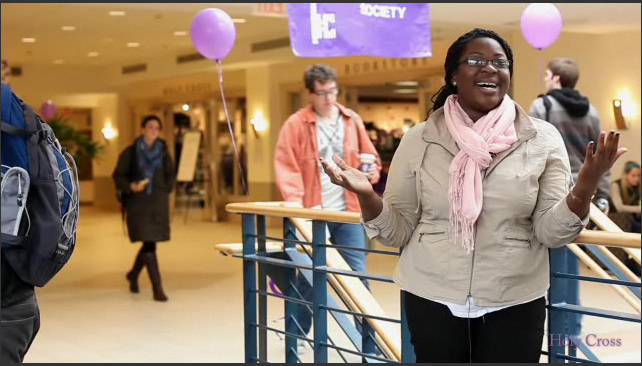
In the Class of 2015, 25 percent of the students are of African-American, Latin American, Asian-American, and Native American (ALANA) heritage. Beyond numbers, students, including those in the video above, often talk about the diverse, welcoming, and supportive environment at Holy Cross today.
The College provides a network of student resources, including an Office of Multicultural Education that works to raise the level of awareness of the importance of diversity and inclusion through educational workshops, critical dialogue, and creative programming; student organizations where students celebrate cultural traditions and advocate for respect and inclusion; and a one-week orientation program called Odyssey open on a voluntary basis to all first-year ALANA and international students.
Diversity at Holy Cross is still a work in progress, students say. In keeping with the Jesuit principles of equality and respect for all, the College is continually working to foster an environment marked by mutual respect and civility toward others. Among other efforts, a search is underway for the newly-created leadership position of chief diversity officer, who will have overall responsibility to build transformative alliances with various College constituencies to achieve a truly diverse and inclusive community of faculty, staff, and students.
Related Information
- Learn more about “Fraternity,” read an excerpt, and see reviews and media coverage
- Diversity at Holy Cross
- Holy Cross Magazine: Campus leaders discuss diversity at the College today
As a 1956 alumnus, I’m delighted to see the advances in diversity that the school has made in the last several years. My memories are starkly different. As a freshman, I lived on Fenwick 4 and John Brooks, who was a scholastic at the time was one of our prefects. There was one (one!!!) black student at the school and, if memory serves, he was a sophomore transfer student who was “forced” to live alone in a room at the end of the hall. No one spoke to him; no one acknowledged his existence; he was isolated from all social contact. I recall feeling tremendous guilt (and still do) but I still did nothing. After Christmas break, he did not return to school. I suspect that when Father Brooks became president, he remembered this and it played some role in his tremendous work in encouraging the school to join the 20th century.