
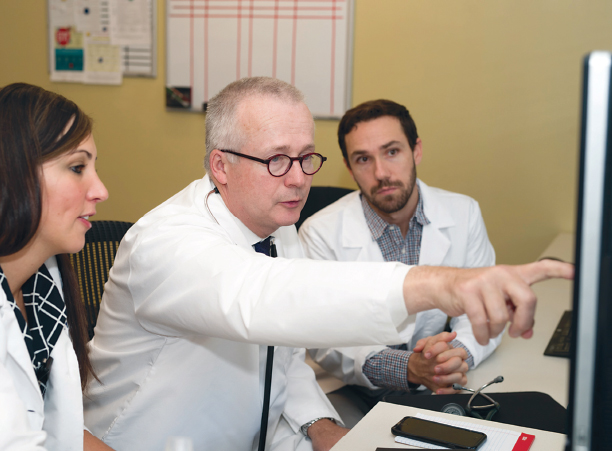
 Even though it was decades ago, Robert Harrington ’82 vividly remembers his tutorial with John Hamilton, associate professor of classics, a weekly one-on-one session on the Greek classics that he took when he was an upperclassman at Holy Cross.
Harrington would write a paper on an assigned topic from the “Odyssey” or the “Aeneid,” but he would never turn it in. Instead, it formed a basis of conversation between student and teacher. As Harrington read his paper, Hamilton interrupted and questioned him intensely, forcing his student to explain everything from his overall perspective right down to his choice of words.
“It taught me a lot about my ability to research a topic and think deeply on a topic, perhaps with minimal guidance, and to be able to defend my argument and my point of view,” Harrington says. “I think back on that now and I think it was one of the most valuable educational experiences I had.”
That experience and the rest of his undergraduate education at Holy Cross have served Harrington well. A cardiologist and clinical investigator, he is a professor of medicine and chairman of the Department of Medicine at Stanford University.
He is among scores of alumni — including Michael Collins ’77, David Ryan ’88 and Jennifer Schneider ’97 — who have made a mark in medicine and attribute their success and contributions, in large part, to their early preparation at Holy Cross. They say the school’s diverse liberal arts offerings, challenging science courses and Jesuit mission to serve helped shape them into the doctors they are today.
Finding a role in the world and seeing how that fits with your spiritual views is “incredibly helpful,” says Ryan, chief of oncology and hematology at Massachusetts General Hospital and a professor of medicine at Harvard Medical School.
“The hard choices that you have in life are going to come to you no matter what, whether you’re an oncologist or a teacher or a police officer or whatever your line of work,” he says. “To have a context for how to manage those hard choices and approach them is incredibly important. And I think a place like