It was Spring 1987 and high school senior Arnold Principal was lost.
He arrived on Mount St. James for a campus visit, got separated from his host and unknowingly stumbled upon the Black Student Union-sponsored Spring Talent Show.
“Two BSU members immediately recognized that I was not a current student and seemed lost,” he remembers. “That night, they made sure I had a great time at the event and hosted me in their dorm. Not only did I join the BSU that fall, but I also performed twice in the talent show the following spring.”
Today a proud alumnus of the class of 1991, Principal recognizes the impact of that happy accident and how it changed his life: “I credit coming to Holy Cross to its students and that one particular event.” Changing lives, taking action, finding lost students (usually figuratively, but in this case, literally) — and inviting them into a welcoming community of shared experience is a common thread that spans the history of the BSU, which celebrated its 50th anniversary in 2018.
A Place to Find Community
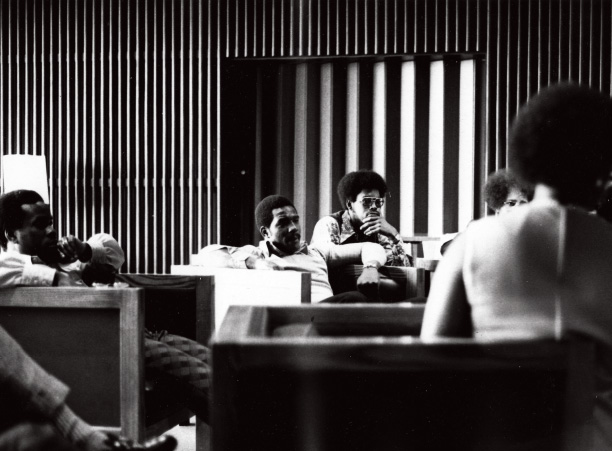
“Prior to 1968, there were very few black students on campus,” notes Arthur “Art” Martin Jr. ’70, first BSU president. He arrived on campus in 1966, one of two black students in a freshman class of 600. “You may have had eight to 10 black students, so there wasn’t any organization or safety net for the number of students who came on board.”
In the wake of the April 1968 assassination of Martin Luther King Jr., Rev. John E. Brooks, S.J., ’49, then academic vice president and dean of the College, took his now-famous road trip up and down the East Coast to recruit more students of color, an effort to better diversify the student body. That fall, 19 black students arrived at Holy Cross, and while they greatly bolstered the minority numbers on campus, they were still a tiny percentage of a nearly all-white institution, which was jarring for many of them — and their new classmates.
“As much as the black students didn’t know the white students, the white students didn’t know the black students,” Martin says. “There were a lot of cultural differences going on back then, even down to the music that people listened to, the way people danced. It was a whole cultural shock for some.”
Notes Theodore V. “Ted” Wells Jr. ’72, who was recruited by Fr. Brooks and later became the BSU’s second president: “When we arrived on campus, I dare say that Holy Cross was not ready for us and we were not ready for Holy Cross.”