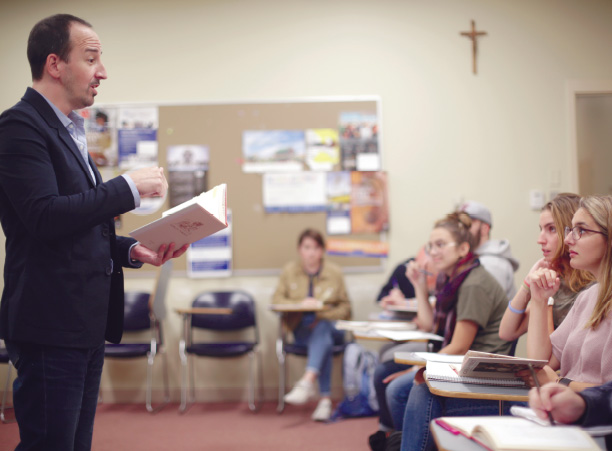
Jonathan Mulrooney speaks in front of a classroom full of students. Photo by Tom Rettig
More than 120 years ago, readers huddled by the amber glow of candlelight in wide-eyed terror to devour the pages of author Bram Stoker’s Gothic tale, “Dracula.” In 2016, viewers by the millions sat in the screen-lit blue light of streaming devices or televisions to watch the Gothic-esque Netflix original thriller, “Stranger Things.” The breakout hit affirmed what English Professor Jonathan Mulrooney has long known: The Gothic is alive and well.
Mulrooney created his course, Stranger Things — Gothic Old and New, to explore this genre, asking students to consider what monsters show us about ourselves. (After all, “monster” is derived from the Latin “monstrare” — “to show.”) “It’s about inviting the students to understand in a deeper way why they’re scared, why they’re excited, and why these things are so popular,” he explains.
While the Dracula image seared into popular memory is that of the blood-sucking count, Mulrooney asks students to think through how Stoker really got under the skin of readers of his time: by twisting and challenging Victorian societal ideas on gender, sexuality, religion and technology, including a recent startling medical advance — blood transfusions.
Set in the 1980s, “Stranger Things” is a nostalgic coming-of-age tale about a group of kids investigating the supernatural while searching for their disappeared friend, and — Mulrooney points out — challenging power structures in the process.
“The Gothic is always expressing the possibility of revolutionary desire or human experiences that cannot be contained by the institutions that want to contain them,” he says. “And that’s exciting to people — even if they don’t know why.” The course explores that question. At one class, students sit with their copies of “Dracula” and volley back and forth in discussion with each other and Mulrooney. They use textual evidence from the book and historical context to explore questions of desire, religion and agency — especially for the female characters — all rooted in a study of the words on the page.
“Go to the passages and let the texts teach you how to talk about them … Always, at the center, is the word,” says Mulrooney; this is his guidance to students and his own teaching philosophy — one he draws from his first time reading “Dracula.”
“I was assigned ‘Dracula’ in my eighth-grade English class by Mrs. Moran,” he remembers. “She was such a great teacher — she would have us look up vocabulary words from ‘Dracula’ so the words were connected with something that was exciting and mattered to us. An attention to the way language works to produce imaginative effects informs my class to this day.”
This approach also resonates for Anastasia Vasko ’19, an English major with a creative writing concentration. One of her favorite parts of Mulrooney’s class is “seeing how stylistic choices on the behalf of the author reinforce the thematic meanings of the prose, poetry or film.” She’s also struck by the way “the Gothic reveals reality.”
“The monsters in these tales are not necessarily the people we would call the monsters — Frankenstein’s creature or Dracula,” Mulrooney explains.
“The scariest part of these books is the humans.”
This realization gives students a foundation to consider how modern media, including films such as “Get Out” and television series like “Buffy the Vampire Slayer,” use the roughly 250-year-old genre to come to terms with real contemporary issues of race, power and gender.
To help his students start to experience stories in a new way, Mulrooney began the course in September with a classic by “Sesame Street” writer, producer and director Jon Stone: “The Monster at the End of This Book,” which features the character of Grover warning young readers that each page turn brings them closer to the monster at the book’s end.
“It’s about the production of fear in the child. But, of course, they’re going to turn the page — this is why we watch horror movies,” Mulrooney says. “There is a dual engagement: Go forward, don’t go forward. Read more, don’t read more. The actual act of reading these texts or seeing these movies becomes an experience like the experiences they’re describing. That’s one of the reasons people love the Gothic.”
English major Bella Arostegui ’19 chose to enroll in the class because she knew the Gothic would be interesting, exciting and revelatory about human nature. “This class has shown me how imaginative and ‘unrealistic’ storytelling — stories that delve into the mysterious and sometimes magical — can often reveal our deepest truths and fears,” she says.
Mulrooney sees this imaginative jolt to the self as being at the core of the College’s liberal arts and Jesuit focus on reflection: “In the Gothic, it’s the scare that in a bodily way, makes you jump out of yourself — which is a good thing, especially if you can then think about, talk about and imagine your way into some conversations about why that just happened to you.”
It’s also why Mulrooney suggested Mary Shelley’s “Frankenstein” as the first-year book for the class of 2022: “It raises issues of: What is the human? Who do we get to decide is inside and outside the border? Who gets to decide who is inside and outside the family? These are things our students should be thinking about.
“If we do not allow ourselves to be haunted — in profound ways — by the sins of our past,” he continues, “then we will forget them.”