The music of Steely Dan, the movie “O Brother, Where Art Thou” and the history of two world wars may seem an odd trio of discussion topics for a classics course. But the juxtaposition of the modern and the ancient is just the point of The Classics & Conflict in the United States, taught by Timothy Joseph ’98, associate professor of classics.
“We look at how the cultures of Greece and Rome have been put toward both positive and negative uses in the U.S.,” Joseph says. The course, which also serves as an elective for the peace and conflict studies concentration, looks at the role of ancient Greece and Rome in American life and includes debates on race, gender and class identity from the 18th century to modern times.
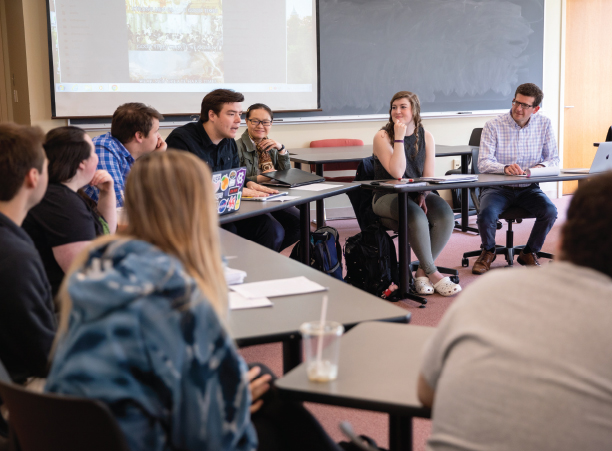
The discourse happens around a scattering of large tables in a light-filled classroom in Stein Hall. Joseph often has students rearrange the tables into a circle to elicit more engaged dialogue.
“Whatever the argument or issue, most Americans will charge headlong toward antiquity to find a matching millennia-old intellectual justification for their position,” says Matthew Anderson ’21, a history major. “This course really pushed me to be a deeper critical thinker by analyzing the ways in which Americans received the stories, histories and philosophies of the past and how they incorporated them into our history.”
As a former classics major at the College, Joseph designed the course from a unique point of view: “In the last several years I’ve spent more time interrogating the discipline and unpacking its history. A number of the students [in the most recent class] were senior classics majors, so they’ve had this experience of four years of a rigorous study of Latin and ancient Greek and of these cultures. And now they’re looking at it in entirely different ways and interrogating their own experience.”
Throughout the semester, students read a variety of texts, ranging from ancient (“The Odyssey” by Homer, in its entirety) to modern (“Not All Dead White Men: Classics and Misogyny in the Digital Age” by Donna Zuckerberg). With the latter, Joseph informed his students in advance that the material — which addresses the use of classical ideas such as stoicism as a weapon in misogynistic discourse — could be difficult to read.
As it turned out, students were up for the historical dichotomy — for that work and others.
“The course forced us into situations that were new to us,” Anderson says. “We had to write persuasive orations based on the classical rhetorical model, and each Friday, a student pair, rather than Professor Joseph, would do the day’s lecture. It wasn’t a course where the professor simply lectured. Instead, this felt more like a group of equals where everyone was growing in their knowledge of the classics and in their confidence in public speaking and debate.”
For some students, the biggest takeaway was the importance of ancient history in the here and now. “The classics are absolutely relevant,” says Riemke Bouvier ’21, a biology major with a peace and conflict studies concentration. “But the true meaning behind classic works can be manipulated and taken out of context. It is important to continue analyzing pieces from classical antiquity to not only avoid misusing them, but to be able to recognize when misuse is occurring.”
The course ended with a reception analysis paper — a rather bland term, Joseph says, for an assignment that stretched students to re–examine their preconceptions of history. “Students looked at one figure from ancient Greece or Rome, or one concept from ancient Greece or Rome, and analyzed two different moments of reception in the United States,” he says. “What you include, and what you leave out, can define that thing in the past. And if students come away understanding that historical significance is often determined at the point of reception, then I think the course will have been successful.”