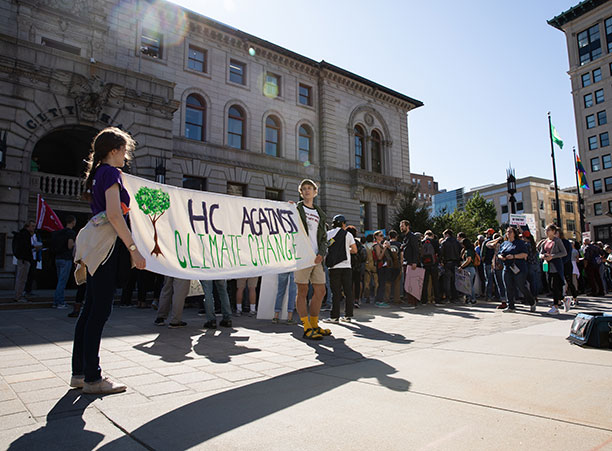
 Climate change is such a large, global challenge, it can be hard to imagine how a single person can make an impact. But not for Renee LeBlanc ’21, an environmental studies and political science double major, and co-chair of the campus club Eco-Action. “People think, ‘Oh, the government needs to make a change or the whole world needs to make a change — but it’s local action that’s actually going to make that difference.”
That theme of local advocacy was on full display in the standing-room-only crowd in Rehm Library in late October for a campus-wide discussion on the book “The Uninhabitable Earth: Life After Warming” by David Wallace-Wells. Held in a fishbowl format, where a small group of “fish” lead the discussion, students, faculty and staff engaged in an important, timely conversation about the book, which had been chosen as the first-year book for the Class of 2023.
The group — which included LeBlanc; Kendy Hess, Brake Smith Associate Professor of Social Philosophy and Ethics in the philosophy department; Ellis Jones, assistant professor of sociology; Katherine Kiel, professor of economics; Sara Mitchell, associate professor of biology; and was moderated by Thomas Landy, director of the McFarland Center for Religion, Ethics and Culture — used their varied backgrounds to give insight into different issues, such as the possibility of implementing a tax on carbon and how to discuss the gravity of climate change to those who are skeptical.