The Golden Rule: Holy Cross Alumnus Helps Provide Health Care to the Homeless

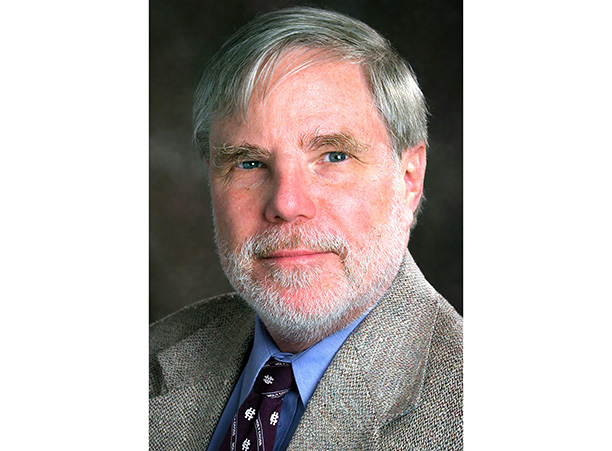
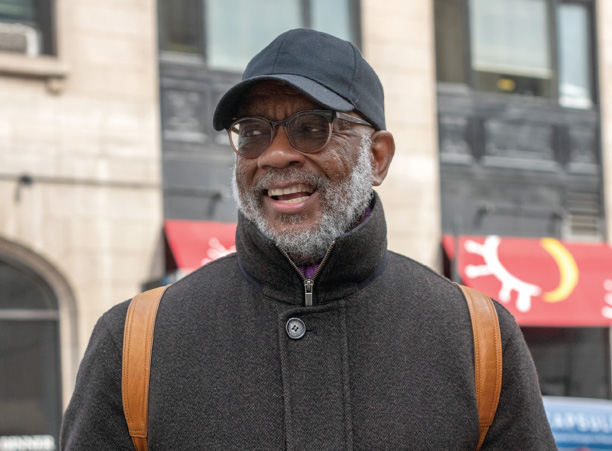
Ron Lawson '75 in New York CityRon Lawson ’75 had worked for 14 years as a financial analyst and manager for some of the biggest firms on Wall Street. So when he was suddenly laid off in the early 1990s recession, he didn’t think much of it. “I figured with my professional and academic background, it would only take me two or three weeks to find another job,” he says.

Three weeks stretched into three months, and then four or five, with no new job materializing. Despite his high-powered lifestyle, Lawson hadn’t given much thought to savings — “everything I earned I wore on my back or on my feet,” he says — and suddenly he found himself unable to pay his rent.

At age 39, he was homeless. “I wound up on the floor of a friend of a friend who I barely knew,” he says, “and all I had to my name were three wardrobe boxes of clothes, a mattress and a sheet I used to pull over my head so that the roaches wouldn’t crawl on me.”

He spent the next six months without a home, without a job and feeling increasingly desperate. The only thing that kept him going was the kindness of friends, one of whom introduced him to a church in Brooklyn Heights led by civil rights icon Rev. Dr. Paul Smith.

“I’d go sit with him and we’d talk and pray, and he’d say, ‘Hard times don’t last always,'” Lawson remembers. Every time, Smith would give him an envelope with a couple of subway tokens and a few dollars that would help him get his next meal. Finally, a good friend asked if he’d be willing to help manage finances for Mayor David Dinkins’ re-election campaign, and suddenly Lawson went from homeless to managing the finances of an $11 million campaign.

Posted in Holy Cross Magazine, News, Political Science, Psychology, Spring 2019 | Comments Off on The Golden Rule: Holy Cross Alumnus Helps Provide Health Care to the Homeless

Holy Cross Students Turn Project Ideas Into Reality Through Ignite Fund

A Nativity School of Worcester student raises his hand in classRev. Thomas McMurray, S.J., wears many hats at Nativity School of Worcester — director of admissions, director of Jesuit mission and identity, and chaplain. When he needed help developing a religious education curriculum for the school, he knew where to look — just a few miles away.

Holy Cross, it turned out, had the perfect program to assist the private middle school: The Ignite Fund. A now two-year-old initiative of the College’s J.D. Power Center for Liberal Arts in the World, the program funds student-driven projects, providing the opportunity and resources to put what they’ve learned in the classroom to work. Rather than waiting until after graduation to make an impact on the world beyond The Hill, The Ignite Fund gives students the foundation they need to put their scholarship and skills to the test immediately.

Rev. John Gavin, S.J., associate professor of religious studies, looked to two students: history major Stefanie Raymond ’18 and religious studies major Roxana Ruiz ’20, both women offering backgrounds in Catholic studies and education.

“They understood what a curriculum plan would be,” Fr. Gavin says. “It seemed like a perfect fit.”

The women thought so, too, and embraced the project.

“What most appealed to me was the ability to combine two things that I really loved: religion and education,” Raymond says. “Because my own religious education had played a big part in my life — I attended Catholic schools from kindergarten to college — I was excited to have an opportunity to apply what I had been taught in a new way.”

“I believe in the goodness that a Jesuit, Catholic education can give to students and even teachers that teach it,” Ruiz adds. “It can provide a more holistic development of the person, no matter the background they come from.”

The 16-year-old Nativity School of Worcester (NSW) provides a tuition-free Jesuit education for underserved fifth-through eighth-grade boys of all faiths. Many of the school’s faculty are Nativity Fellows, recent college graduates hired as full-time teachers for a two-year tenure. Fellows are not required to have a background in education, which left Fr. McMurray with the challenge of creating a structured, integrated curriculum that could build year to year. He and Jesuit novice Kieran Halloran, nS.J., developed a framework, which included teaching the fundamentals of Catholicism, providing an interfaith component and addressing social justice issues. Fr. McMurray then approached Holy Cross and the Ignite Fund for help making it a reality.

“We thought this would be a perfect match,” says Patrick T. Maloney ’02, the school’s president, “and we were lucky [Holy Cross] thought the same way.”

Posted in History, Holy Cross Magazine, J.D. Power Center for Liberal Arts in the World, News, Religious Studies, Spring 2019, Teacher Education | Comments Off on Holy Cross Students Turn Project Ideas Into Reality Through Ignite Fund

Ciocca Center for Business, Ethics, and Society Takes Business Programs at Holy Cross to Next Level

students at a planning meeting“Before, we emphasized that students could ‘major in anything, succeed in business,’ but we only offered the one pathway, the co-curricular certificate of readiness through COES,” says David Chu, the Ciocca Center for Business, Ethics, and Society’s director of certificate programs and prebusiness advisor. “Now, we are going to give students multiple pathways to learn about business.”

Arthur “Art” Ciocca ’59, chairman emeritus of The Wine Group Inc., and his wife, Carlyse, have been significant supporters of “pre-business” programs over the years. With other alumni, parents and friends, their newest investment will greatly expand on the College’s current opportunities for students to study business alongside the liberal arts.

Chu will continue to oversee the certificate programs, which include a business fundamentals certificate and an entrepreneurship certificate. Students can complete the certificate programs over the course of their four years at Holy Cross. Requirements include a set of introductory business workshops, advanced training in Excel and spreadsheet data analysis, a summer internship and three relevant academic classes from options across the curriculum.

“The workshops cover finance, banking, marketing communications and advertising, sales, supply chain — all the various aspects of business that students need to be aware of for them to have a better idea of what business entails. It helps them tremendously in building their knowledge base and, therefore, to have confidence in an interview,” Chu says. “The workshops are designed to prepare students to have a basic level of business literacy and confidence to nail an entry-level position when they graduate from Holy Cross.”

Student interest in these business certificate programs is booming. This semester, there are more than 470 students participating, and they come from all majors. Enrollment in the workshop about supply chain management doubled from 2017 to 2018, from 20 to more than 40 students. The spring 2019 workshop on business ethics and principled leadership had so many students enroll that Chu hopes to offer multiple sessions in the future.

“My job is not to prepare students to go to business school or an MBA program, but to prepare them to get right into the business world if they choose,” Chu says. “With the center, we’re going to be able to significantly expand opportunities to meet student demand. The purpose of the center is to provide students with multiple pathways to learn about business — pathways that can complement any major in the curriculum. We don’t try to replicate a business school curriculum; we take a distinctively liberal arts approach.”

In addition to the co-curricular certificates, another pathway exists for students who are interested in studying business as a topic of analysis in connection with many of the fundamental ethical, political and economic questions facing our world today. The College has recently developed a new interdisciplinary minor in business, ethics, and society, offered through its Center for Interdisciplinary Studies. The minor draws on a range of liberal arts disciplines to help students develop historical, economic, political and philosophical perspectives on the world of business, while exploring overarching questions about the role of business in a just society. In addition to this coursework, students in the minor will complete an internship and participate in relevant workshops offered through the Ciocca Center.

Posted in Business, Ethics, and Society, Ciocca Center for Business, Ethics, and Society, English, Holy Cross Magazine, News, Religious Studies, Spring 2019 | Comments Off on Ciocca Center for Business, Ethics, and Society Takes Business Programs at Holy Cross to Next Level

Holy Cross Alumnus Paves Way for Ethical Business Leaders

Art Ciocca ’59 pours a glass from the iconic, innovative box of Franzia Merlot Before tech startups flocked to Silicon Valley, before entrepreneurs competed for millions in funding on the TV show “Shark Tank,” and before entrepreneurship was part of the cultural zeitgeist in the U.S., Arthur “Art” Ciocca ’59 saw entrepreneurship as the future of business.

When he started his family foundation, the Arthur and Carlyse Ciocca Charitable Foundation, Ciocca focused on providing entrepreneurship training and opportunities for college students, with hopes of equipping the next generation of business leaders with the practical skills to succeed and the ethical foundation to do so in a way that adds the most value to society.

Each of these decisions is rooted in his personal philosophy of “thinking like an owner,” honed at early jobs where he saw management and higher-ups make decisions he didn’t support.

“I would put myself in the owner’s shoes and ask myself what I would do if it were me in those situations. That was a turning point for me, where I knew I wanted to control my own destiny and chart a course around a lot of the obstacles I had learned about in these experiences,” he says. “Entrepreneurship offered the best opportunity for me to control my own destiny and create maximum value.”

For example: When Coca-Cola wanted to get out of the alcohol business in 1981, Ciocca took a risk and bought the wine division, growing it into The Wine Group, the country’s second-largest wine company by sales volume. Today, The Wine Group is famous for brands like Franzia, Cupcake Vineyards and Benzinger Family Winery — and its unique, management-owned structure. Unlike other large companies, it is privately owned and accountable to the employees, rather than outsiders.

When The Wine Group’s competitors had a cost advantage because they self-manufactured their own bottles, Ciocca led a team that decided to do away with glass bottles entirely. Putting Franzia in that now-famous box with the image of wine pouring into a glass was a disruptive innovation that converted a disadvantage into a huge advantage. It offered Franzia consumers the best value in wine and provided dramatic shelf presence that made it easy to find. In addition, it offered many consumer conveniences. It was easier to pour and store and kept wine fresher longer (after opening); it also provided huge barriers to entry for competitors. As a result, Franzia became the largest wine brand in the industry, a position it has held for years.

Posted in Ciocca Center for Business, Ethics, and Society, Economics and Accounting, English, Holy Cross Magazine, J.D. Power Center for Liberal Arts in the World, Mathematics and Computer Science, News, Physics, Spring 2019 | Comments Off on Holy Cross Alumnus Paves Way for Ethical Business Leaders

New Course Explores Storied, Unexpected Relationship Between the Jesuits and Music

Dan DiCenso stands in front of a large group of students in a classroom

What do Freddie Mercury and Chance the Rapper have in common? They’ve both created music that nods to their Jesuit ties. And they’re both topics of discussion in the course Music & the Jesuits, taught by Daniel DiCenso ’98, assistant professor of music.

The Jesuits’ relationship to music is widely misunderstood, says DiCenso — and it’s also widely under-researched.

“I could have called the course ‘Music & the Jesuits?’ — question mark intentional — because, initially, the Jesuit order was the only order of priests that outlawed involvement in the Office, meaning the singing of the Divine Office,” DiCenso explains.

The roots of the music aversion can be traced back to St. Ignatius of Loyola, who wanted the Jesuits to be free to go forth among the people without needing to come back to congregation multiple times a day to sing the psalms. As a result, the Jesuits got a reputation for being against music. “There’s a truth to that, but it doesn’t mean they weren’t involved anyway,” DiCenso says.

With limited resources about the relationship between music and the Jesuits (upon completing a textbook in class, DiCenso remarked, “Congratulations! You’ve now read everything ever written about music and the Jesuits.”), DiCenso saw the course as an opportunity not only for students to discover the history, but for him to do the same.

“I knew what I knew, and I knew what I wanted to find out,” he says. “So I thought it would make a great research seminar, in which I frame some things and then we send the students out on quests.”

DiCenso dug deep to find unexpected stories about how the Jesuits relate to music. His colleague Jessica Waldoff, associate professor of music, suggested the class study an orphanage Mass written by Mozart.

“There was a Jesuit orphanage in Vienna that was consecrating a new church and they hired 12-year-old Mozart to compose a piece for it,” DiCenso says. “The idea was that the piece would be composed by someone the same age as the charges in the orphanage.”

But throughout the semester, DiCenso and his students are expanding the Jesuit music connection beyond commissioned works to unconventional pieces in which Jesuits are more influencer than direct driver. To capture this surprising relationship between Jesuits and music, DiCenso assigns a weekly “snapshot,” where students identify examples of “tenuous, stretchy supposition about a relationship between some kind of music that we wouldn’t think to be Jesuit music, and the Jesuits,” says DiCenso.

In the classroom — a small, warm room nestled in Brooks Hall — students teach each other about unexpected connections they’ve discovered. The late Mercury, front man of the rock band Queen, attended a Jesuit high school in India; a number of Queen’s songs (think, “Bohemian Rhapsody” and “All God’s People”) lean in heavily to Jesuit themes of social justice and equality. More recent examples are even less expected. Chance the Rapper’s manager, Pat “The Manager” Corcoran, also attended a Jesuit high school; on the albums he’s produced, multiple songs nod to his Jesuit heritage.

“Initially, Jesuits were missionaries, though they eventually got into the business of schooling and it’s been quite controversial as to whether schooling put the brakes on the missionary work,” DiCenso remarks. “Regardless, you are, in a sense, training missionaries.” DiCenso points out that a Jesuit education is no guarantee that Jesuit influences will seep into the lyrics, but once in a while, to the careful listener, that’s just what happens.

For Lauren Carey ’19, a music major with a minor in education, finding and redefining what “counts” as Jesuit music has been enlightening: “In most of my other music classes, it’s rare that we discover something ‘new’ about music. However, since there has not been a lot of scholarship on the Jesuits’ relationship to music, in this class we make it a goal to find new connections to music that is not obviously ‘Jesuit’ music.”

The course, which was born out of discussions surrounding the College’s 175th anniversary, leads to a final event much more spectacular than an exam — a full concert with Jesuit music performed by various musical groups on campus (of which include a number of students from the class). The lineup includes traditional songs and psalms written, composed and performed by Jesuits, interspersed with spoken lessons about different aspects of the Jesuits’ relationship to music throughout the years.

Every element of the culminating concert, held at the end of March in St. Joseph Memorial Chapel, was planned by students, from the program notes to the spoken-word elements accompanying the music. Henry Stutz ’19, an accounting major, says the concert-planning process has been a wild ride as a non-music major.

“But,” he adds, “it will be very rewarding to see our work and research come to fruition as a grand concert, as opposed to the traditional paper or exam that I am used to.”

Posted in Economics and Accounting, Education, Holy Cross Magazine, Music, News, Spring 2019 | Comments Off on New Course Explores Storied, Unexpected Relationship Between the Jesuits and Music

20 Years Strong, Plumley Village SPUD Programs Continue to Grow

A Holy Cross student works with young students at Plumley VillageEach week, dozens of Holy Cross student volunteers take a short drive across the city to continue a commute that started two decades ago. The students, members of Student Programs for Urban Development (SPUD), make their way to Plumley Village, a large brick housing complex in Worcester, which has become a popular — and growing — volunteer site for helping youth.

Home to around 500 children and their families, Plumley Village partners with Holy Cross to help foster youth engagement through mentoring, tutoring and more. What began as a Boys and Girls Club extension more than 20 years ago has blossomed into three core Plumley Village SPUD programs, including new Homework Help and LUK Mentoring offerings.

Through the Boys and Girls Club, students work with the children who are Plumley Village residents, offering everything from homework tutoring to a game of foosball. “The best thing they get is a consistent presence in their lives that is solely there to help them with whatever they need,” says SPUD student leader Geraldine Connolly ’19.

The Homework Help Program has seen increased participation thanks to Holy Cross student leadership and partners such as Community Builders, a nonprofit real estate development company dedicated to improving quality of life at its properties. About 10 Holy Cross students volunteer for Homework Help, a drop-in center that runs Mondays through Thursdays. While it started off slowly, the program now has 40 children registered.

Seeing the children’s progress each week serves as a major source of motivation to keep the program going, says Kwame Marshall, Community Builders youth services coordinator: “Giving them leverage, helping them gain confidence and watching them grow academically is such a great feeling.”

Another newly formalized Plumley SPUD site is LUK Mentoring. Its partnership with Holy Cross was born out of a need for more volunteers beyond community mentors. The program pairs 16 female Holy Cross volunteers with 16 girls from Plumley — ranging in age from 7 to 14 — based on their interests and personalities. The goal is to form relationships, encourage healthy habits and foster self-esteem.

Clare Courcey ’19, LUK Mentoring SPUD student leader, says sometimes hearing about the challenges the girls are facing can be disheartening, but it fuels her involvement. “It makes me twice as motivated to go and be a good role model. I use every minute I get with [my mentee]; I provide the best advice I can to her,” she says.

One of the greatest gifts that stems from the programs is perspective for Holy Cross students and their young charges. “I think the Holy Cross students really help the girls see a different perspective,” says Hilary Amedy, LUK Mentoring Program coordinator. “Just encouraging education and letting them know that they’ve worked hard to get to where they are — that it’s possible for them to go to college.”

Volunteering can also be eye-opening for Holy Cross students, reminding them of the world beyond campus. “You want to make sure you’re not just thinking about the Holy Cross bubble,” Connolly says. “You want to be going out in Worcester and actually thinking about ways you can help the community, remembering you’re in a huge city and there is so much you can take advantage of.”


Written by Mary Cunningham ’17 for the Spring 2019 issue of Holy Cross Magazine.

About Holy Cross Magazine
Holy Cross Magazine (HCM) is the quarterly alumni publication of the College of the Holy Cross. The award-winning publication is mailed to alumni and friends of the College and includes intriguing profiles, make-you-think features, alumni news, exclusive photos and more. Visit magazine.holycross.edu/about to contact HCM, submit alumni class notes, milestones, or letters to the editor.

Posted in Holy Cross Magazine, News, Spring 2019 | Comments Off on 20 Years Strong, Plumley Village SPUD Programs Continue to Grow

Jimmy Murray ’17 Works His Way to 2019 AFC Championship Game

Jim Murray in a Chiefs'jerseyJimmy Murray ’17 sees opportunity where others see stop signs. He first worked his way onto his high school football team and later onto the Holy Cross football team as a walk-on. In 2018, he beat the odds once more, going from undrafted free agent to earning a place on the practice squad of the Kansas City Chiefs and, ultimately, the active roster.

In January 2019, the 6’5″ 304-pound rookie offensive lineman became the first Holy Cross graduate to make it to an AFC Championship game since 1989.

Though the New England Patriots beat the Chiefs, 37- 31, and Murray did not play in the game, “It was surreal just being there,” he says. “In my sophomore year at Holy Cross, I was sitting in the 300-level seats [at Gillette Stadium] and saw the Patriots in the AFC Championship game. Then, a couple years later, I’m going up against [Patriots quarterback Tom] Brady.”

Born into a football-loving family in Chicago, Murray rooted for the Bears, collected football cards and played the game with his four brothers in their back yard. At Loyola Academy High School in Wilmette, Illinois, he grinded it out at practices until he finally convinced his coach to give him a spot on the team.

“During senior year, I got my shot,” he remembers. “And it was the same way in college, too. I knew as long as there was a chance, I would do everything in my power to make it. I never put myself down. My philosophy was: Outwork the guy in front of you.”

At Holy Cross, Murray walked onto Fitton Field hoping to land a spot with the Crusaders. His hard work not only convinced coaches to add him to the roster, but he also started each game during his four-year career and was named captain during his senior season.

His never-say-die attitude drove him, yet he also credits Crusaders offensive line coach Chris Smith ’09 for helping him meet his goals.

“Coach Smith did a great job helping me focus on the fundamentals,” Murray says. “He is very passionate about what he does and made me want to do everything in my power to make him happy. He loves Holy Cross and came in every day with a great attitude.

Posted in Chinese Studies, Economics and Accounting, Holy Cross Magazine, News, Spring 2019 | Comments Off on Jimmy Murray ’17 Works His Way to 2019 AFC Championship Game

Jon Favreau ’03, Former Obama Speechwriter, Talks 2020 Presidential Candidates, His First Encounter With Obama, and Holy Cross

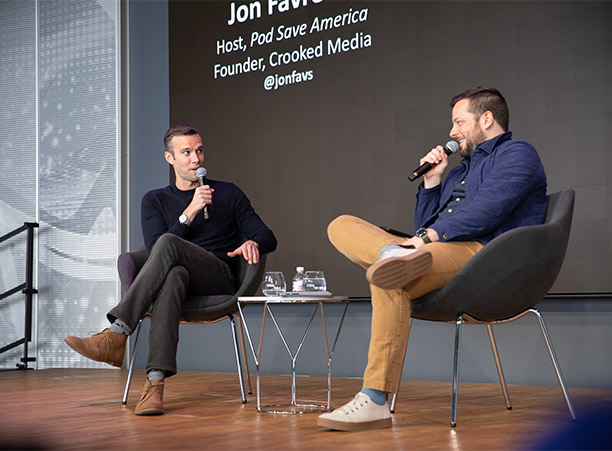
Jon Favreau '03 sits opposite Ben Brock Johnson on stageDuring a single hour-long conversation, former director of speechwriting for President Obama and current podcast celebrity Jon Favreau ’03 covered myriad topics: the strengths and failures of the new Democratic House majority, 2020 presidential candidates, his tense first encounter with Obama at the 2004 Democratic National Convention and his gratitude for Holy Cross.

Favreau, who has gained notoriety for his political podcast “Pod Save America,” took the stage at WBUR CitySpace, the new multimedia venue for Boston’s NPR news station, opposite Ben Brock Johnson, senior producer at WBUR. Part-conversation, part-interview, Johnson asked Favreau to explain the impetus for creating Crooked Media, the media company behind the popular podcast.

“When you get to the end of watching the nightly news, you’re oftentimes left feeling pretty helpless,” said Favreau. “You just covered a lot of really tough problems in the world, really bad news. Having all of that wash over you, and having this feeling of helplessness that you can’t do anything about it, I think it feeds apathy, it feeds cynicism, it feeds all the things that hurt our politics.”

“And as someone who cares about politics so much, and cares about change and social change,” he continued, “I thought, wouldn’t it be great to have a media company where you could diagnose the problem but then also tell people, ‘Here’s what you can do to change it. You actually have agency to change the world around you, to organize, to become active.'”

That, explained Favreau, is the basis for Crooked Media, which he co-founded in 2017 with two other former Obama staffers, Jon Lovett and Tommy Vietor, and which has produced a suite of podcasts, news articles, opinion pieces, and live shows and tours which have featured Favreau and his co-hosts in sold out venues across the U.S. and Europe. “Pod Save America,” their most successful podcast, drops twice a week and averages about 1.5 million listeners per show. The podcast offers a conversational breakdown of the week’s political news, interviews with activists, politicians and political experts, and was broadcast in a four-episode HBO special during the 2018 midterms.

Prompted by an audience-submitted question, Favreau acknowledged the importance of his early role models, before his whirlwind career kicked off in Washington, D.C. Many of these mentors came from Holy Cross, said Favreau, who studied political science at the College and participated in the Washington Semester Program.

“I am where I am today because I’ve had the most fantastic set of teachers throughout my life,” said Favreau, “starting with my mother and father, going into the elementary and high school teachers I had in North Reading, and then the wonderful mentors at Holy Cross, particularly Stephanie Yuhl, Caren Dubnoff, Mary Erdmans — fantastic professors who helped me not only develop a love of politics, but actually believed that I could go do something to change the world.”

Posted in Featured, News, Political Science | Comments Off on Jon Favreau ’03, Former Obama Speechwriter, Talks 2020 Presidential Candidates, His First Encounter With Obama, and Holy Cross

Would a ‘Single Tax’ Fix Income Inequality? Holy Cross History Professor Opines

Edward O'Donnell, associate professor of history

Edward O’Donnell, associate professor of history

The late 19th century “single tax” vision of political economist Henry George, who proposed the exclusive use of a land-value tax, is seen by some economics as a way to combat increasing wealth disparities today.

Ed O’Donnell, associate professor of history at Holy Cross and author of the book “Henry George and the Crisis of Inequality: Progress and Poverty in the Gilded Age” (Columbia University Press, June 2015) told The Atlantic in a recent interview that today’s democratic-socialist and socialist movements in the U.S can be traced to George, and his influential book “Progress and Poverty.”

“At the heart of all of it,” O’Donnell said, “lies the powerful idea George articulated that America is more than individualism—that in the end, amid great surges of economic growth and technological advancement and great wealth, we’re [still] nothing without attending to the common good.”

To read the full article, go to TheAtlantic.com.

Posted in Edward O'Donnell, History, In The News, News | Comments Off on Would a ‘Single Tax’ Fix Income Inequality? Holy Cross History Professor Opines

Diverse Voices Are Key to a Healthy Democracy, Holy Cross Professor Writes in The Washington Post

Thomas Martin, professor and Jeremiah W. O'Connor chair of classics

Thomas Martin, professor and Jeremiah W. O’Connor chair of classics

Controversy is raging in the U.S. over what to do about growing economic inequality, prompting controversial solutions, such as the “wealth tax” proposals of Alexandria Ocasio-Cortez and Elizabeth Warren.

In a commentary for The Washington Post, Thomas Martin, professor and Jeremiah W. O’Connor chair of classics at the College of the Holy Cross, argues that the U.S. isn’t the first democracy to debate whether the common good requires sharing of wealth.

In the piece, Martin draws a parallel with the first ever large-scale democracy of ancient Athens, via “Congresswomen,” a comedy written by the Greek playwright Aristophanes. The play involves a scenario where the women of Athens assume control of the government and where sharing wealth would rescue Athenian society.

“The past so outrageously yet so desperately portrayed in ‘Congresswomen’ seems not past at all, said Martin. “Neither is the fundamental message underlying that ancient fantasy: Listening to those who haven’t previously been listened to is one good way to begin figuring out how to make things better for everyone, a process that somehow needs to include sharing for the common good, as Aristophanes’s congresswomen insisted.”

Professor Martin specializes in the ancient history of democracy, its roots in Athens, and how it compares with modern American democracy. He teaches courses on the Athenian democracy, Hellenism and the Roman Empire.

To read the full article, go to WashingtonPost.com.

Posted in Classics, In The News, News | Comments Off on Diverse Voices Are Key to a Healthy Democracy, Holy Cross Professor Writes in The Washington Post

Holy Cross Cantor Art Gallery to Feature Work of Senior Visual Arts Majors in the Exhibition ‘Ennead’

Artwork by Alexandra Yoeckel '19

Artwork by Alexandra Yoeckel ’19

The Iris and B. Gerald Cantor Art Gallery at the College of the Holy Cross will open an exhibition of artwork by graduating visual arts studio majors in the exhibition “Ennead” on Thursday, April 25. The show’s title, of Greek origin, refers to a group or set of nine, representing the nine women artists showing their work as a collective. Student artists Katherine Badenhausen, Sarah Behrens, Margaret Goddard, Abigail Kostecki, Anna Lenney, Elisaveta Mavrodieva, Mae-Chu O’Connell, Sara Vo, and Alexandra Yoeckel will give presentations about their work in the gallery during the Academic Conference on Wednesday, April 24 beginning at noon through 1 p.m. The opening reception is scheduled for Thursday evening, April 25, 5:30–7 p.m.

Visual arts students who have participated in the year-long Studio Concentration Seminar earn their place in the gallery by developing a cohesive body of work over the fall and spring semesters. In this capstone experience for the visual arts studio major, each student is given individual studio space and are encouraged to experiment with ideas and mediums, while cultivating an independent studio practice.

Professors Cristi Rinklin and Michael Beatty of the Visual Arts Department were the instructors for this year’s seminar course. Rinklin teaches painting and Beatty is the instructor for 3-D design and sculpture. Both are long-term members of Holy Cross’ faculty and are artists with gallery representation in Boston and beyond.

Roger Hankins, director of the Cantor Art Gallery, also works with the students to help them conceptualize the display of their work within the setting of a professional gallery space. “It’s a big leap from a relatively small studio space, which is private, to the public arena of the gallery. I help them to think through what the work requires in order to be seen in its best light. It’s the last crucial step in the process of engaging an audience,” Hankins explains.

All of the artists are double majors, with areas of study including Architectural Studies, English, Political Science, Psychology, and Religious Studies, in addition to graduating with a degree in studio art. “As a four-year liberal arts college, Holy Cross offers students the opportunity to pursue majors in more than one discipline,” explains Professor Beatty. According to Professor Rinklin, this opportunity to experience an interdisciplinary approach to their work, “enables students to cross-pollinate their studio practice in significant and meaningful ways.”

Katherine Badenhausen, the recipient of the Visual Arts Department’s 2019 Reardon Award, uses mixed media to create her work, “My passion for architecture stems from a designer’s ability to visualize, to create, and to build a space for people to inhabit.  I look to highlight the spatial experience of architecture, accentuating the impact of light, shadow and detail in these spaces.” Sarah Behrens, uses mixed media as well to express political ideas, “My work addresses the aesthetics of respectability. I often use elements of humor and satire to disarm the viewer and draw them further into my work. I use satirical reimagining of traditional imagery to push the boundary of respectability.” Margaret Goddard, a painter, uses family photographs as inspiration for exploring familial connections, “When I look at these photographs I wonder how the people in them relate in appearance or in personality to my identity. We share something by way of DNA but our connection is more or less lost. Their image is the only way of relating myself to them.”

Abigail Kostecki describes the process and materials she uses to delve into the subconscious mind, “As an artist, I am drawn to work with fiber because the act of working with the material is meditative in nature. Specifically, the techniques of crochet, weaving, and embroidery allow me to enter into a subconscious state forcing me to surrender control and yield to the material. My current installations and objects are inspired by reoccurring dreams and nightmares, experiences that can be extremely frightening.”  Using recycled materials from thrift stores, Anna Lenney transforms them into spiritual pieces which, “attempt to make visible a subjective experience of the sacred dimension we seek within the mundane world around us… I attempt to visualize that which has a transformative effect on us.” Elisaveta Mavrodieva is a painter who seeks to align herself with, “a long historical tradition of women serving as allegories for the divine. Building on this history of visual representations of the female figure, but reworking it sans the hegemony of the male gaze, is central to my work both because I am a woman and because spirituality, mysticism and the abyss are attainable to every human being.”

Mae-Chu O’Connell uses installation, performative space, and video to examine the adaptability of her physical identity, “My creative work is a backlash against two contradictory sentiments: a desire to achieve traditional feminine beauty, and an urge to be a strong feminist who breaks with societal norms … I also wish to challenge certain tenets of masculinity through appropriation.” Sara Vo explores cultural identity through mixed media, “I see my artwork as a social lens, providing various perspectives of the Vietnamese-American identity. While providing my own insight, I include the historical narrative of my family members to define the contrasting opinions between different generations.” Alexandra Yoeckel describes her attraction to the use of textiles in her work, “The textures of fabric influences the way I see patterns and the interweaving of materials. The combination of color and form has become a metaphor for me of the interweaving realities of individual’s experiences in life… Through the use of printmaking, collage and sewing I am exploring color relationships, texture in textile surface design and the power of layering images.”

“Ennead” will remain on view through graduation day, Friday, May 24.

EVENTS

  • Academic Conference presentation by senior Visual Arts Studio majors

Wednesday, April 24, noon–1 p.m.

  • Opening reception

Thursday, April 25, 5:30–7 p.m.

The gallery will be closed Saturday, May 18th.

Gallery Information

Founded in 1983 through the generosity of Iris & B. Gerald Cantor, the Cantor Art Gallery serves both as a venue for a changing series of historical and contemporary public exhibitions, as well as a vital resource for Holy Cross faculty and students, linking exhibitions to the broader liberal arts curriculum.

The hours for the Cantor Art Gallery are Monday–Friday, 10 a.m.–5 p.m. and Saturdays, noon–5 p.m. Located in O’Kane Hall, 1st Floor, College of the Holy Cross, 1 College Street, Worcester, Mass., 01610.  Visitors needing assistance with handicap accessibility should contact Public Safety at 508-793-2011. Admission to the gallery is free.

For additional information please call 508-793-3356 or visit the gallery’s website at: holycross.edu/cantorartgallery.

Posted in News, Press Release, Visual Arts | Comments Off on Holy Cross Cantor Art Gallery to Feature Work of Senior Visual Arts Majors in the Exhibition ‘Ennead’

Jane McAuliffe, Prominent American Educator and World-Renowned Scholar of Islam, to Deliver 2019 Holy Cross Commencement Address

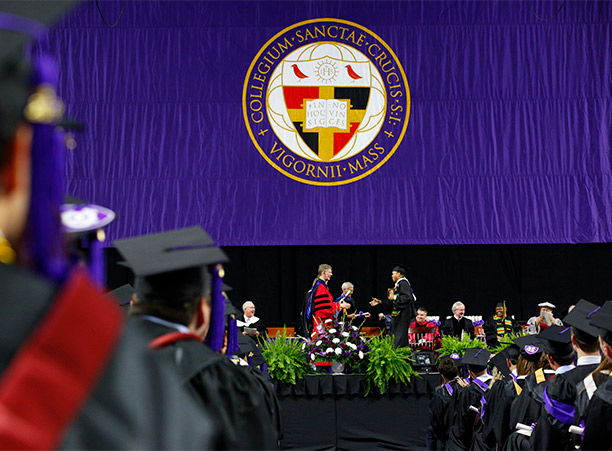
Prominent American educator Jane McAuliffe, a world-renowned scholar of Islam and one of the senior leaders at the Library of Congress, will address this year’s graduates during the College of the Holy Cross Commencement ceremonies on Friday, May 24, at 10:30 a.m. at the DCU Center in Worcester. This year’s commencement marks the College’s 173rd graduating class.
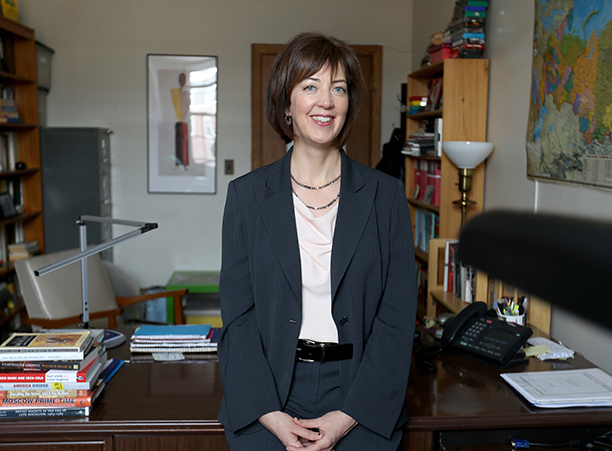
Jane McAuliffe is senior advisor to the librarian of Congress and formerly the inaugural director of national and international outreach. Her work at the Library has involved a broad range of its programs, including the National Book Festival, the Kluge research center for scholars, the Library’s exhibits, publishing office, visitors’ services, and business enterprises.

She is a world-renowned scholar of Islam and has devoted sustained attention to Muslim-Christian dialogue and to the advancement of women around the world. As a specialist in the Qur’an and its interpretation, McAuliffe is general editor of the six-volume “Encyclopaedia of the Qur’an,” the first major reference work for the Qur’an in Western languages.

McAuliffe has served on the Vatican’s Commission for Religious Relations with Muslims and participated frequently in Building Bridges, a meeting of Muslim and Christian scholars established by the Archbishop of Canterbury.

Prior to her role at the Library of Congress, McAuliffe was president of Bryn Mawr College in Pennsylvania from 2008 to 2013. During her tenure at Bryn Mawr, McAuliffe was recognized in 2009 by Forbes Magazine as one of the top “barrier breakers” among women presidents in the country.

Previously, McAuliffe served as dean of arts and sciences at Georgetown University, from 1999 to 2008; as professor and department chair at the University of Toronto, from 1992 to 1999; and as professor and associate dean at Emory University, from 1986 to 1992.

McAuliffe is an elected member of the American Philosophical Society, the American Academy of Arts and Sciences, and the Council on Foreign Relations. She has served on the World Economic Forum’s GAC on Women’s Empowerment; has been president of the American Academy of Religion and has been a leader of Muslim-Christian dialogue initiatives for decades. She is a distinguished fellow of Georgetown’s Berkley Center for Religion, Peace, and World Affairs.

McAuliffe holds a bachelor’s degree in classics and philosophy from Trinity Washington University (formerly known as Trinity College) in Washington, D.C.  She also received a master’s degree in religious studies and a Ph.D. in Islamic studies from the University of Toronto.

McAuliffe will be given an honorary degree during Commencement. In addition to McAuliffe, the College will award honorary degrees to the following individuals during the ceremony:

Rev. Sean Carroll, S.J., is the executive director of the Kino Border Initiative, a migrant shelter and assistance program that conducts work on the U.S.-Mexico border, providing humanitarian aid to migrants and advocating for more humane migration policies. Prior to joining the Kino Border Initiative, Fr. Carroll served as the pastoral ministries assistant for the California Province of the Society of Jesus, helping to coordinate pastoral initiatives among twelve Jesuit parishes in California, Arizona, Utah and Hawaii. Fr. Carroll was ordained a priest in 2000 and served for four years at St. Patrick’s Church in Oakland, California. Currently, Fr. Carroll serves on the Board of Trustees of the University of San Francisco, as well as Brophy College Preparatory, a Jesuit high school in Phoenix, Arizona. He graduated from Stanford University with a bachelor’s degree in history.

Frank Kartheiser ’72 is the newly retired founder and lead organizer at Worcester Interfaith, an alliance of Worcester religious congregations and organizations working together to empower the underprivileged, and a graduate of College of the Holy Cross. Kartheiser, who became involved with the anti-war movement, left Holy Cross in 1969 to become a social advocate for the poor and homeless. Together with fellow classmate Shawn Donovan ’70 he founded The Mustard Seed, which began as a storefront agency dispensing help to the elderly, poor and homeless and eventually grew to a full-time soup kitchen and homeless shelter. Kartheiser has helped create many community organizations in Worcester; served as a field representative for Clergy and Laity Concerned; and has worked for the Diocese of Worcester as director of the Urban Ministry Commission, associate director of religious education, and consultant for social justice and peace. Kartheiser currently serves on the board of the Worcester Community Labor Coalition and is the director of relational spirituality for YOU, Inc. Since 2009, Frank has been an adjunct professor at Clark University, where he teaches community organizing strategies.

For more information on this year’s Commencement events, please visit the Commencement website.

Posted in News, Press Release | Comments Off on Jane McAuliffe, Prominent American Educator and World-Renowned Scholar of Islam, to Deliver 2019 Holy Cross Commencement Address

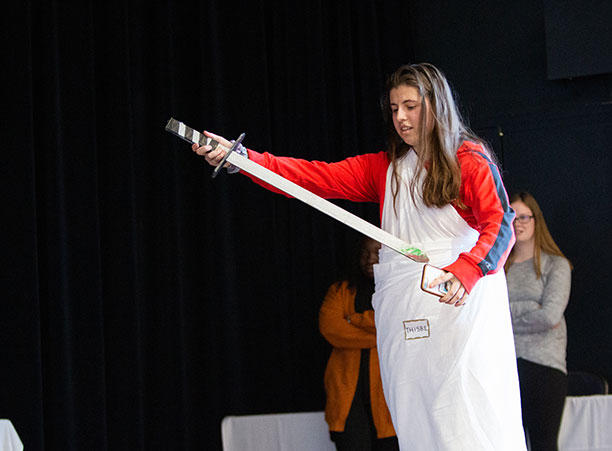
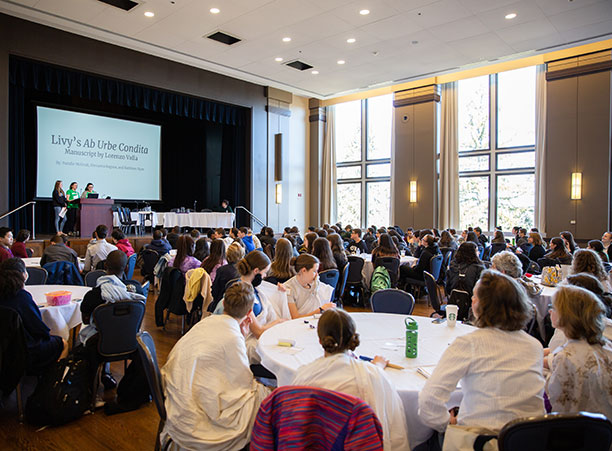
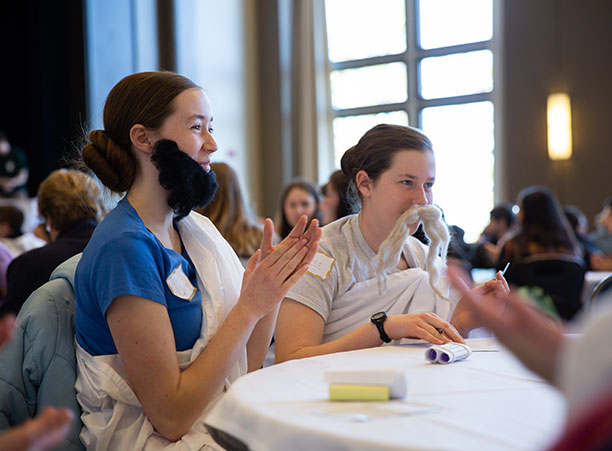
Photos: Holy Cross Students Host Classics Day to Share Passion for Ancient World

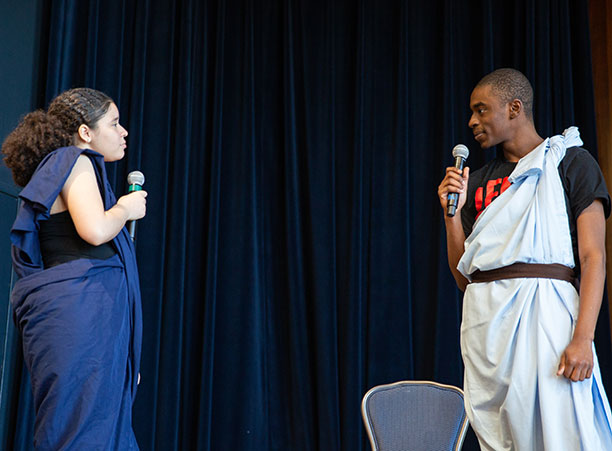
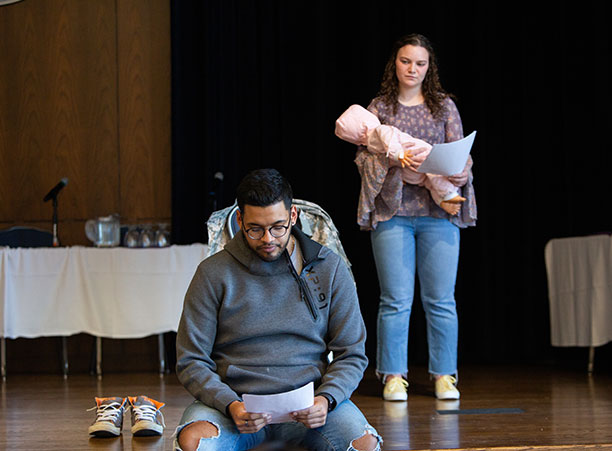
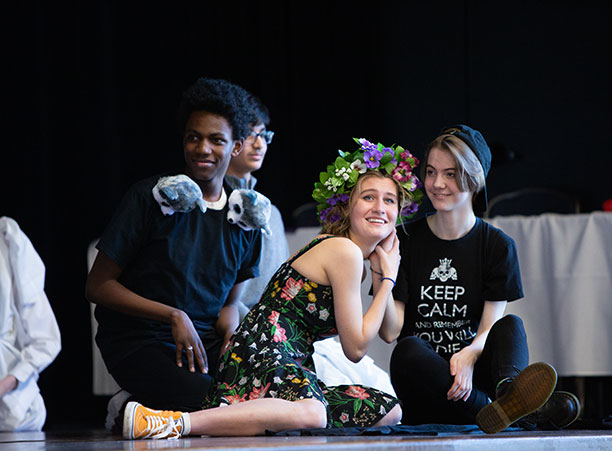
High school students sit on a stage while performing the myth of Persephone and Hades in the costume contest.

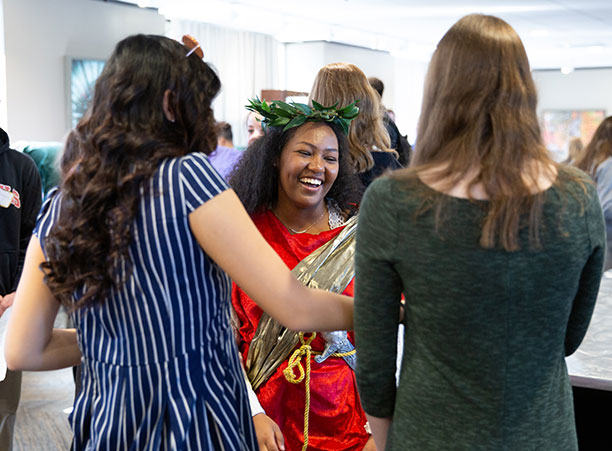
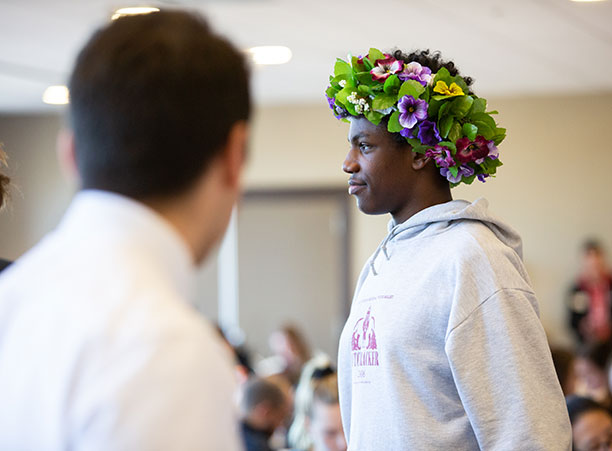
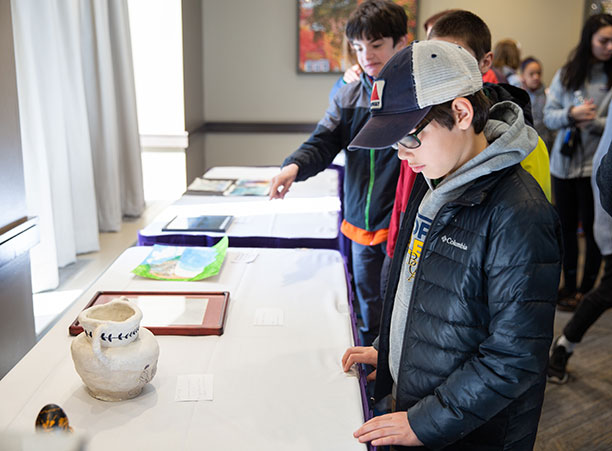
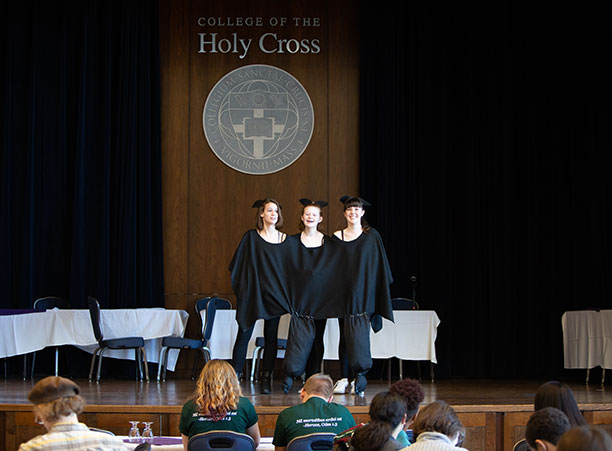
It’s not every day you see a three-headed mythical beast side-stepping its way through the Hogan Campus Center. But that’s par for the course on Classics Day, a College of the Holy Cross tradition celebrating all aspects of ancient Greek and Roman culture.

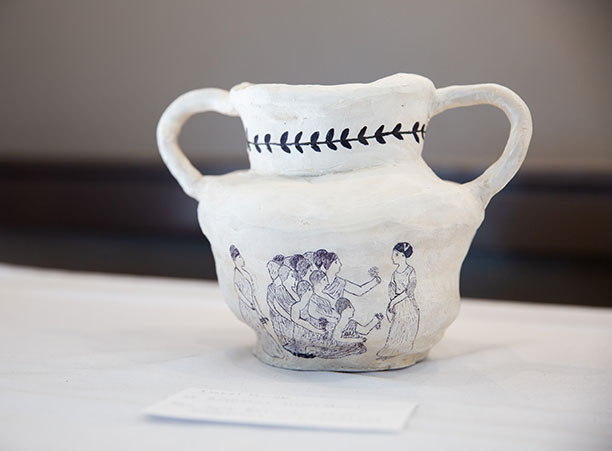
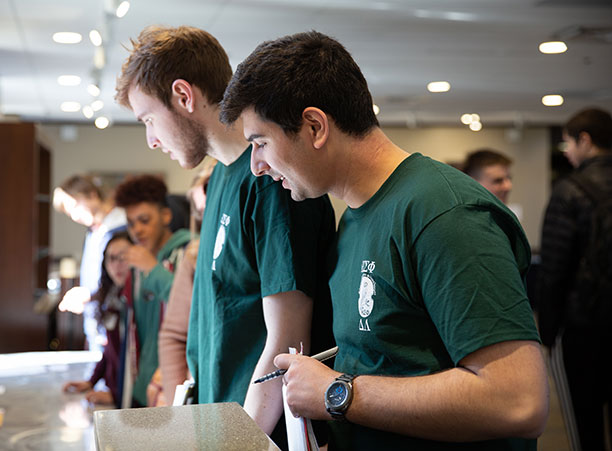
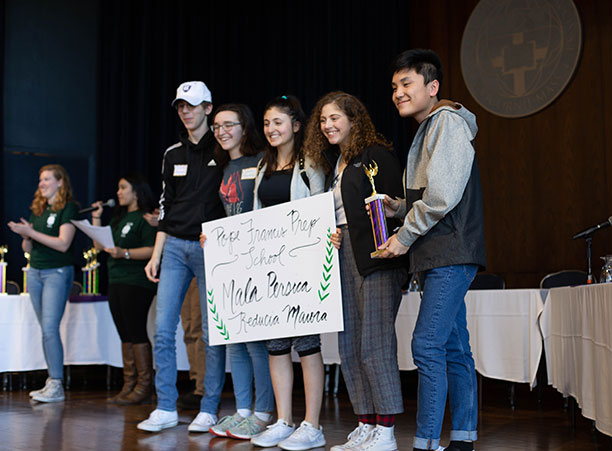
Holy Cross students welcomed over 300 local high school students to participate in activities such as Certamen (quick-thinking classics trivia), a lively costume contest, an art contest, and a manuscripts challenge, where high school students translate ancient texts and present their findings in front of the crowd. The event, now in its 47th year, is planned fully by Holy Cross students, from coordinating the high schoolers to writing the trivia questions for Certamen.

In the eyes of classics major Hannah Nguyen ’19, a Classics Day committee member and president of the national classics honorary society chapter at Holy Cross, the day isn’t just beneficial for the high school students.

“Classics Day allows both groups of students — Holy Cross and high school — to explore a discipline they enjoy and to share it with one another. The high school students remind us why classics is fun and exciting, and we show them why we have chosen to continue to study it, why it is worth further exploration and how it has made us better people and scholars.”

Neel Smith, associate professor of classics and chair of the department, told the high school students that the study of classics is empowering.

“I often am asked by worried parents or students, ‘What do classics majors do after they graduate from college?’ I could start down the whole list of what our majors do — medical school, financial consulting, law school, computer programming, government service — but if I kept going, I’d burn out my time up here really fast. Classics majors, after they graduate, can do whatever they want. That’s what they’re prepared for — they’re prepared for everything.”

Media Coverage

Posted in Classics, Featured, News | Comments Off on Photos: Holy Cross Students Host Classics Day to Share Passion for Ancient World

7 Holy Cross Students Making a Difference in Their Communities

Holy Cross students stand around a tableHoly Cross students are driven to make a difference in their communities — on campus, in Massachusetts and across the globe. Propelled by the College’s mission statement, our students work together to create positive change, to be “men and women for and with others,” through programs like Student Programs for Urban Development, Spring Break Immersion Program and Community-Based Learning. These seven students in particular are doing their part in a variety of ways, from helping recently settled refugees to visiting with elderly Jesuit priests.
Posted in Biology, Featured, Naval Science (NROTC), News, Physics, Psychology | Comments Off on 7 Holy Cross Students Making a Difference in Their Communities

Holy Cross Professor and Russia Expert Analyzes Kremlin’s Media Response to Mueller Report

Cynthia Hooper, associate professor of history and director of Russian and Eastern European Studies. Photo by Tom Rettig

Cynthia Hooper, associate professor of history and director of Russian and Eastern European Studies. Photo by Tom Rettig

Reactions to the release of special counsel Robert Mueller’s report investigating Russia’s interference in the 2016 U.S. presidential election have dominated the news cycle nationwide. But what have Russians been saying about the “no collusion with the Kremlin” findings?

In an article for The Conversation, Cynthia Hooper, associate professor of history and director of Russian and Eastern European Studies at Holy Cross, gives us some insight into Russia’s media coverage on the issue.

And according to Hooper the prevalent reaction is clear: this is “just another example of American dysfunction” in which “Trump is cast as a symptom of larger problems, rather than as the man who might solve them.” One news outlet goes as far as to proclaim that “A mountain has given birth to a mouse. The ‘Russian affair’ falls to pieces before our eyes.”

You can read the full article at The Conversation.

Posted in History, In The News, News, Russian and Eastern European Studies | Comments Off on Holy Cross Professor and Russia Expert Analyzes Kremlin’s Media Response to Mueller Report

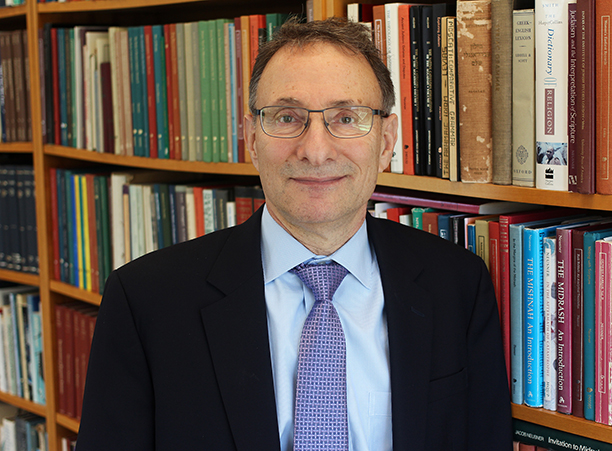
Holy Cross Judaic Studies Professor Explains Debate on Controversial Holocaust-Era Pope

Alan Avery-Peck, Kraft-Hiatt Professor of Judaic Studies. Photo By Austin Bosworth

Alan Avery-Peck, Kraft-Hiatt Professor of Judaic Studies. Photo By Austin Bosworth

Declaring that the church “isn’t afraid of history,” Pope Francis recently announced that the Vatican would open its archives on World War II-era Pope Pius XII, who has been criticized of staying silent on the Holocaust.

In an article for The Conversation, Alan Avery-Peck, Kraft-Hiatt Professor of Judaic Studies at Holy Cross, provides historical context for why Pius XII’s legacy has been one of the most contentious debates involving Church figures of the 20th century, with critics saying he did not do enough to publicly combat the rise of fascism in Germany and Italy, and supporters arguing that he worked diligently behind the scenes to save Jews.

“As a scholar who has been teaching Holocaust history primarily to students who grew up in the Christian faith, the question of the attitudes of Christians, and especially of the Church, comes up frequently in my classes,” wrote Avery-Peck.

So what will the files reveal? That’s still unclear, but according to Avery-Peck “the proof of actions Pius XII took in support of Jews might allow the Church to move forward towards his canonization, which has been stalled since 2009.”

To read the full article, go to The Conversation.

Posted in In The News, News, Religious Studies | Comments Off on Holy Cross Judaic Studies Professor Explains Debate on Controversial Holocaust-Era Pope

Student Organizers Challenge Campus to Critically Explore Issues of Diversity During Unity Week

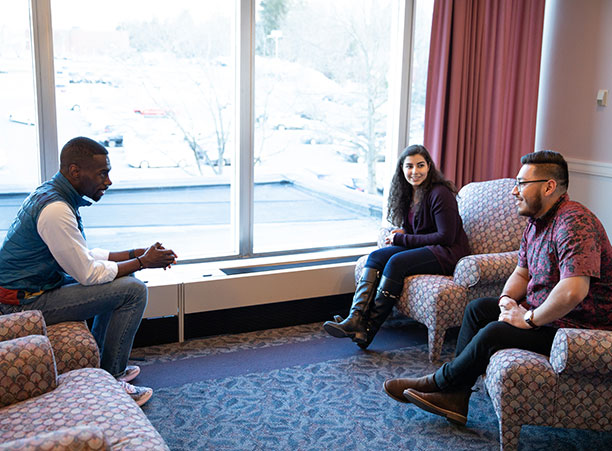
DeRay McKesson sits in a chair across from Mithra Salmassi '19 and Manny Trejo '19

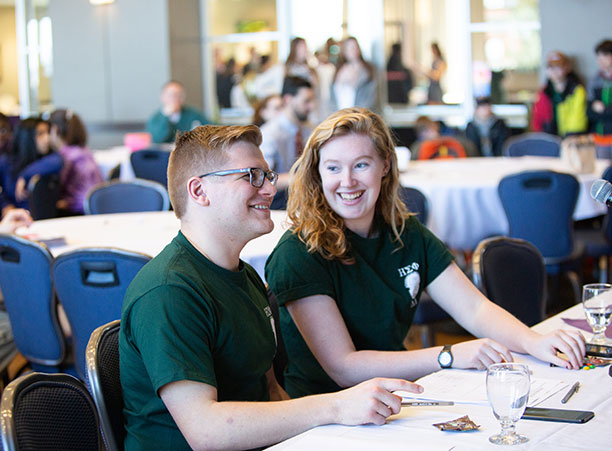
For this year’s annual Unity Week, the two student chairs — Co-Officers of Diversity for the Student Government Association Mithra Salmassi ’19 and Manuel “Manny” Trejo ’19 — wanted to honor intersectionality while leaving space for exploration and introspection. So together, they planned a full week celebrating diversity at Holy Cross, highlighted by a rousing talk by DeRay McKesson, civil rights activist and leading voice in the Black Lives Matter movement.

“Our overarching theme for this semester as co-officers of diversity is civic engagement and change in action,” says Salmassi, an English and psychology major with a concentration in gender, sexuality and women’s studies. “I think we can all agree that this year has been a really formative one at Holy Cross, thanks in no small part to the actions of our student body. We hope Unity Week and our year-long celebration of intersectionality and individuality will allow for deeper critical thinking about how different identities, particularly those that are marginalized, can be upheld.”

Now in its 19th year, Unity Week is a celebration of diversity at Holy Cross and brings the community together through a series of events and various programming with a challenge to think critically.

To bring a diverse range of issues to life — and to action — students, faculty and staff had the chance to learn about the history of medical and environmental racism in the Unites States; the Asian-American experience; feminism; colorism in Asia; and being a first-generation college student, among other topics.

While campus issues are always at the head of the table for students, Trejo, a philosophy major, wanted to be sure other national issues didn’t fall to the wayside. “There are a lot of greater issues that are going on in our country that also need to be highlighted,” he said. “That’s a big reason we chose DeRay to come speak.”

McKesson’s full-time career as an activist was sparked by the 2014 murder of 18-year-old Michael Brown in Ferguson, Missouri. When McKesson heard the news, he drove down to Ferguson, quit his job as a math teacher in Baltimore and marched for months. Since then, he’s been at the forefront of working to confront the structures and policies that have led to mass incarceration and police killings of black and other minority populations.

For Trejo, Unity Week is about “standing up with one another and being involved in that civic engagement and the change in action.”

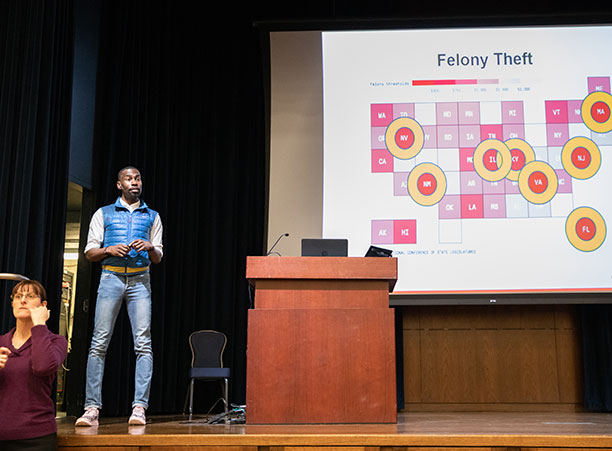
During McKesson’s interactive discussion, held in the Hogan Ballroom, he talked about the inequalities of the American criminal justice system, tying in his own experience of marching — literally — on the frontlines of the Black Lives Matter movement. He often called upon audience members to help him read important facts out loud, or asked them to yell out their own ideas on a topic. One of his points spoke directly to Salmassi and Trejo’s mission for the week: making more people aware of civic issues.

“As organizers, we’re always interested in creating entrances and on-ramps. How do you get people into this space? I think about my Aunt — I try to deliver a message to her. Not because she’s uninformed, but because she’s busy. I have to figure out how to talk to her about these things. Part of our work is not to be so arrogant to believe that the only way to enter is the way that we entered. However you enter into this space is okay, because we know that if we get you in this space, then we can move you around within it.”

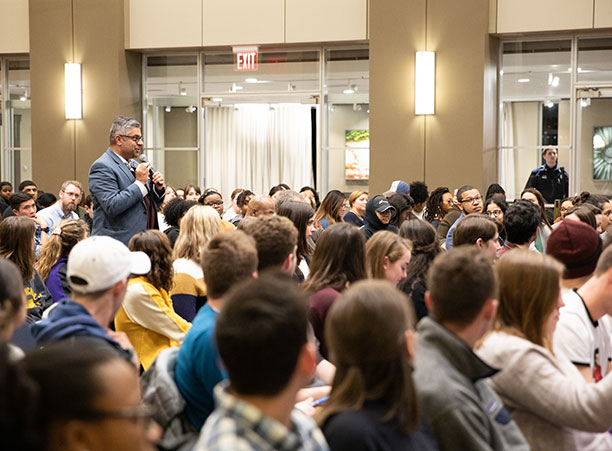
Through a question and answer session, members of both the Holy Cross and greater Worcester communities had a chance to speak to McKesson directly. One student asked how to sustain momentum around an issue after hosting a large, successful event, like a protest.

“The big flashy stuff is often to get attention, and that’s what it’s supposed to do, right?” McKesson asked. “That’s the natural evolution — you fight for attention on an issue because they weren’t listening another way, and then you try the other thing. You try the emails, the phone calls.”

McKesson went on to say that the more important work comes later.

“The grind after the big thing is showing up to all the meetings — somebody has to keep doing that.”

Taking a note from McKesson, Salmassi and Trejo made sure to reiterate that Unity Week is less of a week and more of a guide to keeping the conversation going.

“Unity is not just condensed to this week; we don’t just come together to look at diversity, then go our separate ways,” Salmassi says. “This year has demonstrated that every day should be about that, especially with DeRay’s talk. I hope people come away thinking, ‘I’m happy I got a chance to stand with people and my identity. What’s next?’ We just want to keep pushing that question: ‘What’s next?'”

Posted in English, Featured, Gender, Sexuality, and Women's Studies, News, Philosophy, Psychology | Comments Off on Student Organizers Challenge Campus to Critically Explore Issues of Diversity During Unity Week

No Matter the Path, Holy Cross Students Thrive

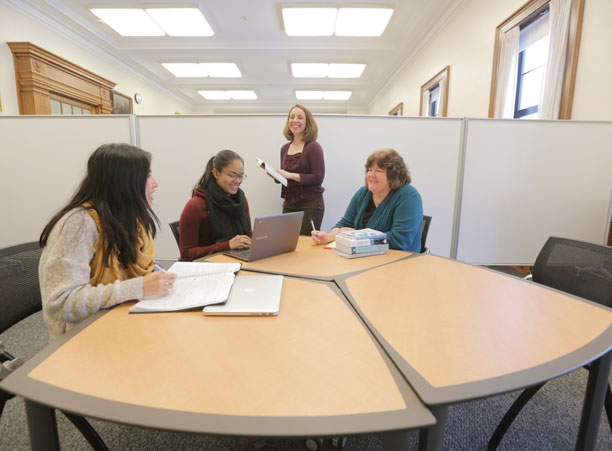
Students sit around a large table while one stands at a blackboard at the front of the roomCollege can often feel like a linear journey — take a few classes, decide on a major, join a club or two, fulfill your requirements and graduate in four years. For many, though, that path is much less precise. Interested in chemistry but have a knack for entrepreneurship? You can do both, and even get support from professors in creating a new, cool product. With countless opportunities at their fingertips, Holy Cross students explore winding paths that lead them in the right direction every time.
Posted in Chemistry, Ciocca Center for Business, Ethics, and Society, Featured, Health Professions Advising, J.D. Power Center for Liberal Arts in the World, Music, News, Sociology and Anthropology | Comments Off on No Matter the Path, Holy Cross Students Thrive

Writing Without Borders: At Holy Cross, Good Writing is Everyone’s Responsibility

Center for Writing Director Laurie Ann Britt-Smith, far right, and Associate Director Kristina Reardon, standing, work with students on their writing

Center for Writing Director Laurie Ann Britt-Smith, far right, and Associate Director Kristina Reardon, standing, work with students on their writing

There is no required Intro to Writing class at the College of the Holy Cross. No Academic Writing seminar. No How to Write the College Essay 101.

How then does Holy Cross expect to turn out good writers? As you might expect, the answer can be found in Cell Biology 266.

Associate Biology Professor Michelle Mondoux says that many professors in the sciences struggle with teaching writing. “As a group, we feel unqualified to teach writing,” she says. “We feel qualified to assign writing.”

But clear, effective writing is crucial in the career of a biologist. Every researcher needs to publish in journals and to apply for grants. So Mondoux carves out precious class time to work on those things.

Every semester, Mondoux’s students must write mock National Institutes of Health grant applications, then critique each others’ work and decide which of their peers’ projects they would choose to fund. It’s Mondoux’s favorite class of the semester.

How does she justify taking time away from studying the structure and function of eukaryotic cells, homeostasis, intracellular compartments and protein trafficking? And what if there’s not enough time for the cytoskeleton?

“What we spend class time on is how we communicate what’s important,” says Mondoux. And at Holy Cross, writing is important.

In 2015, Holy Cross established its Center for Writing, through a generous gift from Agnes N. Williams P’83. Its mission is to instill a positive culture of writing into every academic discipline, from the physics lab to the stage in the theater department. The teaching of writing is not confined to a single first-year class, or even to classes in the humanities. Instead, it’s infused throughout the College curriculum.

“It’s everyone’s responsibility,” says Laurie Ann Britt-Smith, the Center’s director. Britt-Smith keeps in her office a large poster board that says “Writing is Never ‘Just’ Writing” – a phrase, she says, that embodies the Jesuit ideal of Eloquentia Perfecta. She occasionally brings along the poster board when she gives a talk to underscore that point.

She and colleague Kristina Reardon, associate director of the Center for Writing, spend their days presenting to classes across every department. One day, they might be in a physics class talking about writing effective introductions, and the next day, a history class to discuss annotated bibliographies. They wind up spending as much time in science labs as in humanities classes.

The Writing Center offers Holy Cross faculty support in a number of ways, including one-on-one consultations about course materials and writing pedagogies, as well as in-class workshops. Plans are in motion for a faculty collaborative on writing issues. They also manage the student Writers Workshop, where Holy Cross students meet with trained, peer consultants to talk about their progress as writers and to get help at any part of the writing process.

Britt-Smith explains that by removing the onus to create good writers from a single introductory class, the College’s curriculum instead places the responsibility with everyone. And while there is no College Writing 101 required course, the positive culture of writing is instilled early on in a student’s Holy Cross experience.

It starts in Montserrat, Holy Cross’ innovative year-long program for first-year students. Montserrat courses are built on a single theme — environmental justice or Chinese culture, for example — but their underlying goal is to cultivate in students a shift in their ways of learning, one that reflects the values of a liberal arts education. That includes thoughtful, clear, reflective writing.

Indeed, eloquence is one of the core values of Holy Cross’ liberal arts curriculum. In 2012, the College’s Presidential Colloquium on Jesuit Liberal Arts issued a report that said, “Eloquence plays a crucial role in the search for liberation and truth. Critical inquiry has little impact without the ability to share, debate and reshape our ideas with others. The long tradition of Jesuit education emphasizes learning to speak persuasively, to write crisply, to argue and debate effectively, and to express oneself creatively.”

Faculty members across departments are now putting their heads together to develop these ideas even further and produce College-wide writing goals through an initiative called Writing Across Curriculum. It’s an initiative that seeks to expand the first-year writing goals and to continue them across all four years of a student’s time at Holy Cross.

Britt-Smith says, “That’s the big question: What is good writing? What does it mean, and how do we assess it?”

This story was originally published in the March issue of “Connections,” a monthly publication of the Association of Jesuit Colleges and Universities. 

Related

MLA Style Center, April 16: Adopting Writing Center Practices in Teaching

Posted in Biology, News | Comments Off on Writing Without Borders: At Holy Cross, Good Writing is Everyone’s Responsibility

Holy Cross History Professor Is Leading Voice Nationally on Irish-American History

Edward O'Donnell, associate professor of history. Photo by Tom Rettig

Edward O’Donnell, associate professor of history. Photo by Tom Rettig

In this time of divisive rhetoric about recent immigrants and terrorism, Ed O’Donnell, associate professor of history at Holy Cross, says that we can learn a lot from the discarded stereotypes of the past.

In a Washington Post commentary, Professor O’Donnell takes us back to the late 19th century, a time when Irish immigrants were seen as terrorists who threatened U.S. national security.

“That’s right,” said O’Donnell. “The immigrant group that today most Americans associate with leprechauns, the Blarney stone and Guinness beer was 150 years ago reviled as a band of foreign terrorists. This teaches us a valuable lesson about stereotyping entire groups based upon the actions of a few — a lesson we should apply to minority groups today.”

As a leading voice nationally on Irish-American history, O’Donnell was also recently interviewed by the TODAY Show on the history of St. Patrick’s Day.

“St. Patrick’s Day began as a religious holiday,” O’Donnell told TODAY. “But over time it has become a universal celebration of ethnic pride and Irish culture.”

O’Donnell, a member of the Holy Cross class of 1986, is the author of several books, including “1001 Things Everyone Should Know About Irish-American History” (Broadway Books, 2002) and “Henry George and the Crisis of Inequality: Progress and Poverty in the Gilded Age” (Columbia University Press, June 2015). He also hosts a popular podcast, In The Past Lane, exploring various topics in U.S. history.

Posted in Alumni, Edward O'Donnell, History, In The News, News | Comments Off on Holy Cross History Professor Is Leading Voice Nationally on Irish-American History